What Is a Debt Ratio and How Does It Measure Leverage?
The debt ratio shows how much of a company's assets are funded by debt. It is a quick test of financial leverage and of how exposed a business may be if earnings fall. This entry covers the formula, a worked example, what counts as debt, and how the ratio differs from similar measures.

What Is a Debt Ratio?
A debt ratio compares a company's total debt with its total assets. Both figures come from the balance sheet, the financial statement that lists what a company owns and what it owes on a given date.
The result answers a simple question: what share of the assets is financed by lenders? A ratio of 0.3 means debt covers 30% of the assets. The remainder is funded by shareholders' equity and, depending on the definition used, by other liabilities.
The measure is used by lenders, bond investors and equity analysts to judge solvency, which is a company's ability to meet its long-term obligations.
Debt Ratio Formula and Calculation
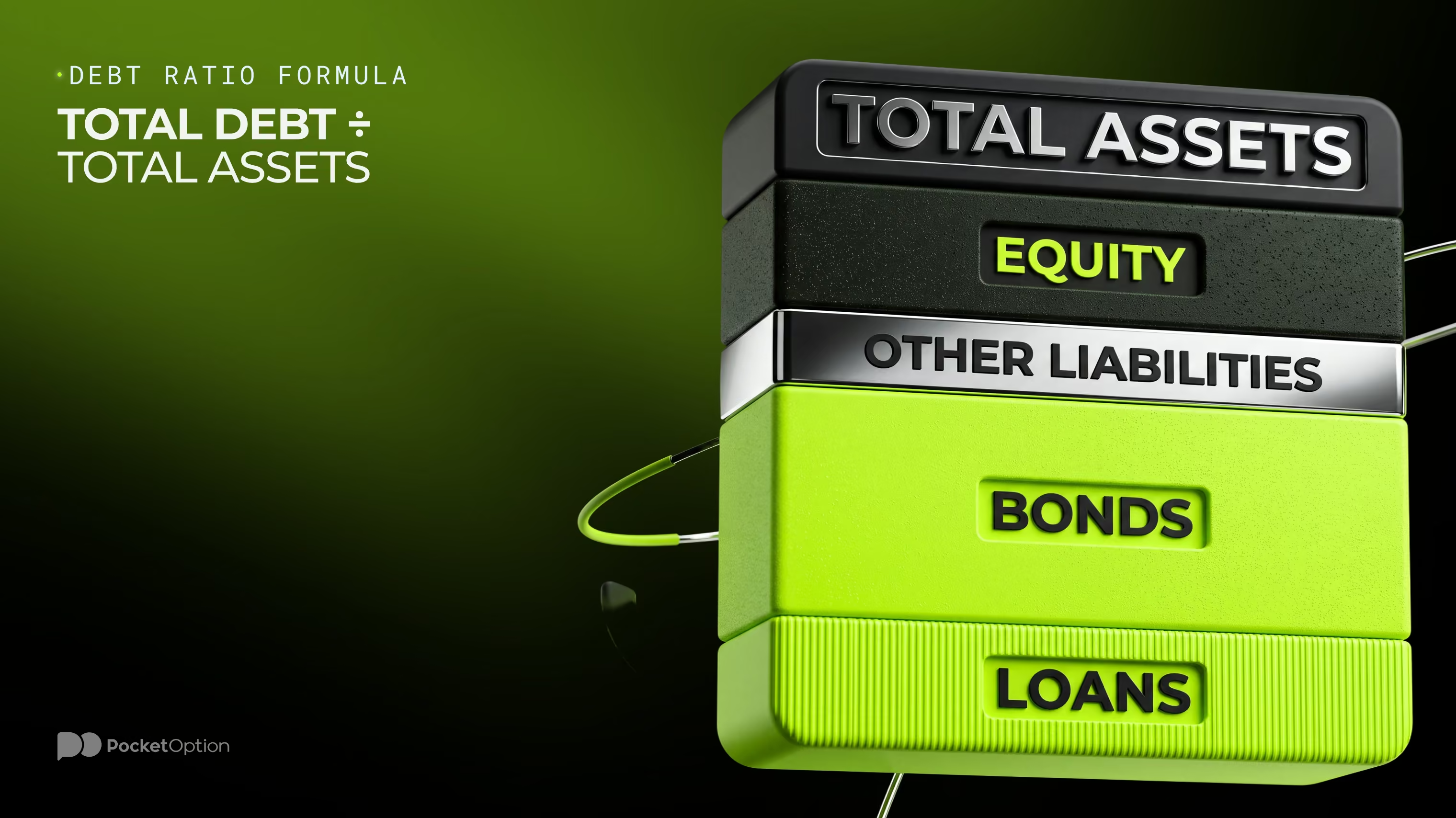
The standard formula is: Debt ratio = Total debt ÷ Total assets.
Consider a hypothetical company with the following figures:
Total assets: $800,000
Bank loans: $150,000
Bonds issued: $250,000
Accounts payable and other non-interest-bearing liabilities: $100,000
Using interest-bearing debt only, total debt is $400,000. The debt ratio is $400,000 ÷ $800,000 = 0.5, or 50%, so half of the assets are funded with borrowed money. Using total liabilities instead, the figure becomes $500,000 ÷ $800,000 = 0.625, or 62.5%.
Interest-bearing debt covers loans, bonds, notes and, under many accounting standards, lease liabilities. Total liabilities is broader and also includes accounts payable, accrued expenses, deferred revenue and other obligations that carry no interest. Data providers apply different conventions, so the definition should be checked before two ratios are compared. The same balance sheet figures feed valuation measures such as the price-to-book ratio.
How the Debt Ratio Measures Financial Leverage
Financial leverage is the use of borrowed money to fund assets. A higher debt ratio means more leverage. Borrowing can lift returns for shareholders when the assets earn more than the cost of the debt, but it also adds risk, because interest and repayments fall due whether profits arrive or not.
As a rough guide, the ratio is often read along these lines, with large differences between industries:
A low ratio suggests debt plays a modest role in the capital structure, which is the mix of debt and equity a company uses.
A mid-range ratio is common among established companies with steady revenue.
A high ratio signals heavy reliance on borrowing, which can strain financial stability if interest rates rise or sales fall.
Bond investors watch leverage closely, since it affects how likely a borrower is to repay. This guide to corporate bonds and how corporate debt is rated explains how debt levels feed into credit assessments.
Debt Ratio vs Debt-to-Equity Ratio
The debt-to-equity ratio divides total debt by shareholders' equity instead of total assets. It shows how much debt exists for every dollar invested by owners. For the company above, with $300,000 of equity, the debt-to-equity ratio is $400,000 ÷ $300,000 = 1.33.
Ratio | Formula | What it shows |
|---|---|---|
Debt ratio | Total debt ÷ total assets | Share of assets funded by debt |
Debt-to-equity | Total debt ÷ shareholders' equity | Debt per unit of owners' capital |
Debt-to-income (personal) | Monthly debt payments ÷ gross monthly income | A household's ability to service its borrowing |
The personal debt-to-income ratio is a separate tool. It is used by lenders such as mortgage providers to assess individuals, not companies, and it is built from income rather than from a balance sheet.
Limitations of the Debt Ratio
The debt ratio is a snapshot taken on one date. On its own, it says nothing about:
The cost of debt. Two companies with the same ratio may pay very different interest rates.
Maturity. Debt due next year carries more refinancing risk than debt due in ten years.
Asset values. Book figures follow accounting rules and may differ from what the assets would fetch if sold.
Cash flow. A business with steady cash flow can usually carry more debt than one with volatile earnings.
Industry context matters too. Capital-heavy sectors such as utilities tend to report higher ratios than asset-light businesses. Pairing the debt ratio with efficiency measures such as the asset turnover ratio shows how productively the assets behind the debt are being used.
Conclusion
The debt ratio reduces a company's funding mix to a single number: the share of its assets paid for with borrowed money.
Apply what the numbers reveal.
Start NowA reading of 0.5 can signal caution in one industry and comfort in another. The definition of debt, the sector and the cash flow behind the figure decide what that number means.
Disclaimer: This article is for informational purposes only and does not constitute financial advice. Trading involves risk, including the possible loss of invested capital.
See more:Glossary