Interest Rate Parity: How Interest Rate Differentials Link Spot and Forward Exchange Rates
A forward exchange rate isn't a forecast. It's the spot rate, with two interest rates folded into it, and interest rate parity is the rule saying how it is done. This mechanism makes risk-free arbitrage impossible, guaranteeing similar returns on investments in different currencies after hedging.

What Is Interest Rate Parity
Interest rate parity is a no-arbitrage condition, pinning down the price at which nobody gets to pull free money out of the market. This parity ties four numbers up together:
The spot exchange rate (what one currency goes for in another at the moment)
The forward rate (agreed today for an exchange of currencies on some later date).
The interest rate in the first currency, over that stretch of time.
And the rate in the second one, over the same period too.
Logic goes something like this: if somebody with a pile of cash wants to park it for a year, they have two roads they can take. Either they leave it in their home currency, and earn the ‘home’ rate. Or they change it into some foreign currency, at the current spot rate, and get the foreign interest rates. Then, after a year has passed, they would exchange that currency back into their ‘home’ one, and count their returns.
If both roads come free of exchange-rate risks, they ought to end up in roughly the same place. Or else everybody just piles everything onto the better currency, and the gap shuts by itself. This is the interest rate parity, and this soft rule gets mentioned by traders and investors all the time.
Mind you, the end result doesn’t always have to follow the interest rate parity formula, but it’s a useful metric to have in your arsenal, to see what can be expected (or what the market is roughly expecting as of now).
Covered Interest Rate Parity (CIRP): The Formula
Covered interest rate parity is the version with the fix in it. The foreign leg gets covered by a forward contract, so it doesn’t quite matter where spot ends up later. The covered interest rate parity formula goes like:
F = S x (1 + i_d) / (1 + i_f)
F here is the forward rate, S the spot rate, the i_d is the domestic interest rate, and i_f the foreign one. Both rates are taken over the period that the forward runs for. For anything short of a year the rates get shrunk down.
Which currency counts as the "domestic" one is down to the quote (not to where anybody lives). In EUR/USD, euro is the base, because it comes first. Dollar the quote currency here, so it plays as domestic role. How quotes work in forex is explained in our guide on how currency pairs are structured.
A shorthand to the formula gets quoted plenty as well. The interest rate parity formula in its rough form can say that the forward premium or discount, in percent, roughly comes out about level with the gap between the two rates. In that case, (F - S) / S ≈ i_d - i_f.
A Worked Example: Calculating the Forward Rate
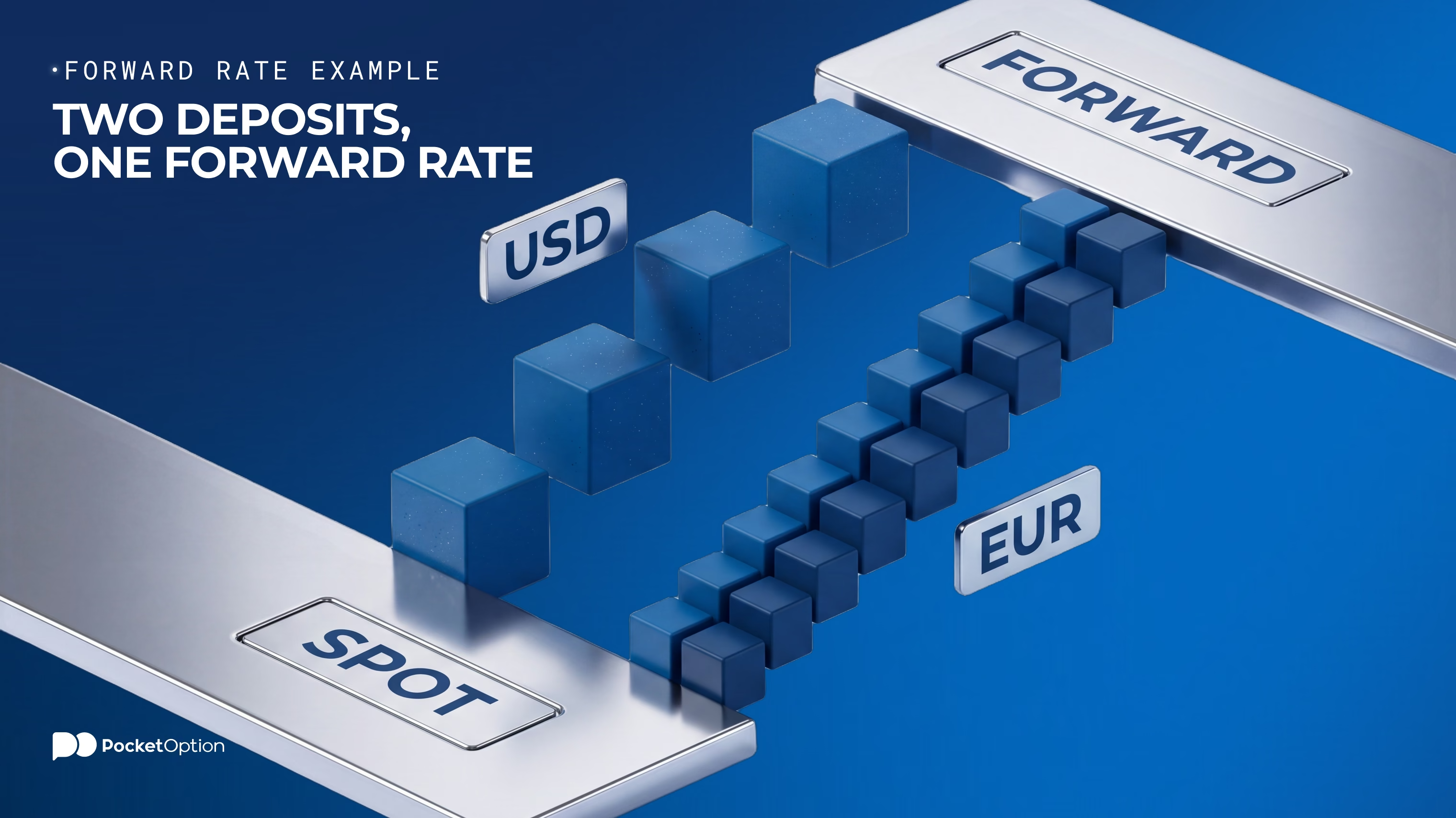
Let’s take, say, EUR/USD at the current spot of 1.1000. A one-year dollar rate is 4.00% (average), and a one-year euro rate is 2.00%. Where does covered interest rate parity formula lead us in this case?
We start off with $1,000,000 left in dollars. At 4.00% it would grow to $1,040,000 over this year.
Or, we can change it to euros right now at 1.1000, which would be €909,090.91.
Stick the euros on deposit at 2.00%. In a year, they will be ~€927,272.73.
For both roads to finish at roughly the same spot, €927,272.73 has to change back into exactly $1,040,000. So the forward rate in this case has to be 1,040,000 split by 927,272.73, which works out at 1.1216.
Or we could’ve just used the formula. There, 1.1000 x 1.04 / 1.02 = 1.1216. Same answer, less faff.
So the one-year forward rate ends up sitting about 216 pips over current spot. These are sometimes called ‘forward points’. They are not prediction, but the interest rate gap, which may or may not materialize. There are no guarantees in the market, but it’s a metric that no one in long-term investing or positional trading should ignore outright.
Why the Higher-Rate Currency Trades at a Forward Discount
In the above example the dollar pays more interest, and so the dollar's also the one buying less in the future. A dollar fetches, according to the covered interest rate parity formula, about 0.909 euros today, but only ~0.892 euros a year forward. That's what a ‘forward discount’ means. Higher-rate currency comes cheaper for later delivery.
The discount, however, isn't the market being 100% sure that the dollar is headed down in the future. It's just the market pricing away the extra interest. If this didn’t happen, and the dollar still paid 2% more, without any possible forward loss at all times, every bank would just borrow euros in as large an amount as possible, buy dollars for them, sell them forward, and pocket the gap. They still do this, of course, but this implies risks, and have to be weighed in carefully, because of the implied interest rate parity, and the forward discount.
For anyone coming at this from the spot end, the thing that probably matters most is that a higher policy rate on one side of a pair shows up straight off in the forward points. By the way, to understand more about how pairs move and what can happen to them day to day can start by reading our beginner's guide to starting with forex trading. Parity is the layer that sits under that price action, and subtly guides it at times.
Uncovered Interest Rate Parity (UIRP): The Expectations Version
If the forward contract is dropped out altogether, this becomes uncovered interest rate parity. It can be useful, as the investor gets the foreign rate and just waits it out, at whatever spot rate there is at the end. Nothing is nailed down in this case, so parity can only hold on expectations. In this case the formula is:
E(S_t) = S x (1 + i_d) / (1 + i_f)
Here, E(S_t) is spot rate that the market reckons at the end of the period. Put plainly, uncovered interest rate parity says that the higher-yield currency should, on average, weaken over time by about the size of the interest gap. So if a bank or an investor is chasing after the better rate, they should end up in about the same place in the end, because the extra interest will get eaten by the currency's slide.
Covered vs Uncovered: Why One Holds and One Often Doesn't
The covered interest rate parity gets held in place by arbitrage. In regular-working markets the covered link holds near enough to the decimal, give or take dealing costs.
Uncovered parity, however, has nothing holding it up. That is because breaking it doesn't hand anybody money for nothing, it only hands them a bet on the exchange rate, and those bets can lose. And quite often, they do.
Eugene Fama's 1984 study of forward and spot exchange rates found that high-interest currencies, over short time horizons, tend not to weaken the way UIRP says they should. Sometimes they get stronger instead. The pattern got named the ‘forward premium puzzle’, and has cropped up in a great many studies since.
Feature | Covered interest rate parity | Uncovered interest rate parity |
|---|---|---|
Uses a forward contract | Yes | No |
Exchange-rate risk | Removed by the forward | Fully carried out by investors |
What enforces it | Arbitrage between spot, forward and money markets | Only investor expectations |
How well it holds | Very closely in normal markets (with small gaps since 2008) | Poorly over short time horizons; somewhat better over many years |
Formula | F = S x (1 + i_d) / (1 + i_f) | E(S_t) = S x (1 + i_d) / (1 + i_f) |
Covered Interest Arbitrage: What Keeps CIRP in Place
If we go back to the worked example, where parity put the one-year forward at 1.1216. Say, a dealer is quoting 1.1300 instead. This seems quite the opportunity. The euro has got too dear in the forward market, so the trade now is selling euros forward, and funding the lot in dollars.
A trader, trying to exploit this, borrows $1,000,000 at 4.00%, owing $1,040,000 a year out. The dollars get changed into €909,090.91 at spot and put on deposit at 2.00%, growing to €927,272.73. At the same time, those euros are sold forward at 1.1300, which gets $1,047,818.18 for the far date. Loan gets paid back, and $7,818.18 of ‘profit’ is left!
No exchange-rate risk got taken along the way. This is covered interest arbitrage, that keeps funding in check. Every leg of the trade, forward price leans on the gap from a different side, till that gap is gone. This is why covered interest rate parity holds so tight under normal conditions, and why quotes breaking it are not seen that often.
Why This Matters for Reading Forex Pricing
A forward price over spot on a pair like EUR/USD says the dollar pays more interest than the euro, but not much about where the pair is off to. When a central bank lifts or trims its rate the forward points shift the very same day, often before the spot rate has made its mind up which way to go.
The same logic sits under any price quoted for a date past normal spot settlement. This is part of how rate decisions and inflation figures shove currency pairs about as much as they do. To go deeper into this, take a look at our article about quick trading versus MT trading for forex.
One thing that also has to be remembered is that the interest rate parity accounts for the gap between spot and forward, and not that much past that.
See pairs react in real time.
Get StartedConclusion
Two hundred and sixteen pips. That was how far apart the spot and the one-year forward sat in the example. Every one of those pips came out from the 2% difference between EUR and USD rates. No economy or currency forecasts were made beside that. This is why interest rate parity is an easy fast lens to look at the currency markets with, and should be kept in your toolkit.
Disclaimer: Trading involves risks of capital loss, and may not be suitable for all investors. Past performances are not a guarantee of future results.
See more:Knowledge baseTrading