
How to Start with Forex Trading: Applying Forex Strategies with Pocket Option Currency Pairs
Forex trading is conducted on the biggest financial market in the world. In excess of $7 trillion worth of money is traded on a daily basis on the foreign exchange market by different currencies, different time zones and different players. It might be frightening because of its magnitude but if you wonder how to start with forex trading, reading this article might be helpful for you. Just keep going.

What Is Forex Trading and How Does It Work
Foreign exchange trading means the simultaneous buying of one currency and the selling of another. All currency transactions are conducted in pairs, because there is always a seller and there is always a buyer in any kind of transaction.
For example, when a trader purchases EUR/USD, he actually buys the euros and sells the U.S. dollars at the same time. If his prediction about Euro strengthening was right, he will generate profit. The whole process is very similar to exchanging the currency at an airport, except it is done in order to make some money.
The forex market is open 24 hours a day from Sunday to Friday night. It does not have a centralized exchange like other financial markets do. It is traded electronically between banks, institutional players and private individuals.
Understanding Currency Pairs
Each currency pair consists of a base currency (the first one) and a quote currency (the second). When you see the rate on EUR/USD is 1.0850, it means that for 1 euro you get 1.0850 US dollars. If the rate increases to 1.0900, the euro appreciates, and in case of 1.0800 - depreciates.
There are three types of currency pairs:
Major pairs: EUR/USD, GBP/USD, USD/JPY, USD/CHF. This type involves the US dollar and the most liquid currency pairs with the narrowest spread.
Minor pairs (crosses): EUR/GBP, AUD/NZD, GBP/JPY. This type does not include the US dollar, but involves major currencies, with somewhat larger spread.
Exotic pairs: USD/TRY, EUR/ZAR, USD/THB. Involves one major currency and one currency of an economically less developed country, with wide spread.
In general, beginners are recommended to trade in major currency pairs due to the highest liquidity and low cost of transactions.
What Moves Exchange Rates
Exchange rates result from a combination of macroeconomic factors, central bank actions, and changes in the sentiment of the markets. Higher interest rates offered in one nation increase the probability that the currency will attract capital, thus making it strong. However, the most powerful factors in foreign exchange markets are the Central Banks, and their bank rate decisions.
Economic news such as GDP growth, employment numbers, inflation, and balance of payments affect the perception that the markets have of the value of a particular currency. Geopolitical news like elections, trade disputes, military clashes, and policy changes may lead to unpredictable movements in exchange rates.
Market sentiment is yet another critical factor since traders with a high-risk appetite invest in safe havens like the USD, JPY, and CHF currencies or growth currencies like AUD and NZD.
Key Forex Terms: Pips, Spread, Leverage, and Margin
Term | Definition |
|---|---|
Pip | Minimum pip movement in a forex pair. In most cases, 1 pip = 0.0001, but in case of JPY pairs 1 pip = 0.01. |
Spread | The difference between the bid (sell) and ask (buy) price. This is the implicit cost of each trade. Tighter spreads mean lower costs. |
Leverage | A system that allows a trader to use more funds than the deposited ones to control a certain position. 1:100 leverage allows controlling $10,000 with a $100 deposit. Leverage works both ways. |
Margin | The amount of money required to maintain a certain position. In case the equity of your account falls below the margin level, your positions will be automatically closed. |
Stop loss | A special order that closes a trade once the specified price is reached. Mandatory for every trade. |
Why Starting with Low Leverage Matters
Leverage makes trading economically viable for retail traders. However, leverage also is that which exposes small accounts to high risks of being wiped off by a losing position much faster than in the case of an experienced trader's account. If a position is opened at 1:500 leverage, then it works five times faster than at 1:100 and fifty times faster than 1:10 leverage.
Low leverage of 1:10 or 1:20 should be selected by beginner traders. Low leverage brings lower potential gains but also lower potential losses. In the beginning, the aim is not to earn much but to survive long enough to learn. High leverage forces a beginner to learn through a series of quick account losses.
How Much Money Do You Need to Start
It depends on the brokers you choose. Different brokers have different minimum deposit requirements. Pocket Option is known as an accessible platform, and one can open and start forex trading with just a $10 deposit. This won’t be effective trading, of course, but it’s enough to gain experience without risking too much money in your first real account ever.
Regardless of your account size, what matters more is your position sizing, or what percentage of your account size you risk on each trade. The rule of thumb is 2%. If the balance is $100 and the percentage of risk is 1%, then a maximum loss per trade is $1. This limits position sizes but at the same time to cut the account in half, a trader will need to lose 50 trades in a row.
Quick Trading vs MT-Format Currency Pairs on Pocket Option
Feature | Quick Trading | MT-Format Trading |
|---|---|---|
Trade duration | Seconds to minutes (fixed expiry) | Open-ended (close manually or by stop/TP) |
Execution | Simplified interface, one-click entry | Full order types (market, limit, stop) |
Analysis tools | Basic charting on platform | Full MT charting suite with indicators |
Best for | Testing reactions to short-term moves | Building and executing a structured trading plan |
Learning value | Speed of feedback; emotional pressure testing | Full trade lifecycle management (entry, management, exit) |
Both formats are available on the demo account. It is recommended to try both and make a choice based on the preferred format.
QT trading and MT trading, unlimited
Get StartedHow to Start Currency Trading on Pocket Option Step by Step
Register an account on Pocket Option (registration takes less than a minute).
Start by exploring the demo account first. It provides virtual money that can be replenished anytime.
Select one major currency pair such as EUR/USD, and choose either Quick Trading or MT format.
Include one or two tools (indicators) on your chart to get started: a 20-period exponential moving average and RSI will do just fine.
Prior to making a trade, set your entry level, define where you going to place your stop-loss and take-profit orders.
Make the trade and document its outcome in your journal, including instrument, direction, entry and exit levels, reason behind the trade, and its outcome.
When you've made 30 or more demo trades, analyse the journal to see what patterns there are in your results and behaviour.
Building a Simple Forex Trading Plan
A trading plan does not necessarily need to be complex to be good. All that it requires is to be specific. Integrating the following components should be sufficient:
Which currency pairs to trade (one or two major pairs for starters).
On what timeframe the analysis will be done (4-hour or daily charts for swing trades; 15-minute charts for intraday trades).
When will the signal to enter occur (indicator, price level, or candlestick formation).
At what point is the stop loss set (support below for long and resistance above for short).
Take profit (previous swing highs/lows or a predetermined risk/reward ratio).
What is the risk per trade (1 to 2 percent of account funds).
Core Beginner-Friendly Forex Strategies
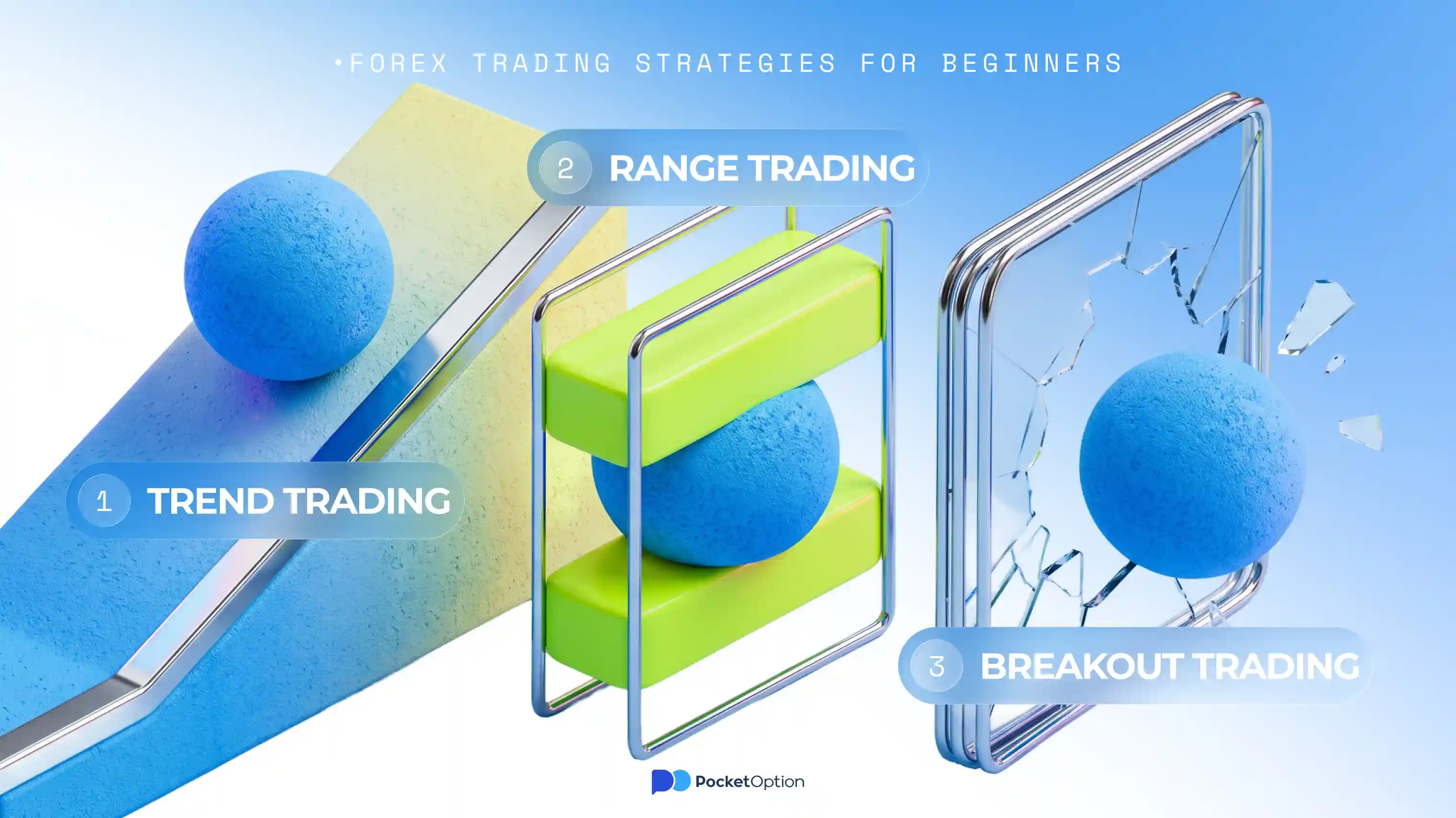
Trend Trading
It is as simple as identifying whether there is an uptrend or a downtrend in the market using a moving average. Price above the 50 EMA indicates an uptrend and vice versa. The trend can be traded when the price pulls back to the moving average level. For long positions, set the stop loss right below the last swing low. It works best during trending conditions and poorly when the market is consolidating.
Range Trading
This strategy comes in handy when the market price is oscillating between support and resistance levels. Trades are made when the price touches one level of the box and closed when it reaches the other. Set the stop loss beyond the range box in order to protect against a breakout situation. Range trading works well in consolidation phase and fails when the market is trending.
Breakout Trading
The strategy involves making a trade when the price breaks out decisively above a certain level for longs, or below for shorts after consolidation. Confirmation of breakout through volume analysis is essential. Breakouts that are done on high volume have a higher chance of success compared to those on low volume.
Choosing Your First Currency Pairs
EUR/USD is the most liquid currency pair in the world and, therefore, the obvious place for most beginners learning how to start in forex trading. It has tight spread, great liquidity, and is responsive to a wide range of macroeconomic events. Having learned how to trade this pair, the other two pairs which you should add are GBP/USD and USD/JPY.
In the learning stage, one needs to avoid exotic currency pairs due to their wide spreads and unpredictable volatility which may affect the performance of an otherwise profitable system in the major currency pairs.
Risk Management Rules for Beginners
Never risk more than 1 to 2% of your account on any single trade.
Always set a stop loss on each trade before entering at a meaningful technical level.
Never allow your total risk on the open positions to go above 5% of your account.
Maintain a daily loss limit of 3%; once it's hit, end the trading day.
Use 1:10 or 1:20 leverage for the first three months of trading live.
Practicing on the Pocket Option Demo Account
Learning occurs in the demo trading platform where trading is done under real market conditions with virtual money. Try out all systems, rules and emotional responses on the demo trading platform before engaging in live trading. The minimum number of trades to be made in the demo is 30, although the real minimum is when you see a consistent journal entry and a positive expectancy.
paper trading with unlimited potential
Try Demo AccountCommon Mistakes New Forex Traders Make
Too much leverage, too early. This will happen the fastest to destroy a small account.
No planning. Acting purely on impulses without rules and planning.
Spread ignorance. A strategy targeting 10 pips becomes 3 pips in spread paid, so now we are at 7 pips in effect.
Overtrading. 20 trades a day on a swing trading strategy doesn’t make sense.
Not keeping a journal. Without a journal, we won’t have feedback, and without it, we can't improve.
Placing the stop farther away to "give the trade some room." That is not flexibility but increased risk after the fact.
Conclusion
Getting into forex trading is not a one-time occurrence, but rather a step-by-step process of careful planning. The selection of the currency pair, learning of the terms, formulation of the strategy, trading on a demo account, analysis of the journal - only when everything proves to be correct, you start working with real money using low leverage.
Pocket Option is there to help you at each stage of your way: Quick Trading for prompt results, MT format for smooth execution, demo account for practice without any risk. The means are provided, the order of actions is clear - there is nothing left but to follow it. This is how to start trading with forex.
Disclaimer: Nothing of what is mentioned in the article should be considered as financial advice. Forex trading involves significant risks, including total loss of your deposit. Using leveraged products may result in loss greater than your deposit. Previous performance is not a guarantee of future results. Before you trade with real money, consider your financial situation.
See more:Product Guides