
Forex Trading on Pocket Option: Quick Trading vs MT Trading
One can access, among others, two types of trading on Pocket Option - Quick Trading and MT Trading. One is tailored for quick, certain predictions, while the other follows the conventional way to trade forex using lots, leverage, and spreads. This article shows how each works and which suits your style of trading.

What Is Quick Trading on Pocket Option
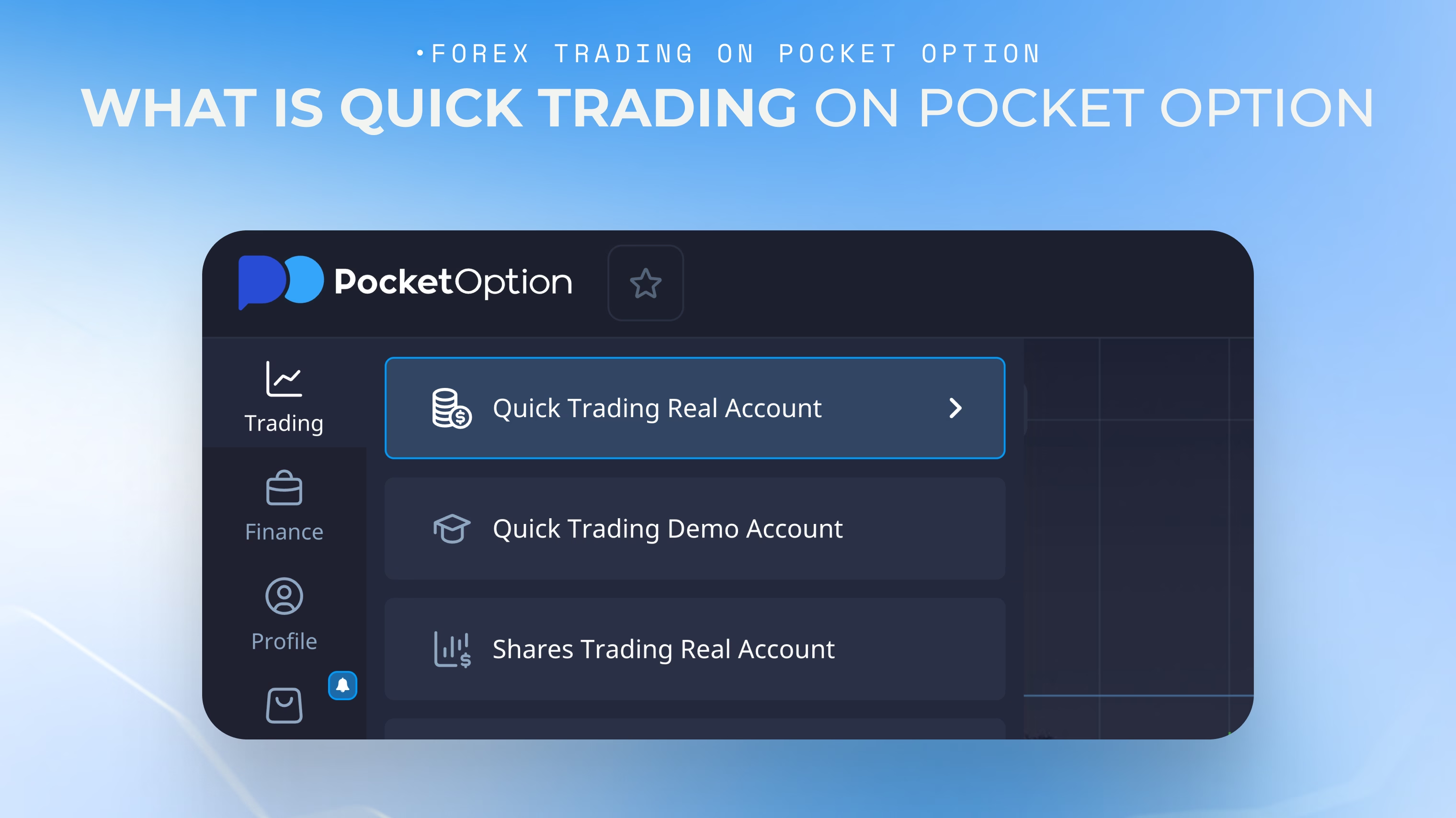
Quick Trading involves a fixed duration of trading. The trader picks an asset to trade on, the direction of the trade, which could either be upward or downward and picks the period he wishes the trade to last.
The profit amount is set even before the trade is made. In case of success, a pre-determined percentage is awarded. However, in case of failure, the money staked on that particular trade gets lost. It is either win or lose because there are no half profits.
The advantage of this type of structure is that it eliminates some of the factors that one would encounter with an ordinary position. This includes the need to deal with lots, margin levels, and the manual closing of positions. The disadvantage of this arrangement is that both the gain and risk are predetermined.
What Is MT Trading on Pocket Option
"MT Trading", sometimes shortened to "mttrading", means trade via MetaTrader, which is the most used software in trade forex. In the process of trading, one opens up a position with a particular lot size and uses leverage in order to manage the risk exposure of that lot size.A full walkthrough of the platform is available in the MT5 setup guide for traders who want the exact steps.
While a trade done by Quick Trading gets settled once after a certain period of time, a trade made via MT Trading remains open till it is closed by the client himself or by hitting a certain stop loss/take profit level. Profits and losses keep varying with the market trend throughout the trade period.
How Order Execution Works in MT Trading
In MT Trading, execution is different from fixed time prediction because the trade is executed in the market at the best available price within the bid/ask spread, whereas in fixed time prediction the trades are closed at a fixed price at a predetermined time.
Fills, spread, and slippage explained
A fill is the price at which the trade takes place. A fill in normal market conditions will be close to the price at which the trade was originally quoted. However, in volatile market conditions, there can be a difference between the price at which the trade was executed and the quote price.
Spread is the difference between the buying price and selling price of a financial instrument. Spread serves as a kind of cost associated with making a trade and it exists irrespective of whether the trade ends up in profit or loss. Traders who want a closer look at execution mechanics can read the MT4 trading guide, which walks through order types and platform settings step by step.
Since the MT Trading positions remain open, there is the issue of spread and slippage. In quick trading, however, there is no effect of spread because the profit or loss of the trade is determined by the expiry price rather than the execution price.
Quick Trading vs MT Trading: Side-by-Side Comparison
Both have the same market foundations, but what makes them different is the structure, cost, and kind of decision-making involved.
Risk and payout structure
In Quick Trading, the risk level is set by the total amount used in a particular trade, while in MT Trading, the risk level is dependent on the position and the leverage, and losses in such cases may exceed the initial investment if a position lacks a stop-loss.
Capital and position sizing
Quick Trading allows the trader to position size per prediction without any margin requirement that exists in the trading period. In MT Trading, lot size, margin, and account size need to be considered because the small account size with high leverage is vulnerable to market movements. Rookies who wish to test position sizing without investing large amounts often start with a micro forex account before scaling up.
Trade duration and speed
The Quick Trade time periods are quite short - often in minutes - and the outcome is known once the timer runs out. The MT Trading period can be minutes, hours, or even days, and there is no definite termination point until either the trader or an order terminates it.
Skill and analysis required
Quick Trading is rewarded by the clear vision for the short term regarding the direction and timing of a trade. MT Trading is more rewarded by the process of analyzing the position from technical analysis, margin, and position management as the trade is never concluded instantly when placed.
Aspect | Quick Trading | MT Trading |
|---|---|---|
Risk | Capped at the amount placed on the trade | Depends on lot size and leverage used |
Trade duration | Fixed and short, set before entry | Open ended, until closed manually or by order |
Capital needed | Sized per trade, no margin held | Margin held for the life of the position |
Skill focus | Short term direction and timing | Technical analysis and position management |
Figures and conditions shown are for illustration and can change. Current terms should always be confirmed on the Pocket Option platform before trading.
Who Quick Trading Is Best Suited For
Quick Trading is generally appropriate for traders who:
Like definite endings rather than indefinite trading
Need both risk and rewards defined before trade
Are developing trading skills on small sums before using complicated techniques
Trade on short news events or intraday market moves
Who MT Trading Is Best Suited For
MT Trading is generally suited for people who wish to keep their position for a longer period, use leverage in a more careful manner, and actively manage their trades instead of waiting for just one specific result. It is also suitable for people who want an expanded technical analysis framework and automated strategies, and who are comfortable studying a forex leverage example before committing significant capital.
Can You Use Both Formats Together
There is nothing within Pocket Option that will limit the format of an account to one particular format. A lot of people use Quick Trading for shorter-term views related to certain events while at the same time using the MT Trading system for long-term views. It’s usually easier to analyze both formats separately than as one combined format.
Getting Started: Practicing Each Format on Demo
Both versions are offered on a demo version before any money is put at risk. Trading through the demo version enables one to learn how the fixed time expiry works as well as how the leveraged trade moves in relation to the market.
with Pocket Option
Try Demo AccountManaging Risk Across Both Formats
Regardless of what format out of these two is used, the trade must be sized in accordance with a plan rather than a feeling. With Quick Trading, this translates to deciding beforehand what proportion of the account can be put at risk on one particular prediction. With MT Trading, this translates to placing a stop-loss order before a trade is made, rather than after. Any possible profits from such a trading scheme must always be considered in light of the losses that could accrue from a bad prediction or trade.
Choosing What Fits Your Trading Style
Whereas a trader seeking to get a clear and definite response in short term perspective will benefit from Quick Trading more, a trader who would like to slowly accumulate a position, and to leverage with intent will find that MT Trading better suits his needs. Some traders decide upon one trading format having tested both, whereas others keep using both for separate purposes.
Staying Disciplined as a Trader
Either way, the same principles hold true. The plan is made prior to the entry of the trade, the size of risk that is to be taken is known beforehand, and the profit or loss, whichever it may be, becomes just one result in an ongoing series of results.
Conclusion
The Quick and MT trading modes are designed for decision-making of varying nature. While the former is a timed prediction with a definite payoff, the latter is a conventional foreign currency position with leverage, spread, and management. There is no better method between the two since which one will be more suitable depends on the time a trader will dedicate to managing his position, how much certainty is wanted about the outcome before entering a trade.
Open an account and choose the format that fits your strategy.
Create AccountDisclaimer:There is a high level of risk of losing money in forex and other financial products. The historical performance and the features of the platform mentioned above cannot be considered as a guarantee of the future outcome. In case of necessity, one should obtain independent advice. Conditions of trading should be checked on the Pocket Option platform.
See more:Product Guides