Bitcoin Inverse ETF 3x: How It Works, the Risks, and Which Products Actually Exist
Quick word up front, before the rest of it. Thing most folk are after when they punch in Bitcoin inverse ETF 3x isn't traded in the United States, not presently anyhow. The one that does exist is sat over in Switzerland, and it carries on nothing like a plain short position would.

What Is an Inverse ETF?
An inverse fund is set up to rise whenever the thing it tracks takes a tumble. That is the inverse ETF explained in one line, and everything past it is mostly plumbing. No Bitcoin gets owned by it, not a single coin. What it holds is whatever kit hands back the opposite of Bitcoin, which in the main comes down to swaps, futures, or some blend of the pair kept up against a pile of cash.
Direction and leverage are two different dials, and a great many folk muddle the two up the whole time. Direction is which way round you want the fund heading. Leverage is how hard it swings that way. Bolt the pair together and what you end up with is the shelf as it stands presently:
Minus one times. Bitcoin slips a percent on the day, fund is supposed to gain round about a percent. Plain short Bitcoin exposure, nothing stacked atop it.
Minus two times. Same move with roughly double the reaction on it, and roughly double the damage as well whenever the call goes the wrong way, which it does oftener than folk tend to own up to.
Minus three times. Three times the daily move, flipped round. Thin air, up that high. Certain markets only.
Why is the word daily forever cropping up? Because every last one of these gets reset at the close, and what trips folk up, near enough every time, is the reset works off a fresh number each day.
None of it started out with crypto, by the by. Inverse and leveraged wrappers have been sat atop stock indices, oil and gold down the years, a leveraged Bitcoin ETF is merely the same machinery with the sign turned round. This walkthrough of leveraged Bitcoin funds goes into how the long side of it acts, and that is worth getting straight in your head before the short side is looked at.
How Does a 3x Inverse Bitcoin ETF Work?
A 3x inverse Bitcoin ETF is not sat on some great heap of borrowed coins, whatever the name might suggest. Derivatives are what it holds, and its chore every morning is sizing those so a one percent fall in Bitcoin over the session shows up as roughly three percent of gain, less fees, while a one percent rise shows up as roughly three percent lost.
Fund tots up what its book is worth come the close. Base, call that.
Base times three spits out the short exposure it is after for tomorrow.
Derivatives get nudged about till they land on that figure, by way of futures or swaps or both together, depending on who the issuer is.
Next session plays out, value shifts, and the very same sum gets done over again at the following close.
Step four is where the whole story lives, at bottom. Exposure is reset off the new base, be it smaller or bigger than yesterday's, and never off whatever base you happened to buy in at, so the leverage you truly carry on the first stake starts wandering off the moment day one is done with. Much the same drift is apt to catch folk out in ordinary margin accounts, and the errors in Bitcoin leverage trading rhyme fairly close with the ones here.
Worth spelling out what it isn't, too. A Bitcoin futures ETF of the ordinary kind tracks price one for one, even with futures doing the donkey work inside of it. This sort takes that move and multiplies it and turns it on its head, which makes it a different animal altogether, wearing a coat that looks much the same from across the room.
Daily Rebalancing and Path-Dependent Returns
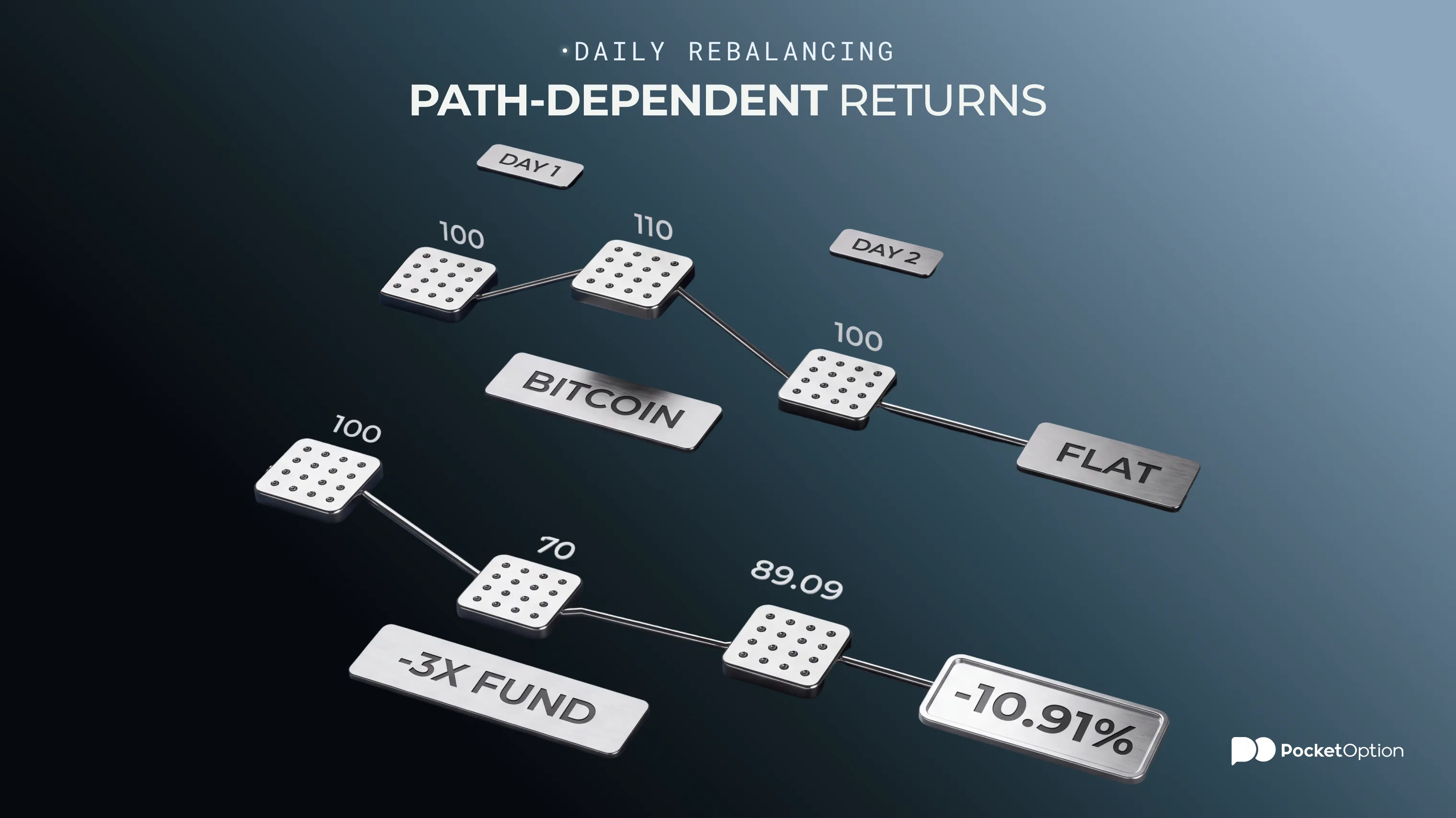
Here is the spot where the arithmetic starts biting. A daily rebalancing ETF hands over the multiple for one session and not a minute longer. String a handful of sessions end to end and what you walk off with hangs on the order the moves came in, not merely on wherever Bitcoin happened to finish up.
Say a fund starts off at 100, and say Bitcoin goes exactly nowhere by the end of it.
Bitcoin move | Target for a minus three times fund | Fund value, starting at 100 | |
|---|---|---|---|
Day 1 | +10% | -30% | 70.00 |
Day 2 | -9.09% | +27.27% | 89.09 |
Both days | back where it started out | down 10.91% |
Bitcoin ended up flat. Fund ended up down near enough eleven percent, and nothing whatever broke along the way. Gap like that has a name to it, and anybody who goes digging for volatility decay leveraged ETF lands on this exact sum, written out twenty different ways by twenty different folk.
Cuts the other way round in a clean trend, mind. Two sessions of Bitcoin shedding ten percent apiece leave it down nineteen percent all told, while the fund compounds from 100 to 130 to 169, a gain of sixty-nine percent set against the fifty-seven that three times the total move would give. Compounding pays out handsome when the market marches the one way and bleeds you quiet when it saws back and forth. Chop, as it happens, is the usual case and not the odd one out. Which is where a good deal of the money goes, without much noise about it.
Typical Use Cases for 3x Inverse Bitcoin ETFs
Two jobs, in the main, and both of them get measured in days rather than months.
First is a hedge that can be kept inside a regular brokerage account. Somebody who is sat on spot Bitcoin and doesn't fancy selling ahead of a Fed meeting can pick up a slice of short Bitcoin exposure against what they hold, and a minus three times product lets them do so with less money tied up than a minus one times would call for. Offset is rough and ready more than exact, and it goes rougher still the longer it's left sat there.
Second is a tactical short. You have a view on the next few sessions and would sooner not go opening a margin or futures account merely to act on it. No borrowing and no maintenance calls. Nor liquidation either, not in the margin meaning of the word anyhow. Losses stop at whatever was put in, and that is a proper advantage, baked right into how the thing is built, over shorting the coin direct.
What neither one of those is: a way of staying bearish for a whole quarter. More on that a little further down.
Set up an account in minutes.
Get StartedKey Risks of Leveraged Inverse Crypto ETFs
Decay first, being as it's the one doing the quiet damage. Nothing at all has to go wrong for it to cost you, market merely has to wobble, and Bitcoin wobbles for a living. A fortnight of sideways noise is apt to leave a position well down while the underlying sits right where you found it, not a whisker off.
Then comes gap risk. These funds reset at the close of whichever venue has them listed, and Bitcoin carries on trading straight through the night and the weekend both, and through whatever a Sunday throws up besides. Any move made while the exchange is shut is sat waiting at the open, three times the size already, with no chance whatever to do a thing about it in between.
Cost is number three. Leverage doesn't come free and nor does the daily plumbing. The management fee perched atop everything, the financing tucked away inside the derivatives, the spreads paid out on each and every rebalance, they all get charged whether the trade comes off or not. On triple-leveraged wrappers that fee runs a good deal dearer than on a plain tracker as well.
After that, the extinction case, which is scarcer and nastier. One single adverse day past roughly thirty-three percent is enough to wipe out a minus three times position on the arithmetic alone, and that's why wrappers at this leverage, the Bitcoin inverse ETF 3x sort among them, mostly carry some kind of intraday reset or cap. Those resets keep the value off zero, they also hand you a poorer base for any recovery thereafter, so living through the day and getting your money back are two different things entirely.
Liquidity comes last, and it counts the most on the European listings. Thin order books make for wide spreads, and a wide spread on something held for maybe two sessions is a cost you end up paying twice over, once going in and once more coming out.
Examples of 3x Short Bitcoin Products
Time for some names, and this is the point where the search term and the real shelf go their separate ways.
In the United States the inverse shelf stops at minus two times. ProShares runs the Short Bitcoin ETF (BITI) at minus one times the daily move and the UltraShort Bitcoin ETF (SBIT) at minus two times, both of them set against the Bloomberg Bitcoin Index and both worked through swaps and futures rather than coins, SBIT having come to market on 1 April 2024. No minus three times equivalent is listed over there, not as things stand.
For a proper 3x short Bitcoin wrapper it's Europe you need to be looking to. Leverage Shares listed a minus three times Short Bitcoin ETP (BTC3S) on SIX Swiss Exchange in November 2025, aiming for minus three hundred percent of Bitcoin's daily performance less fees. Mind the last letter there: it is a crypto leveraged ETP and not an ETF, a legal line with real knock-on effects for who gets let in to buy it, and the issuer pitches it at professional and active traders instead of handing it out to retail direct.
Product | Daily target | Listed | Wrapper |
|---|---|---|---|
ProShares Short Bitcoin ETF (BITI) | minus one times | United States | ETF, run on swaps and futures |
ProShares UltraShort Bitcoin ETF (SBIT) | minus two times | United States | ETF, run on swaps and futures |
Leverage Shares Short Bitcoin ETP (BTC3S) | minus three times | SIX Swiss Exchange | ETP, aimed at professional and active traders |
21Shares Short Bitcoin ETP | minus one times | Europe | ETP |
Tickers, listings and availability differ from country to country and are apt to change, and nothing in the above is a recommendation of any kind. Check what your own broker really carries before planning anything round it.
One more note on the American side of things. Cboe BZX filed with the SEC on 10 August 2026 to list a batch of 3x funds sponsored by Volatility Shares, Bitcoin and Ether amongst them, and the SEC put out notice of the filing on 14 August 2026. Those ones are three times long and not inverse, the filing was still pending, and the registration statement was not yet effective. Leveraged products sit outside the exchange's generic listing standards, so each of them needs an approval of its own before anything gets traded. Should you go near this family at all, the piece on day trading leveraged ETFs lays out the session-by-session habits that go along with them.
Bitcoin Inverse ETF 3x Price and Performance: What to Watch
A Bitcoin inverse ETF 3x price isn't a number that can be read straight off Bitcoin. It's what comes out the far end of every reset since the fund launched, which is why two products chasing the very same target can be quoted at wildly different levels a few years on.
Keep an eye on the premium or discount to net asset value first off, as these wrappers wander from their own book once volumes thin out. Spread next, that being your cost on the way in and again on the way back out. After that, the fund's published daily returns held up next to the benchmark's, day by day and not month by month, since that side-by-side is the one straight test of whether the thing is doing the job it says on the tin.
And check the reset convention while you are in among the documents. Some wrappers rebalance just the once at the close, others rebalance intraday whenever the underlying runs far enough, and that second sort acts quite otherwise on a rough afternoon. Documentation says which is which. Dull reading, that, and it is the whole of the difference between knowing your position and getting caught out by it.
Who Should (and Should Not) Use 3x Inverse Bitcoin ETFs?
Short and blunt, this bit. Needs to be.
It suits a trader who already has daily compounding down pat, who measures the hold in sessions, who has an exit level in mind before ever going in and can stomach the position running against them overnight with no way whatever to step in. Professional and semi-professional folk, put another way, and over in Europe the minus three times products are pitched at precisely that person.
It doesn't suit anybody after a long-run bet on Bitcoin coming down. Arithmetic is set against you there, and no amount of being right on direction mends a decay that goes on compounding the whole time you wait. Nor does it suit a first account. If the phrase inverse Bitcoin ETF 3x was new to you up at the top of this page, the sensible order is learning on something that moves at one times before ever reaching for three.
And nobody at all should be grabbing one as a stand in for position sizing. Three times the exposure on the same stake is three times the exposure, however neat and tidy the wrapper looks from the outside.
No deposit needed to start.
Try DemoConclusion
Hang on to the 89.09. Bitcoin went up ten percent, came back down to exactly where it set out from, and the fund finished that round trip down near enough eleven percent, nothing broken and nobody to blame for it. That is the product doing just what it was built to do, over two sessions, in a market which did nothing at all by the end. Stretch that pattern over a fortnight of chop and you can work out for yourself how much of the stake is left standing. So the question worth putting to yourself before buying one is never whether Bitcoin will fall. It's whether Bitcoin will fall soon, and in a more or less straight line, and those two are very different wagers to be making.
Disclaimer: Leveraged and inverse products carry a high risk of losing money rapidly and are not suitable for all investors. This article is for informational purposes only and does not constitute financial advice.
See more:Knowledge baseTrading