What Is Total Supply and How Does Total Token Supply Affect Crypto?
Total supply shows how many tokens of a cryptocurrency exist right now. It is not the same as the number that can be traded, and that gap often matters more than the headline figure.

What Is Total Supply in Crypto?
Total supply is the number of tokens currently in existence, minus any tokens that have been verifiably burned. A burned token has been sent to an address from which it can never be spent. Total supply counts every token already issued, whether it trades freely or not. Different data sites can show slightly different totals for the same token, depending on which addresses they treat as burned.
Because token balances are recorded on a public ledger, total supply can usually be checked onchain. This overview of how blockchain works explains how that record is kept.
What Does Total Token Supply Include?
Total supply includes tokens that exist but are not yet available to the market, such as:
Treasury allocations held by a project or foundation for future spending.
Team and investor tokens subject to token vesting, where tokens are released gradually over time.
Reserves set aside for ecosystem grants, staking rewards or partnerships.
Tokens that have not been minted yet are not part of total supply, even if they are planned under the project's emission schedule.
Total Supply vs Circulating Supply vs Max Supply
Metric | What it measures | Includes locked tokens? |
|---|---|---|
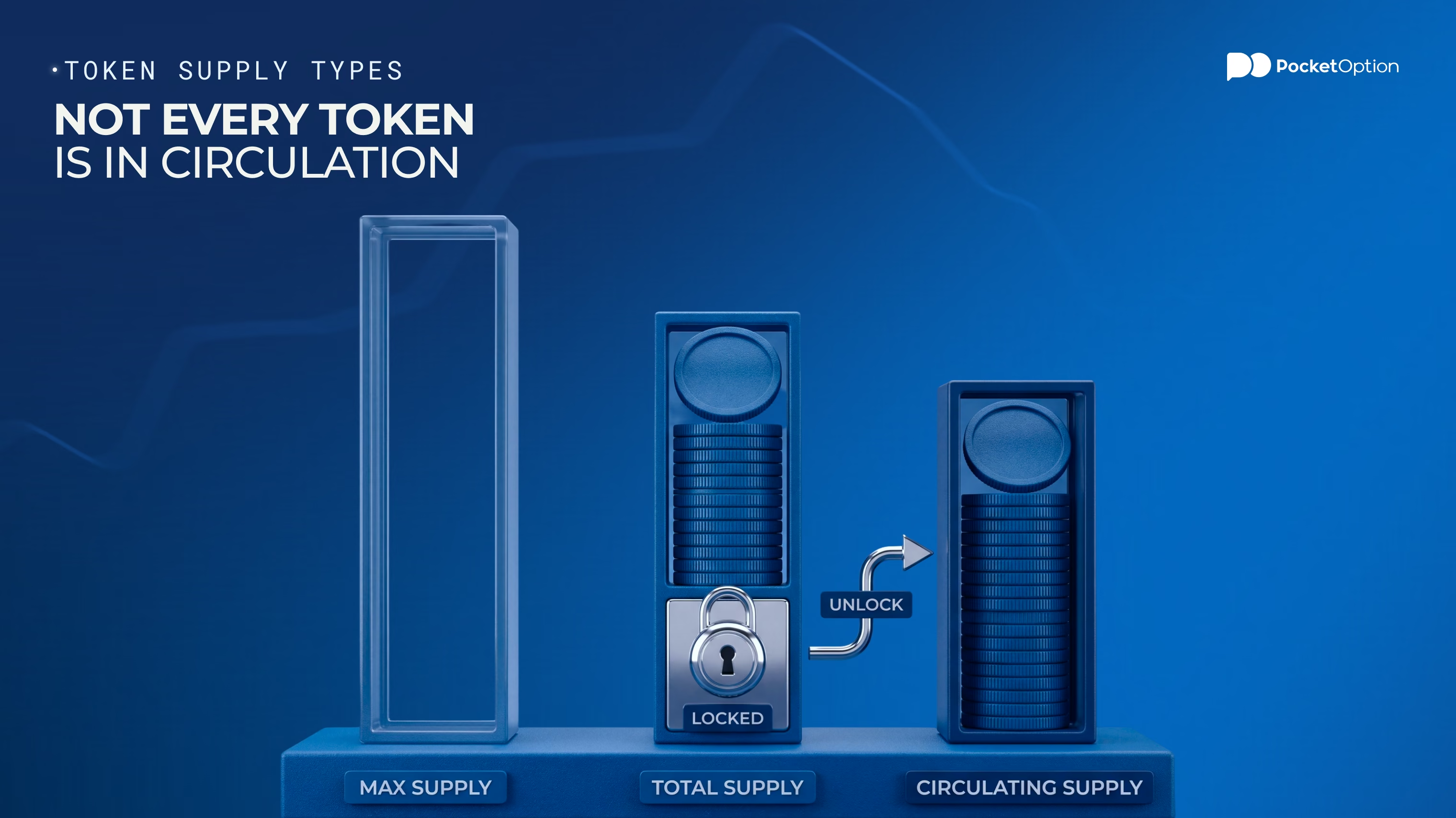
Total supply | Tokens in existence minus burned tokens | Yes |
Circulating supply | Tokens publicly available and trading | No |
Max supply | The most tokens that will ever exist | Yes, plus tokens not yet minted |
Some assets have a fixed supply cap, such as Bitcoin's 21 million coins. Others have no maximum, in which case max supply is shown as unlimited or not available.
How Minting, Burns and Unlocks Change Supply
Three events move the numbers in different ways:
Minting creates new tokens through token issuance, which increases total supply.
Burning destroys tokens permanently, which reduces total supply.
Unlocking releases already issued tokens from vesting or reserves. Circulating supply rises, but total supply stays the same because the tokens already existed.
Take a token with a supply cap of 2,000,000,000. It has issued 1,000,000,000 tokens and burned 50,000,000, so its total supply is 950,000,000. Of these, 400,000,000 are locked in vesting and treasury wallets, leaving 550,000,000 in circulation.
If 50,000,000 tokens unlock under the token unlock schedule, circulating supply rises to 600,000,000 while total supply remains 950,000,000. If the project later mints 100,000,000 new tokens, total supply grows to 1,050,000,000, and circulating supply changes only if those tokens are distributed. How these mechanics fit into a project's wider economic design is covered in this guide to tokenomics.
Total Supply, Market Capitalisation and Fully Diluted Valuation
Circulating market capitalisation is price multiplied by circulating supply, because it is meant to reflect the value of tokens the market can actually trade. Multiplying price by total supply gives a larger figure that also includes locked tokens.
Fully diluted valuation (FDV) is usually calculated as price multiplied by max supply. Where no max supply exists, data providers typically use total supply instead, and some use total supply by default, so the basis should always be checked. Using the original figures and a price of $0.50:
Circulating market capitalisation: $0.50 × 550,000,000 = $275,000,000.
Price × total supply: $0.50 × 950,000,000 = $475,000,000.
FDV on a max supply basis: $0.50 × 2,000,000,000 = $1,000,000,000.
How Token Supply Can Affect Crypto Prices
Supply changes do not set prices on their own, but they can shift the balance between buyers and sellers. Large unlocks may add selling pressure if recipients sell, while burns reduce supply but support the price only if demand holds up. Ongoing token issuance under an emission schedule works in a similar way, since new tokens dilute existing holders unless demand grows at least as fast. A wide gap between market capitalisation and FDV signals that many tokens could still reach the market. What gives a token value in the first place is discussed in this article on why crypto has value.
Conclusion
Total supply counts every issued token that has not been burned, including locked and reserved tokens. Circulating supply shows what can trade today, and max supply shows the ceiling, if one exists.
Check the numbers, then practise.
Get StartedReading all three figures together, along with the token unlock schedule, gives a clearer picture of potential dilution than any single number.
Disclaimer: This article is for informational purposes only and does not constitute investment advice. Cryptocurrency trading involves a high risk of capital loss, and past performance does not guarantee future results.
See more:Glossary