What Is Tokenomics? How Supply and Demand Shape Crypto Prices
Token's supply, allocation, and utility are part of tokenomics. These are the economic rules of the blockchain, that greatly impact the token’s price, and determine how crypto can be traded.

What Is Tokenomics: Definition
So what is tokenomics? In crypto, this means the economics of the token. Rules that govern how it was created, and how it’s then distributed and used. Issuance schedules, how much insiders own, how the public can buy them, whether some tokens are locked up, how the network operates with the token, and what’s its role in the ecosystem.
A clear tokenomics definition is important to understand in investing and trading: these rules govern demand and supply mechanics, and directly influence price. Two very similar projects, with identical technology, can perform drastically different price-wise if one has good tokenomics for investors or traders, and the other one has many unlocked tokens flooding the market, or has a lot of supply locked in to insiders.
Token Supply: Circulating, Total, and Max Supply
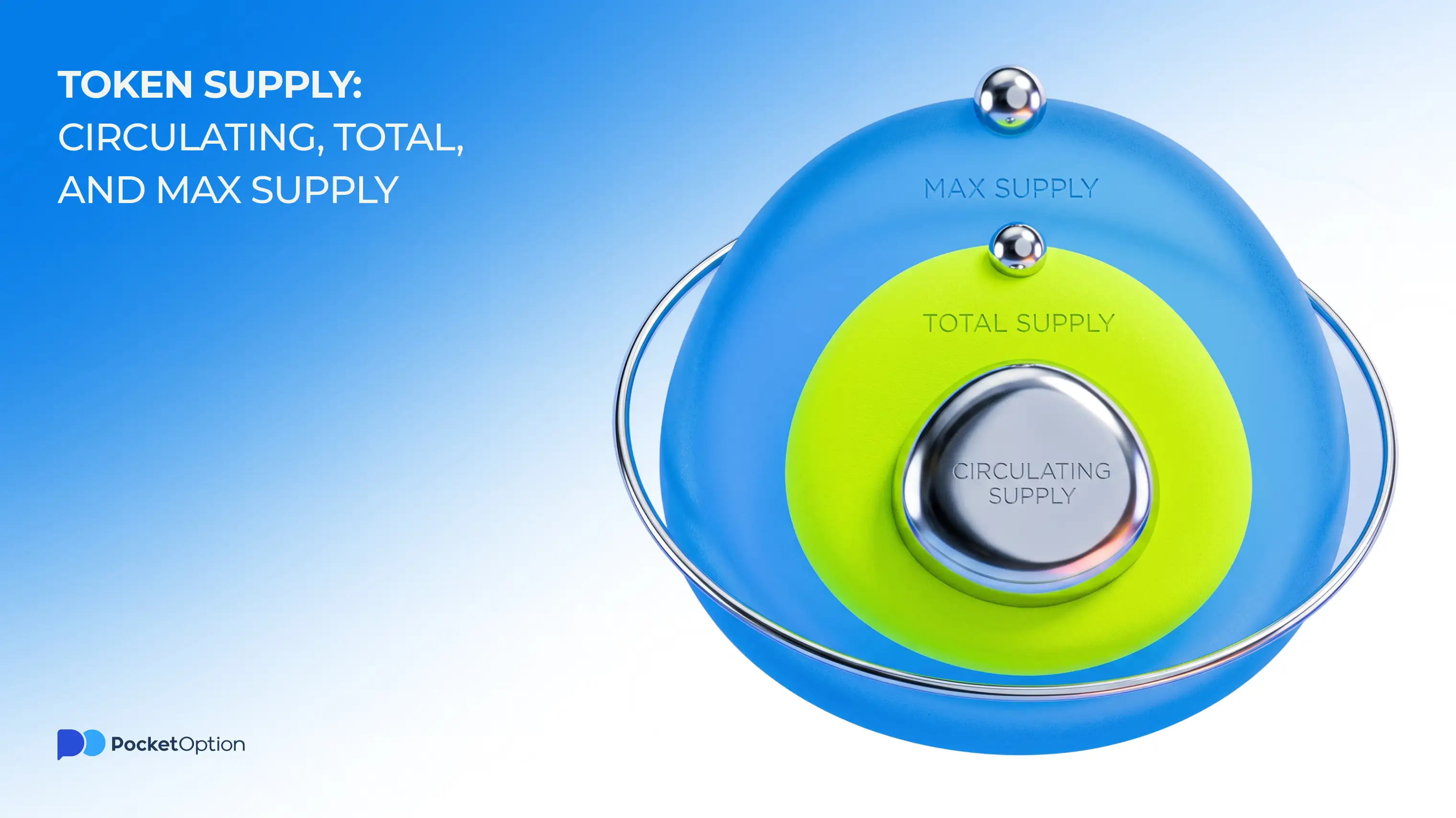
In tokenomics, three figures matter, and they’re often confused with each other:
Circulating supply, shows the total number of tokens that are in the market right now (fully tradable and investable).
Total supply is circulating supply + any tokens that exist right now. Part of them can be reserved or locked, but they can be released.
Max supply is the hard cap on the amount of token that can ever exist. Not every token has max supply (some are inflationary by nature, and so their count increases in perpetuity), but if it has, it’s usually treated by the market as a green flag.
If a token has relatively low circulating supply, compared to its total or max, this is implying a dilution risk down the road, where each current token owner will get a lower share of the total pie. This creates a downward pressure on the price, and often doesn’t let the token to appreciate freely, even if there’s a genuine demand. A token that doesn’t have dilution risks often has easier price appreciation trajectories.
Market Cap vs Fully Diluted Valuation (FDV)
Market cap of a crypto token is its current circulating supply, multiplied by current price. This gives traders an overview of the recent coin valuation. Meanwhile, Fully Diluted Valuation shows how much this token would cost if the max supply would be released. If the max supply does not exist, then the total supply is used in this calculation. This gives a theoretical valuation of the token if the max supply were fully released. It's not a prediction of where the price is headed, but it helps spot the potential dilution and sell pressure sitting in the tokenomics.
If there’s a wide gap between FDV and current market cap, this implies some potential problems down the line. A large supply can be unlocked, and if it reaches the market, the token price could drop significantly. This is not great news for investors, but it can be good for potential short-term traders, as when those unlocks hit the market, it creates some trading opportunities.
New supply that’s coming in from being vested/locked now has to be absorbed by the market. While it’s being absorbed, the price can adjusts downwards. That’s why understanding how fully diluted valuation is calculated and watching the vesting schedule (esp. for a token with a large FDV gap) is important for traders.
Token Allocation and Distribution
One of the tokenomics examples is the amount of tokens being distributed and allocated. Getting this mechanic wrong can sometimes kill the project outright. ‘Allocation’ means how many tokens are given (distributed) to the founding team, early investors, the treasury, and the public. If too large of a percentage is given to the founders, it is often treated by the market as a concentration and dilution risk down the line.
A healthy allocation gives a meaningful share of the tokens to the actual community the project has, and its users. As an example, it can look like this:
Team and founders: 10-20%, but vested over 1-3 years, so that they can’t sell all the tokens on the market right away. This also gives the team a reason to improve the project, and make the token value rise further.
Private investors: 15-25%, but preferably less.
Treasury or foundation: this is reserve for the future, sometimes operated by DAO. Can be no allocation at all, but often a high allocation is not treated by the market too harshly.
Public and community: airdrops, sales, or mining distributes the rest of the token supply to the actual users of the project.
If early insiders hold a disproportionately large share of the token, their eventual selling creates long-term downward pressure on the price, even if the project is successful otherwise on all accounts.
Vesting Schedules and Why They Matter
A vesting schedule shows investors (or anyone interested in the token) when the unlocks from insiders, team, or foundation will happen. For a good tokenomics meaning token rules that create upward pressure on the price, vesting schedule is rather important. It shows that the release will happen gradually, and not all at once. It is creating a story for investors, and prevents holders from rapidly undermining prices for anyone else.
A common vesting structure includes a ‘cliff’ (a period where no token unlocks happen at all), which is then followed by monthly or quarterly releases, in a set intervals, over 1-3 years. If a ‘cliff’ is short, and vesting is fast, this creates higher dilution risks. Set multi-year schedules and long cliffs are treated as more of a green flag.
Token Burning and Deflationary Mechanisms
This is the other side of tokenomics definition, the supply side that’s working in the token's favor. If vesting and unlocks add tokens to the supply over time, burning does the opposite by permanently removing them. Some of that reduction can be built directly into the protocol itself, through burning mechanics. A portion of tokens can be burned each time a particular action is performed. This creates deflationary pressure, and can make the token more scarce later on, if there’s enough transactions or other actions going on in the network.
Some protocols or projects directly remove tokens from circulation, or permanently destroy them or lower the issuance of the token. All of this can be called ‘burns’, and can be done automatically by the network, or executed manually by the team (usually by removing tokens from treasury reserves).
Burning does not guarantee a rising price of the coin, but it certainly helps, by tightening the supply. Investors who favor long-term holding strategies often prefer tokens with burn or other deflationary mechanics baked in.
Utility: Why the Token Is Actually Needed
If a token is useful within its ecosystem, such as for transacting or governing it, this can also create upward pressures on its price, and is considered good tokenomics. It’s much better than if it is only useful for speculation.
A token with ongoing, long-term utility has an extra demand source, and that demand can persist regardless of the current price. This can help establish a bottom during bear markets, and can help with the upside in the bull markets. It’s less dependent on the current market sentiment. That said, position sizing and portfolio allocation are still important, because even a token with great tokenomics and good utility can still have sudden price shifts and downturns.
A Quick Example: Evaluating a Token's Tokenomics Before Trading
To understand what is tokenomics, let’s consider an example. There’s a token with a circulating (meaning, current) supply of 100 million, which has a max supply of 1 billion. It’s priced at $1 right now, therefore its market cap is $100 million, but FDV is $1 billion. This is a tenfold gap, a clear warning sign for investors. Then, they check the allocation, and see that the team and insiders (seed round investors) have 45% of the supply. It can have, let’s say, a cliff of 6 months, and then 2 years of linear vesting baked into the smart contract. Usually all this information is publicly visible on the blockchain to everybody.
To any potential buyer this combination flags real risk. There’s large dilution happening after 6 months, and over all ten times the current amount of tokens will be released later on. Plus, a team and insiders have a lot of supply to sell to the market. A token might still perform well, if the demand for the project is strong, but these tokenomics often hurt the project, and the price will perform worse than for the same project with a token that has no such dilution risks down the road.
open a free account today
Get StartedRed Flags to Watch For
No public info about allocation, no specific percentages or vesting schedule.
A small circulating supply compared to the max or total supply.
Unlocks starting soon (good opportunity for shorting, but often not for investing).
Team and investor allocation being high, especially if they’re exceeding half of total supply.
No clear utility for the token, no need for it in the project or larger blockchain ecosystem.
Any undisclosed token mints, any creation of the token beyond what has been specified beforehand.
And, of course, same due diligence rules that are needed for any crypto project also apply here. It can be a scam, so there’s a need to verify a platform or project before committing any funds.
Conclusion
Tokenomics determine how supply and demand for a token work over its lifetime. How much will be burned and on what occasions, how much will be unlocked and to whom, etc. Checking the FDV gap, vesting, and allocations, is important to understand the long-term future of the crypto project. That said, tokenomics are not set in stone, they can be changed or fixed through an update to the project. In some cases might improve the long-term price trajectory of the token.
test your analysis with a demo account
Try DemoDisclaimer: Trading involves risks of capital loss and may not be suitable for all investors. Past results do not guarantee future performance. Research everything thoroughly before committing any real funds.
See more:Crypto