Why Does Crypto Have Value? What Actually Backs Digital Assets
People outside of blockchain and tokenomics often dismiss crypto altogether as 'backed by nothing'. But is it really true, or does scarcity, cost of production, utility, and trust have monetary value?

What "Backed By" Actually Means
If something is 'backed by' something, this usually implies it can be interchanged for it. Such as when USD was backed by gold: you could request to get gold for the amount of money you have. In this regard, only stablecoins can be considered 'backed by' anything in that strict sense (sometimes it's gold, sometimes it's money in a central bank). Most cryptos, and modern fiat currencies including the euro or the USD, are no longer backed by a redeemable physical asset.
That doesn't mean fiat currencies rest on trust alone, though. The US dollar is legal tender, meaning courts and contracts must recognize it for settling debts, and it represents an obligation of the US government, backed by institutions like the Federal Reserve and the government's taxing power. BTC works differently: it carries no legal tender status or government obligation, so its value depends instead on trust in the crypto ecosystem and the immutability of the blockchain. This is the new paradigm, established ever since the dollar abandoned the gold standard: government institutions and legal enforcement anchor fiat, while decentralized consensus and trust anchor crypto.
This matters for the question of why does crypto have value, because critics often say that if it's not backed by something tangible, physical, then it is valueless. But judging crypto this way, we inevitably come to the conclusion that no major currency is actually any different, and nobody can pass this test.
A Brief History: From Commodity Money to Fiat
Early forms of money were commodities. Salt, cattle, wood, pelts. Their value was intrinsic, as they could be directly used to benefit people's lives.
After that came precious metals, usually in the form of coins. They could be interchanged, or even completely deformed, and still not lose their value, as long as the amount of metal was the same. Their value came from their physical weight in a specific metal.
As economies grew and became more complex, gold and silver gave way to paper certificates that could be redeemed for a fixed quantity of the specific metal. This became the basis of the gold standard, which most currencies used.
However, as the amount of gold in the world is static, and the amount of money continuously increases, governments broke the direct value link over the twentieth century. By 1971, when the US ended the dollar convertibility into gold, currencies became fully fiat: money no longer had any value ties to anything physical.
Source 1: Scarcity and Capped Supply
Now, Bitcoin actually re-introduces some physical aspects to the value capture. Mining requires real hardware and real electricity, creating a direct physical link from this digital money to the real world, which did not exist before. BTC cannot be created out of thin air in unlimited quantities, like fiat currencies can.
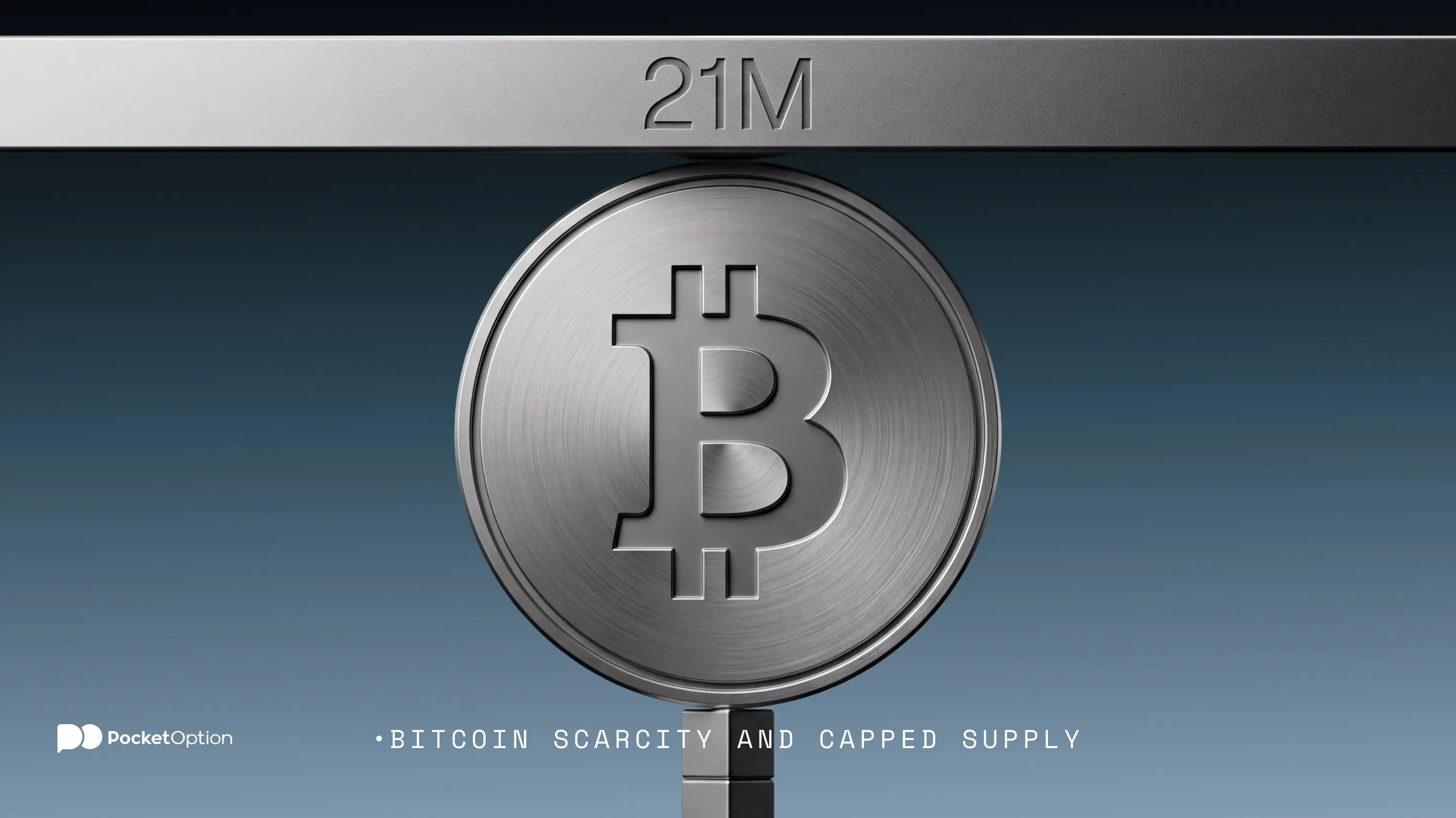
This gives each Bitcoin scarcity like nothing in the 'real' currencies world. Its supply is capped at 21 million coins, and mining new coins still takes real energy and effort each time, though the amount of energy required isn't fixed and shifts with network difficulty over time. So why does crypto have value? One reason is, it can be fundamentally scarce, and it costs money/resources to create it. This is written into code and enforced by every node in the blockchain network.
This kind of programmed scarcity is very unusual. Even gold has potentially unlimited supply, as it can be mined from asteroids, or created in a lab. But Bitcoin, and other cryptos with hard cap, have fundamental, observable limits. For a deeper look into how capped supply shapes crypto valuation, you can read our guide, but suffice it to say, the more difficult something is to obtain or to create, the more valuable it usually is.
Source 2: Cost of Production (Mining)
Proof-of-work cryptos require real hardware and electricity to produce, unlike a fiat currency, which a central bank can create at near-zero marginal cost. This cost doesn't set a reliable floor under the price, though: mining difficulty and hash rate adjust to whatever price and technology exist at the time, so the cost of producing new coins moves with the market rather than anchoring it.
However, this only works for cryptocurrencies with PoW network models. More modern cryptos with PoS (proof-of-stake) model have no direct connection to electricity cost. Instead, they have an indirect one: users still need to run the servers just to support the network. But increase in energy output doesn't directly translate to more ETH or SOL being mined. Instead, it's the amount of tokens a user owns that determines their stake in subsequent distributions, and not the raw compute power.
Source 3: Network Utility and Demand
Beyond just scarcity and production costs, one of the main reasons for why does crypto have value are its actual use cases. Networks that support popular smart contracts, or in-demand decentralized applications, are worth more than a ghost town without any users. This is why faster, and more low-cost networks with cheap transfers, such as Solana or Tron, are often quite valuable, despite the token not having a fixed supply, and not being directly tied to any energy cost. Instead, these tokens are required (in one way or another) to pay for transacting on the network, which is valuable to people.
This utility-based demand can be compared to demand for regular fiat currency, in that it's proportional to the size of and speed of the economy that uses it. A large, active network usually has more demand for its token that runs within its ecosystem.
Source 4: Trust and Network Effect
Trust plays a crucial role in any monetary system, whether digital or traditional. A currency is only valuable to people if enough other people accept it as such. If it can be freely exchanged for other assets, services, or goods. This is where a network effect comes into play. The more people know about Bitcoin or Ethereum, the more participants join a network and use the token, the more trust is ultimately created, the more valuable crypto becomes.
Even if a token would be completely useless, and had uncapped supply, sometimes trust effects prevail, and it still obtains great value (such as what happened with memecoin craze on Solana in 2024, with some tokens achieving capitalization in billions, with nothing but user network effects backing them up). Trust and hype can create value in themselves, with nothing else needed to be intrinsic to the asset.
That trust can disappear overnight, however, from some news article or blog posts, and so it can be a fickle thing. But this form of value creation is still there, and it's not unique to crypto. Ultimately, gold, or fiat money, are also valued more for the fact that the people believe that these assets will continue to be accepted tomorrow, and will not disappear overnight.
What Actually Backs Fiat Currencies
Fiat currencies are backed mainly by the authority of governments, their legal tender status, and general public trust in the issuing institution. A central bank can prop up or decrease a currency's value with interest rate policies and by reducing or increasing the money supply. Meanwhile, crypto's value operates entirely differently, with no laws governing it, beyond the written code on the chain.
Confidence in a particular real world currency also depends on perceived stability of the government and the central bank backing it. If a state is unstable, politically or economically, their currency historically lost value over time, sometimes quite rapidly. In this way, fiat's value ultimately rests on government institutions and legal enforcement, reinforced by public trust, rather than on trust alone.
What Actually Backs Gold
Gold's value has some physical elements, which are hard to replace or reproduce. It has real industrial and decorative use, long cultural history, and scarcity. Although companies dig out comparatively more gold per year than the amount of BTC that is mined, it is still not unlimited supply, unlike fiat, and that's why gold is perceived as a good store of value.
A large share of gold supply is held in jewelry, alongside other decorative and industrial applications, with much of the remainder held for investment or central bank reserves. Even so, a meaningful part of gold's price still reflects trust and tradition rather than pure utility, since jewelry demand itself is driven partly by gold's perceived lasting value rather than by its physical properties alone. The 2 biggest differences are that gold is physical in nature, and is stored in vaults rather than on the blockchain, and that gold has a more deep and rich history, and so the amount of accumulated trust is much higher.
Crypto vs Fiat vs Gold: Side-by-Side Comparison
Source of value | Crypto | Fiat currency | Gold |
|---|---|---|---|
Scarcity | Protocol-enforced | Set by monetary policy, not fixed | Limited, but slowly growing |
Production cost | Mining hardware, electricity | Near zero | Mining and refining costs |
Utility | Transactions, smart contracts | Legal tender, such as for debts and taxes | Some industrial use |
Backing authority | Decentralized consensus | Central banks, governments | No formal authority |
Core value driver | Trust + network effects | Trust + legal enforcement | Trust + tradition |
start exploring crypto markets
Get StartedAddressing the "Greater Fool Theory" Criticism
A common criticism for why does crypto have value is that it's all a big Ponzi scheme. It has value only as long as the next buyer comes in, and bails the previous buyer out. This is a dynamic known as the 'greater fool theory'.
This concern is not unreasonable, because speculation clearly plays a big role in price swings, especially for crypto. We detailed this in our look at what causes Bitcoin to go up and down.
However, there are some counterarguments worth considering. A version of this logic applies to fiat currencies, gold, and even collectible art too, since each is also worth more if someone else is willing to pay for it later. But the mechanics of that demand differ substantially: fiat currencies carry legal tender status that mandates acceptance regardless of speculation, and gold carries real industrial and decorative demand alongside its investment appeal. Crypto's price, by comparison, leans more heavily on the expectation of future buyers, without either of those other demand floors underneath it.
Crypto's proportion of speculative value might be unusually high compared with these older and more established assets. But 'greater fool theory' can't be used as a rebuke against the entire ecosystem. This is a distinction explored further in the bitcoin is worthless debate.
Conclusion
Crypto is backed by the same things as the money or gold that are already in everyday use: trust, network effects, cost of production. With some additional value like scarcity baked into Bitcoin and some other products.
The same ingredients work for all assets that have value, except in slightly different proportions. Frameworks built around these ingredients, including scarcity-based pricing models, give a grounded starting point for evaluating the actual value of digital assets.
practice with virtual funds
Try DemoDisclaimer: Trading involves risks of capital loss, and thus may not be suitable for all investors. Remember that past performances do not guarantee future results.
Vedi di più:Crypto