What Is Investment Capital and How Is Trading Capital Allocated?
Not all the money in a bank account is available for trading. Investment capital is the share set aside for investing or trading, apart from living costs and emergency savings, and the way it is sized and divided decides how much one bad trade can hurt.

What Is Investment Capital
Investment capital is the part of a person's financial resources committed to investing or trading. It can be cash in a brokerage account or assets such as stocks, bonds or crypto held for that purpose. For an active trader it is often called trading capital, the balance used to open positions. In most cases it is only a portion of total wealth, chosen so that losing it would not affect daily life.
Investment Capital vs Savings and Other Money
Three kinds of money are usually kept apart from investment capital:
Money for living costs: rent, bills, food and debt payments due in the coming months.
An emergency fund: a cash reserve, often several months of expenses, for job loss or sudden costs.
Savings for set goals, such as a home deposit or school fees needed on a fixed date.
These must be available on time and at full value, so they are kept out of assets that can fall in price. Investment capital is money that can stay invested through a downturn without forcing a sale.
How Much to Set Aside
A common rule is to commit only risk capital: money whose loss would hurt but would not change living standards or plans. Take someone with $30,000. If $6,000 covers the next few months of bills, $12,000 forms an emergency fund and $7,000 is saved for a home deposit, that leaves $5,000 of investment capital. The figure differs for everyone, and the emotional side matters as much as the arithmetic, a point covered in trading psychology for beginners.
How Investment Capital Is Allocated
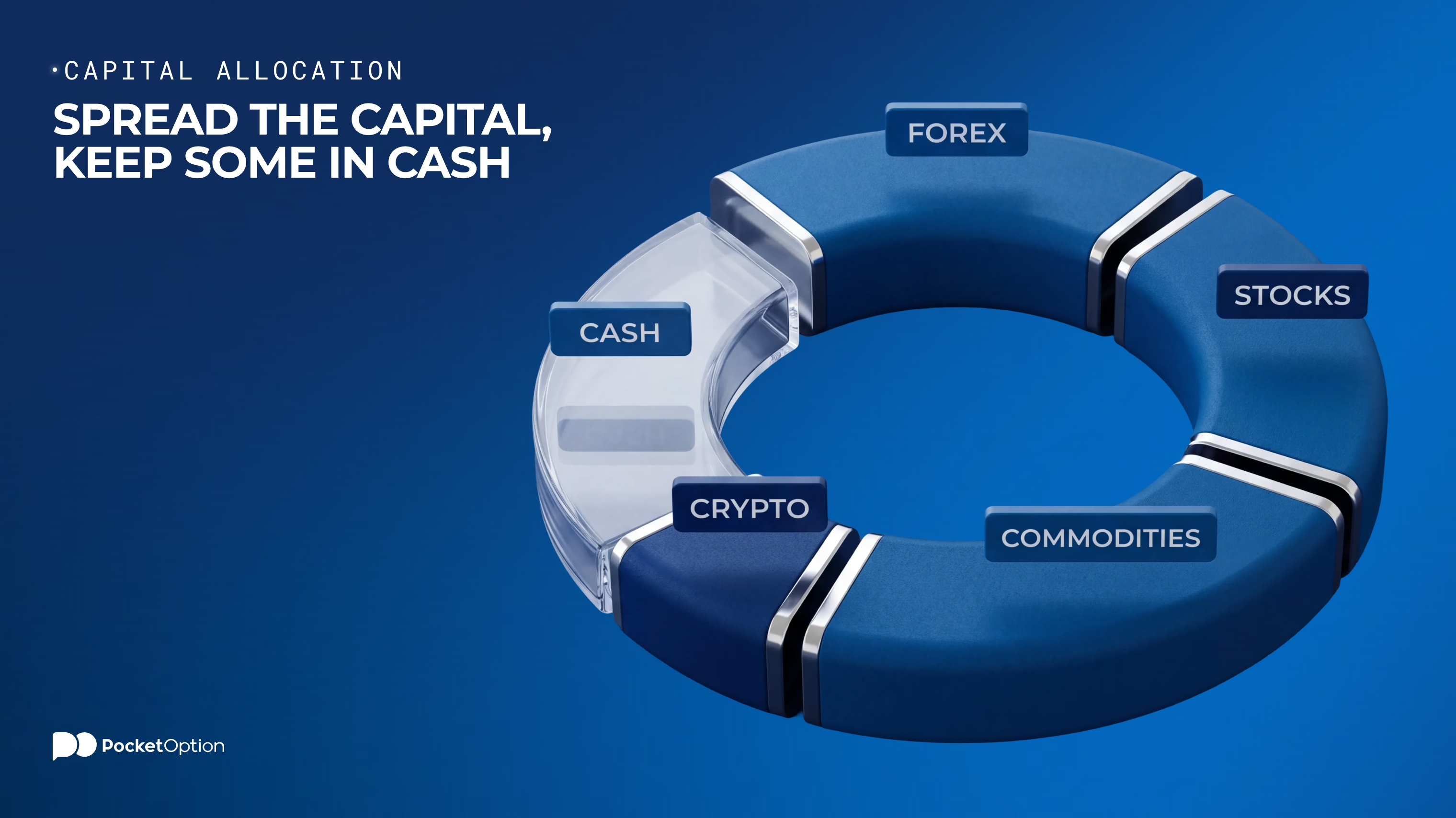
Capital allocation means dividing investment capital across assets, strategies and time horizons. A trader might keep part of the balance for longer-term holdings, part for short-term trades and part in cash, ready for new opportunities. Spreading money across assets that do not move together, such as currencies, stocks and commodities, reduces the chance that one event hits everything at once, although it does not remove risk. Crypto adds its own volatility, and crypto risk management often means giving it a smaller share than steadier assets.
Risk per Trade and Position Size
Position sizing turns the capital into a trade size. Many traders limit the loss on any single trade to 1% to 2% of investment capital. With $5,000 and a 1% limit, the maximum loss is $50:
Entry price $100 and stop-loss $95, so the risk is $5 per share.
Position size: $50 ÷ $5 = 10 shares, a $1,000 position.
If the stop is hit, the loss is $50 and $4,950 remains.
The position is 20% of the capital, but only 1% is at risk. The same logic underpins day trading risk management, where the stop is set first and the size follows from it.
The Role of Leverage
Leverage lets a trader control a position larger than the capital put up. With 10x leverage, $1,000 of margin controls a $10,000 position. A 5% move in the trader's favor earns $500; a 5% move against loses $500, half the margin and 10% of the $5,000 capital. Gains and losses grow together, and a large enough loss ends in forced liquidation of the position. Leverage extends exposure without adding capital, so risk per trade should be measured on the full position, not the margin.
Other Meanings of Investment Capital
Outside personal trading, the term has two other common uses. In business, investment capital means money raised from investors, such as venture capital or equity funding, to start or grow a company; the US Small Business Administration uses it in this sense. In accounting, capital expenditure, or capital investment, means a company's spending on long-term assets such as buildings and machinery. This entry uses only the personal meaning: money set aside to invest or trade.
Conclusion
Investment capital is the money set aside for investing or trading once living costs, an emergency fund and fixed goals are covered. Commit only risk capital, decide its allocation before trading, cap the loss on each trade at a small share of the balance, size positions from the stop-loss, and measure leveraged risk on the full position rather than the margin.
Test position sizing with virtual funds.
Try DemoDisclaimer: Trading involves significant risk of capital loss and may not be suitable for all investors. Past performance does not guarantee future results.
See more:Glossary