Trading Psychology for Beginners: Discipline, Emotions and Risk Control
Ask any trader why some people succeed where others fail, and you will probably not get an answer about a particular chart formation or a specific indicator setting. What you will get is a discussion about trading psychology, or the ability to stick to the rules even when you feel like running away from them. This is not an easy conversation to have since discipline cannot be downloaded or implemented from someone else's system. Discipline must be developed and ideally in the demo environment before risking any money. We will give an overview of the common psychological pitfalls for beginner traders, discuss how to develop discipline in the Pocket Options demo mode and give a simple discipline training routine that you can do even when trading live.

What Trading Psychology Means for New Traders
Trading psychology (known also as the psychology of trading or trade psychology) relates to the way of thinking that impacts a trader's decisions. For example, two traders may use the same indicators to analyze the chart but come to entirely different conclusions. And that is not because one is more clever. It happens because one's mind perceives risk/reward in an entirely different way from the other.
As far as a newbie is concerned, there is only one psychological concept that needs to be acknowledged: under stress people act instinctively instead of consciously. Fear makes you take profit too soon while greed makes you stay in a losing position for too long.
Why Discipline Matters More Than Any Single Strategy
An average strategy implemented in a disciplined way will always perform better than an outstanding strategy implemented haphazardly. The explanation behind this is purely mathematical. Strategies provide returns through a series of trades. By not adhering to the guidelines after two failures, there isn't enough scope for the edge to kick in.
It is pertinent to this topic of day trading psychology because of the rapid nature of the decision making process. A day trader who lacks discipline doesn't just lose money on trades, he loses money on good setups he got exited too early or never entered at all.
Common Emotional Traps Beginners Face on Pocket Option
The trading platform is a mirror. Whatever emotional patterns you carry into a trading session the market will reflect them back. Usually in the form of losses. Here are the most common:
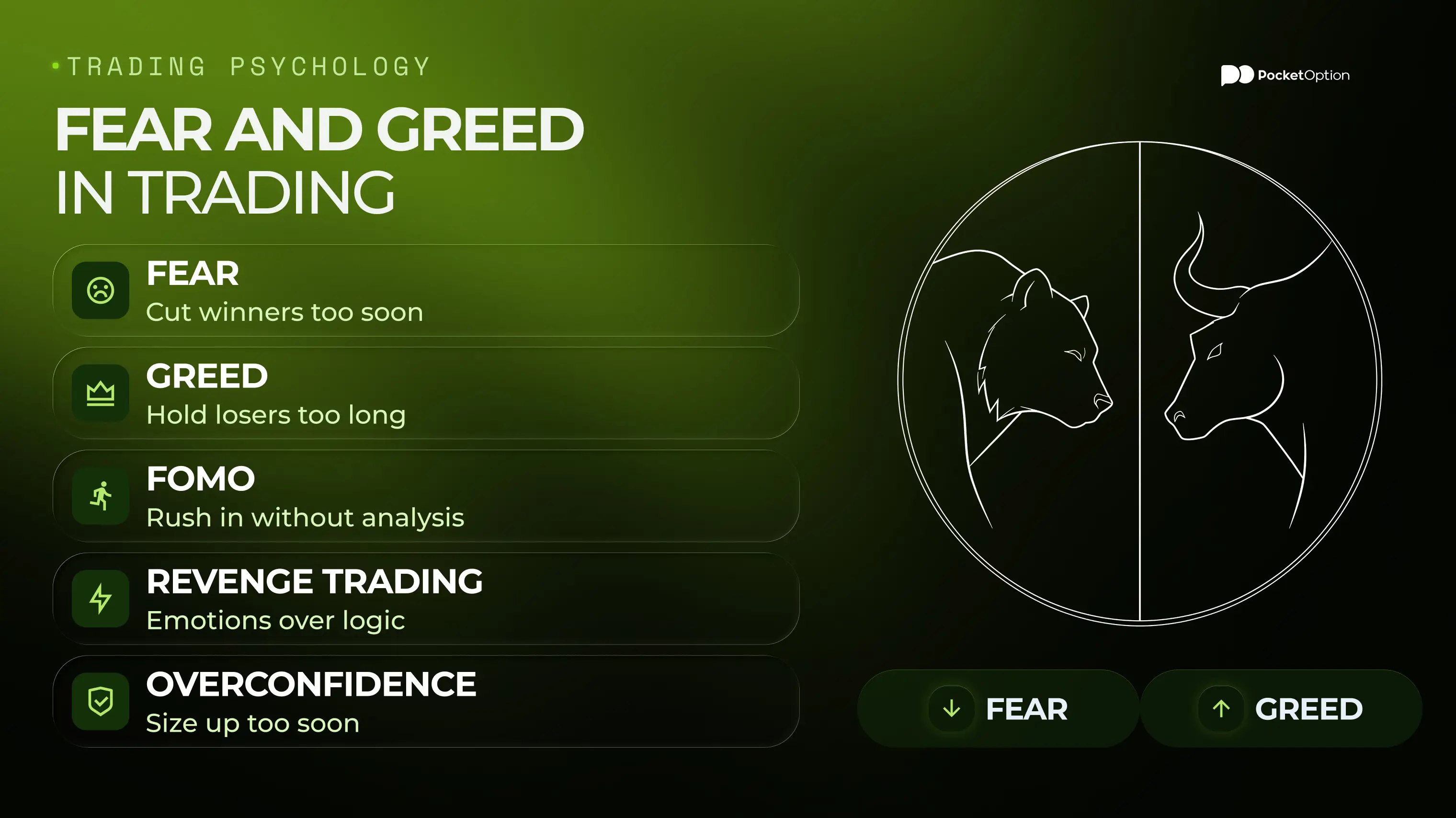
Fear and greed in trading. Fear will cut a profitable trade too soon, whereas greed will prolong an unprofitable trade.
Fear of Missing Opportunities (FOMO) in trading decisions. Rushing into the trade without analysis just because you feel that losing the trade hurts more than doing a bad trade.
Revenge trading impulses. The mood that influences your decision-making process has no relation whatsoever to the market environment.
Overconfidence in markets. Believing that luck and skills are interchangeable, and thus increasing the position size too soon.
Loss aversion and regret. The pain from losing $100 is twice the joy from earning $100.
Using the Pocket Option Demo Account to Train Discipline
The demo account is not where you learn where the buttons are located. The demo account is where you practice your emotional self-control when trading, without any financial costs associated with it. The trades that occur in the demo environment are fictional, but the sudden rush of adrenaline when you lose money, or the desire to double your stake is very real.
In order to make use of the demo, you must:
Treat it like your real money. This is the key rule of demo trading. Once you stop treating demo money seriously, the entire exercise becomes useless.
Follow your written plan on every trade. If you don't have a written plan yet, that is the problem to solve.
Set a stop-loss in a demo environment. If you reach that level, you need to leave the trade.
After each session write down what you felt in addition to the trading log. The trading journal practice is where the real learning occurs.
Unlimited refills
Try Demo AccountSimple Routines to Build Emotional Control
Emotional control for traders is not eliminating emotion entirely. That is neither possible nor desirable. It is more about creating distance between a feeling and a decision that you can choose whether to act on it.
Three behaviors which help include:
The pre-trading session check-up. Just before logging into the trading platform, ask yourself whether you are calm, frustrated, bored or anxious. If the answer is anything except calm or focused, then either cut down your position size or even skip the session altogether.
The ten second rule. In case you feel the need to enter a trade immediately after having a loss, just count to ten. If you still think that the setup is valid, then go ahead with the trade; otherwise it was purely emotional and not analytical.
The end-of-day review. Five minutes after the trade is completed should be spent on assessing both what went well and what did not.
How to Create and Use a Trading Journal
A trading journal practice does not need to be elaborate. A spreadsheet or notebook with these columns is enough:
Date, time, instrument and direction.
Entry reason. What signal or setup triggered the trade.
Exit reason. Planned or unplanned.
Emotional state. One or two words on how you felt before and during the trade.
Outcome. Profit, loss or breakeven.
It is the emotional state column which beginners ignore but which gives out the insight. Over 20 or 30 different entry patterns come up: trades executed when feeling frustrated usually fail; trades executed following a headed morning review usually succeed. The information is invaluable compared to any indicator settings.
Moving from Demo to Real Trading Without Losing Discipline
The transition from demo to live trading — the point where a risk management mindset is tested most — is where most trading discipline habits tend to collapse. The reason is simple: real money activates a part of the brain. A loss on demo is an entry in a journal. A loss on an account feels personal.
To protect the habits you built on demo:
Start with the position size available. The goal of your live trades is not profit, it is proving to yourself that you can follow the plan under real conditions.
Keep the daily loss limit you used on demo. Do not raise it because "now it matters."
Keep writing in your journal. The emotion is more meaningful once money is actually on the line.
Use trading psychology for your advantage
Register NowLong-Term Mindset: Accepting Losses and Staying Consistent
No one, no matter how experienced, ever wins all of his trades. Risk management is an attitude that accepts the above as part and parcel of the game and not some sort of personal failing.
Look at it as tuition money. The expense that is needed to gather the information as to what works and what happens when you get stressed out. The successful traders that stick around long enough to make money are the ones that figured out how to lose without altering the process.
Conclusion
Trading psychology is not a soft skill, it is the backbone. An ineffective chart pattern will mean nothing to you when you don’t abide by its rules. Risk management will mean nothing to you when you override it whenever you are afraid or greedy.
Start on the demo. Build the habits. Keep the journal.. When you move to real trading carry the discipline with you. It is the edge that does not degrade over time.
Risk disclaimer: This content is provided for educational and informational purposes only. It does not constitute financial, investment, or trading advice, nor a recommendation to buy or sell any instrument. Do your own research before acting.
See more:Psychology