What Is a Stop Limit Order and How Do Stop-Limit Orders Control Entry and Exit?
A stop limit order lets you set two prices instead of one. The first wakes the order up. The second caps the price you'll accept. You gain control over price, but you give up the certainty of a fill.

What Is a Stop-Limit Order: Definition
So, what is a stop limit order? It's a conditional order that pairs a stop price with a limit price. Nothing happens until the market reaches your stop. Once it does, the order turns into a limit order at your chosen price or better.
It helps to know the building blocks. A market order buys or sells right away at the best available price. A limit order fills only at your price or better. The stop loss meaning is simple too: an order that closes a position once price moves against you to a set level. Where traders tend to place those levels is covered in this guide to stop loss placement in day trading.
How the Stop Price and Limit Price Work Together
Think of it as two steps. The stop price is the trigger. The limit price is the boundary.
For a sell order, the stop sits below the current price. When the market trades at or below it, a sell limit order goes live.
For a buy order, the stop sits above the current price. When the market trades at or above it, a buy limit order goes live.
The two prices don't have to match. Sellers often set the limit a little below the stop, and buyers a little above, to leave room for a fill.
What counts as reaching the stop can vary. Some brokers use the last traded price, others the bid or ask. Many stock brokers trigger stops only during regular trading hours, so check your platform's rules first.
A Worked Example
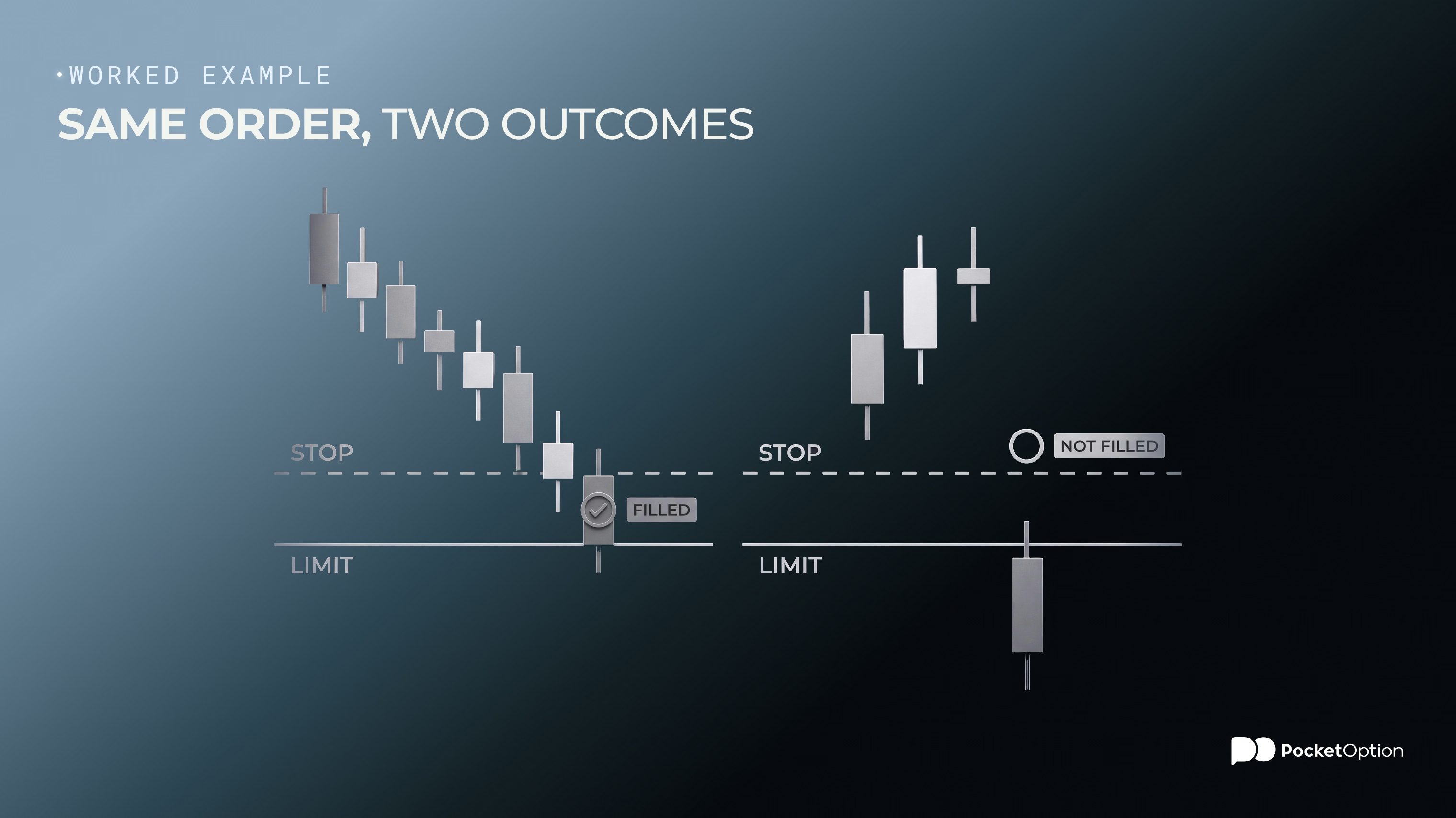
Say you own a stock trading at $50. You want out if it falls, but you don't want to sell for less than $47.50. You place a sell stop limit order with a stop price of $48 and a limit price of $47.50.
In an orderly drop, price slides to $48 and your stop triggers. A sell limit order at $47.50 goes to the market. Buyers are still there, so you sell at $47.90.
Now picture bad news overnight. The stock opens at $45. Your stop triggers, but no one will pay $47.50, so the order sits unfilled. You still hold the stock, and it's still falling.
Stop-Limit Order vs Regular Stop Order
A regular stop order becomes a market order once triggered. The fill is close to certain, but the price isn't. A stop limit order becomes a limit order. The price is under your control, but the fill isn't assured.
Feature | Stop order | Stop limit order |
|---|---|---|
After the trigger | Becomes a market order | Becomes a limit order |
Fill | Very likely | Not certain |
Execution price | Can be worse than the stop | Limit price or better |
On a price gap | Fills at the next available price | May not fill at all |
In the example above, a plain stop at $48 would have sold near $45 on the gap. That's a poor price, but you're out. Which outcome is worse depends on your situation. Sharp drops also stir up emotion, and this piece on panic selling explains why traders so often exit at the worst moment.
The Main Risk: Your Order May Not Fill
If price jumps past your limit, the order may never execute. That can happen on a gap at the open, after a news release or in a thin market with few buyers and sellers.
It works the same way on the buy side. If you're short and use a buy stop limit order to cap losses, a fast spike can leap over your limit and leave you exposed. That's what happens during a squeeze, as this explainer on short squeezes shows.
Partial fills are possible too. Part of the order may fill at your limit while the rest waits. Watch open orders, and decide ahead of time what you'll do if the order doesn't fill.
Know your levels in advance.
Get StartedConclusion
A stop limit order gives you a price floor or ceiling, not a guarantee. Use it when price matters more than getting out at any cost. If a certain exit is the priority, a regular stop or a market order may suit you better. Either way, learn how your platform handles triggers and gaps before real money is on the line.
Disclaimer: Trading involves significant risk of capital loss and may not be suitable for all investors. Past performance does not guarantee future results.
See more:Glossary