
What Is a Merger and How Do Company Mergers Work in Finance?
A merger joins two companies into one business. Deals can reshape industries and move share prices sharply on the day they are announced. This entry explains how a merger differs from an acquisition, why companies combine, how the process runs and what shareholders receive.

What Is a Merger?
A merger is a transaction in which two companies combine to form a single business. Shareholders of the company being absorbed usually receive shares in the combined group, cash, or a mix of both.
Mergers take several legal forms. In many deals, one company survives and absorbs the other, which ceases to exist. In a consolidation, both original companies are replaced by a new entity. The two sides do not need to be equal in size, and deals described as a "merger of equals" are relatively uncommon.
Merger vs Acquisition
In an acquisition, one company buys control of another, which may continue to operate as a subsidiary. In a merger, the two businesses are brought together into one legal entity or group, usually on terms agreed by both boards.
In practice the terms overlap, and the phrase mergers and acquisitions (M&A) covers both. The difference often lies in structure and approach. An acquisition can be hostile, with an offer made directly to shareholders without board support, whereas a merger is normally negotiated between the two companies.
Why Do Companies Merge?
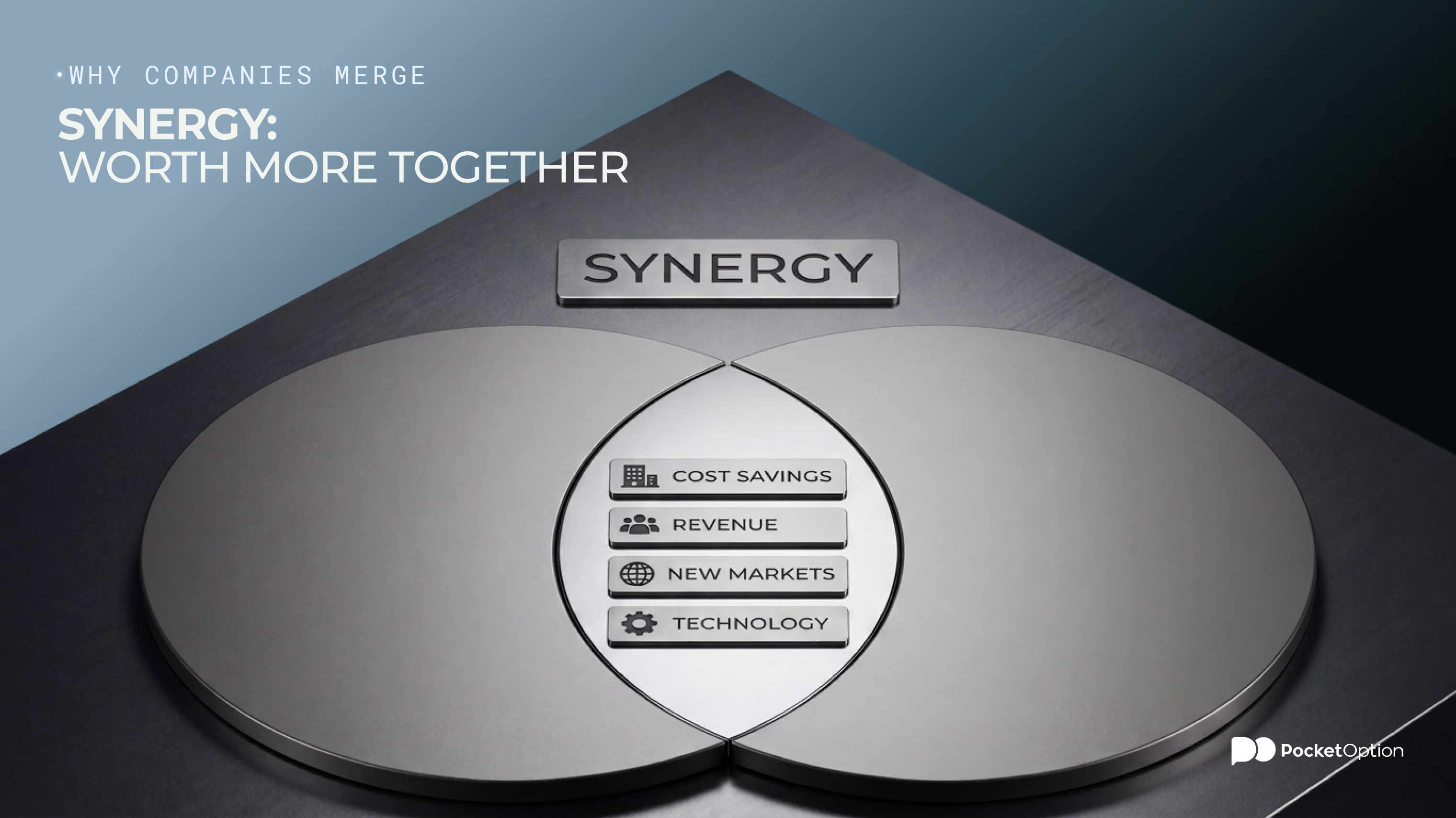
Companies merge when management expects the combined business to be worth more than the two parts on their own. The extra value is called synergy. Common motives include:
Cost savings from shared offices, systems, purchasing and support functions.
Revenue gains from selling more products to a larger customer base.
Expansion into new regions or markets without building operations from scratch.
Access to technology, patents or skilled teams.
Greater scale, which can strengthen bargaining power with suppliers.
Expected synergies are estimates. Integration costs, cultural differences and conditions set by regulators can reduce them, and some deals fail to deliver the benefits projected at the outset.
Main Types of Company Mergers
Mergers are usually grouped by the relationship between the two businesses.
Type | Description | Hypothetical example |
|---|---|---|
Horizontal | Competitors in the same industry combine | Two regional supermarket chains |
Vertical | Companies at different stages of the same supply chain combine | A carmaker and a parts supplier |
Conglomerate | Businesses in unrelated industries combine | A food producer and an insurer |
Market extension | Similar products, different geographic markets | Two banks operating in different countries |
Product extension | Related products sold to the same customers | A phone maker and a headphone brand |
When listed companies are involved, their shares react on the exchanges where they trade, a process explained in this overview of how the stock market works.
How Does a Company Merger Work?
Most deals follow a similar sequence, although the timeline can run from a few months to more than a year.
Negotiations and Due Diligence
Talks often begin privately between executives and their advisers. Once a price range is agreed in principle, the buyer carries out due diligence, a detailed review of the other company's finances, contracts, debts, legal risks and operations. Problems uncovered at this stage can lower the price or end the talks.
Merger Agreement and Public Announcement
If both boards approve, a definitive merger agreement is signed. It sets the price, the form of payment, the conditions for closing and any penalties if either side walks away. The deal is then announced publicly. Cash offers are often funded with new borrowing, including bond issues, which are explained in this guide to corporate bonds.
Shareholder and Regulatory Approvals
Shareholder approval is often required, particularly from the target company's investors and, in some share-based deals, from the buyer's as well. Regulatory approval may be needed from competition authorities, which check whether the deal would weaken competition, and from sector regulators in areas such as banking. Authorities can clear a deal, impose conditions such as asset sales, or block it.
Deal Completion and Business Integration
Once all conditions are met, the deal closes. The target's shares are usually delisted, and its shareholders receive the agreed payment. Integration then begins: combining systems, teams, brands and suppliers. This stage often determines whether the expected synergies are achieved.
What Happens to Shares in a Merger?
Shareholders of the target company are typically paid in one of three ways:
Cash consideration: a fixed amount per share, for example $50 in cash for each share held.
Stock-for-stock merger: target shareholders receive shares in the buyer, based on an exchange ratio.
Mixed consideration: part cash, part shares.
An exchange ratio of 0.6 means each target share is swapped for 0.6 shares of the buyer. If the buyer's shares trade at $80, each target share is worth $48 in buyer stock at that moment. Because payment is made in shares, its value moves with the buyer's share price until the deal closes.
After an announcement, the target's shares often move toward the offer value but tend to trade slightly below it. The gap reflects the time to completion and the risk that the deal fails. The buyer's shares may rise or fall, depending on whether investors see the price as fair. Mapping out both outcomes in a realistic trading plan helps keep positions around such events within defined risk limits.
Conclusion
A merger turns two companies into one, but for shareholders the deal comes down to its terms: cash, shares or both, and the conditions that must be met before closing.
React to news with a plan.
Get StartedThe gap between a target's share price and the offer value is the market's running estimate of that risk. A narrow gap signals confidence that the deal will close, and a wide one signals doubt.
Disclaimer: This article is for informational purposes only and does not constitute financial advice. Trading involves risk, including the possible loss of invested capital.
See more:Glossary