How Does the Stock Market Work? Simple Explanation and How to Trade Stocks on Pocket Option
To gain an understanding the stock market, it’s important to know answers to one question: how does the stock market work? Which means, what drives supply and demand? We explain issuance, trading, and price formation, and how to trade it all on Pocket Option.

What Is a Stock Market: Definition
In the simplest terms, what is a stock market? It is a collection of traded stocks. You used to have to drive to a specific place, an exchange, and offer money to buy a share in someone’s company. Now it is all done automatically, online. With shares of thousands of companies being sold every day. With daily turnover ratio reaching $1 trillion a day. Billionaires and millionaires are made daily on stocks, through investments and trading.
Another stock market definition says it’s a network of exchanges and brokers that connects to each other and to customers. Firms that are looking for capital are connected to investors seeking to deploy some of their funds.
Each exchange sets its own rules: trading hours, listings, settlements, fees, are rather diverse. But the underlying purpose for it all stays the same.
How a Stock Is Issued: From IPO to Public Trading
A private company can raise additional cash through capital markets through a special so-called initial public offering. By doing so, a private company becomes a public one. Investment banks in this case help the company assess its earnings potential and growth prospects.
When a company's stock is issued for public access in the markets, the company's shares are listed on an exchange and can be bought and sold. This is the starting point for most investing in stocks.
How Stocks Are Traded After the IPO
After the IPO, shares of a company move into the secondary market. In the secondary market, existing market participants can purchase or sell company shares via brokers. Having a basic sense of how the stock market works at this stage makes the rest of this guide easier to follow.
An order is routed through a broker to match with a seller’s offer - when both parties’ conditions are met, a trade gets completed. A separate guide on how to buy stocks covers the account and order-placing steps in more detail. The company itself does not get involved itself as it has already received the capital.
How Supply and Demand Set the Price
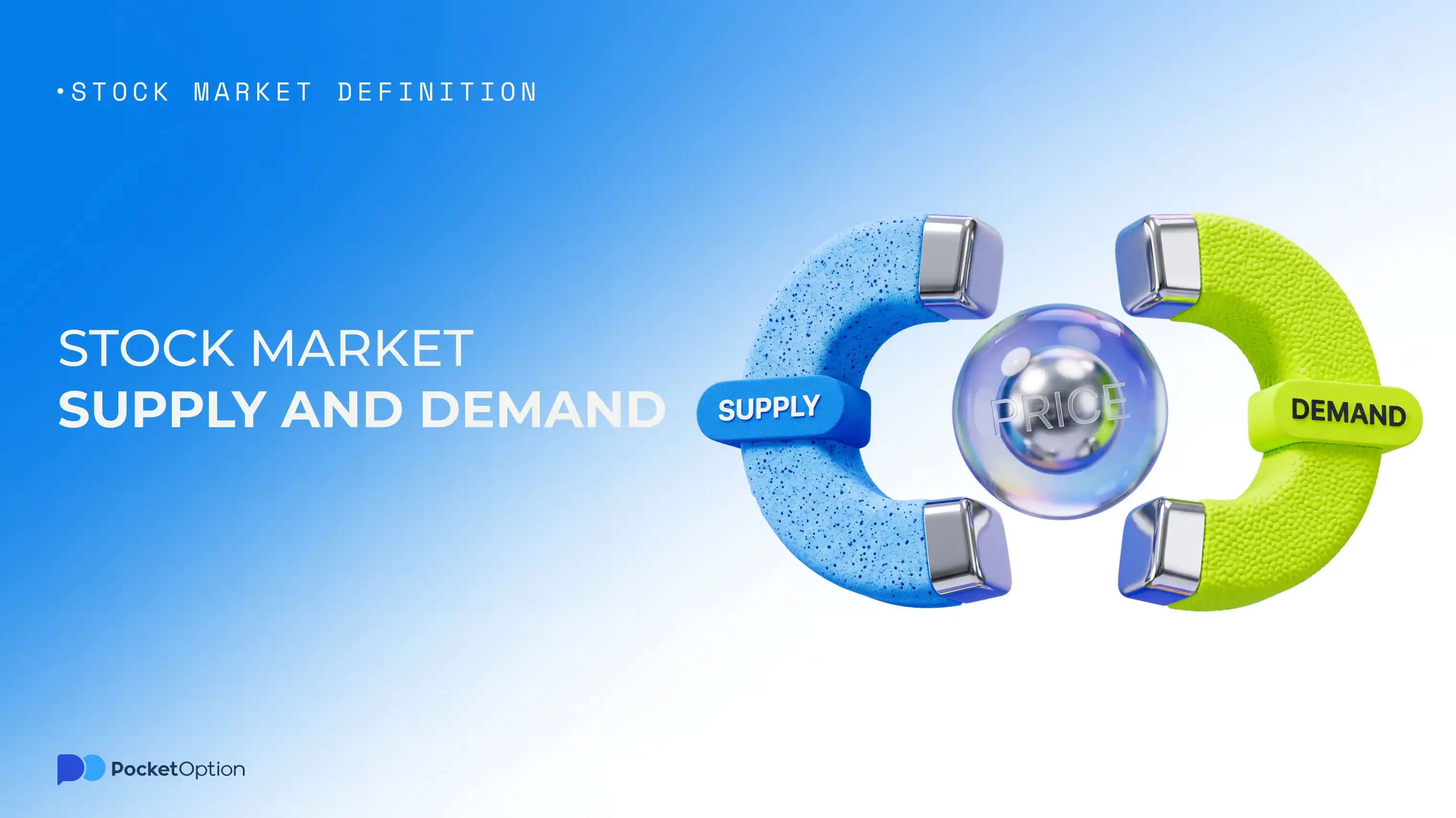
The stock market is essentially an example of a free market system. It's governed by the universal laws of supply and demand. If there are more buyers than sellers, a company's share price will rise. If the opposite is true, and there are more sellers, there will be downward pressure on the price.
This constant negotiation between buyers and sellers happens every second, if not every nanosecond, in the stock market, which results in the company’s stock price.
Behind that concept of supply and demand there is a more mechanical process, the order book. At any given time, an exchange has a stack of buy orders and a stack of sell orders, each order at a different price level. The spread is the difference between the highest bid and the lowest ask, and trades only occur when a buyer and seller agree on a price to trade at, or when one side is willing to cross the spread to trade immediately. Market makers usually are on both sides of this book and provide liquidity so a buyer doesn't have to wait for the perfect seller to show up. This is what allows a stock to change hands in a split second even if no two traders agree on exactly what the right price should be. The price you see on the chart, the last traded price, is just a snapshot of where the last match of a bid and an ask took place.
How Stock Prices Are Formed on the Pocket Option Platform
So what does this mean for a platform like Pocket Option, where a trader is not taking an order directly on the NY Stock Exchange or Nasdaq?
Pocket Option does not own the shares. A trade on the platform is not sent to an exchange order book. Instead of this, how the stock market works on the platform is through quotes from real market prices. It mirrors the same supply/demand dynamics happening on the real exchange, streamed to the platform in real time.
When a stock's price moves on its home exchange because more buyers than sellers show up, that movement is then reflected on the Pocket Option chart, with minimal delay.
This is important because it means that the above price formation, order books, bid-ask spreads, market makers, is still what ultimately drives the number displayed on the screen. The platform is not inventing the price from nothing, it’s just following it.
This is during normal hours. But when stock exchanges are closed, it works differently. Some assets on Pocket Option are available to trade round the clock, through the OTC (over-the-counter) mechanism. It means that the quote no longer comes from a live exchange (exchange is closed, afterall). Instead, platform’s own pricing model takes over. This allows the trader to continue to practice or trade on the chart at any time of day.
This is not unique to Pocket Option, many platforms working 24/7 operate this way. What’s important to know is, what mode a chart is in at any given moment. For instance, a weekday chart on a large-cap stock often moves in sync with news events, or earnings release, or a rate decision, for instance. But during a weekend (or on after hours) the same instrument won’t react to same news in real time, as there’s no opened exchange to sell/buy the real asset at. As such, spreads can also react very differently when the market is closed: they can sometimes widen simply because there is less activity feeding into the pricing model.
This doesn't make the OTC mode useless, plenty of traders use it on purpose to test a strategy without the pressure of live markets, but it does mean a trader should always check which mode an asset is in before drawing any conclusions from a chart pattern.
This whole model is essentially about tracking the price, and not owning the underlying asset. On Pocket Option, investing in stocks is not possible, and instead it allows trading its price movement. There’s no need to be exposed to the downside potential of a share ownership, and OTC trading becomes a possibility.
A trader picks the stock, sets a trade amount they want to be exposed to, chooses a timeframe to watch and execute on, and then forecasts whether the price will rise or fall. In a Quick Trading mode, they select Buy or Sell, and is executed immediately after the button is pressed. In the MT mode, an order can be a Market order, or a Price order.
The outcome of a trade depends on whether the forecast was correct by the time the timeframe ends, not by dividends, voting rights or anything that comes from actual share ownership. That's the practical trade-off for buying a price contract instead of stock outright: no capital outlay for a full share, but also none of the rights that come with being a shareholder.
What Moves Stock Prices Day to Day
Several factors drive prices in the short term:
earnings reports and revenue guidance,
interest rate decisions and inflation data from central banks,
sector news,
competitor data releases,
Wall Street analysts’ upgrades or downgrades,
Overall broad market sentiment.
An experienced trader knows that none of the above factors act alone. A strong earnings report does not automatically guarantee a rise in the stock price. Shareholders might see an earnings report in a different way: sometimes strong earnings conceal structural changes in the company.
Many searches for how does stock market work in the short lead here, at the intersection of news and expectation.
It's this same set of triggers that actually moves the chart that a trader is watching on Pocket Option. An earnings release or a central bank rate decision doesn’t just move the price on the exchange somewhere else, it moves the quote streamed to the screen at close to the same time which is why the timing of these events matters just as much when trading a price contract as it does for someone who owns the underlying share.
When Did the Stock Market Start
Formal stock trading goes back to the Dutch East India Company in the early 17th century. The first exchanges, or first stock markets per se, appeared in Amsterdam, followed by London. Merchants and financiers gathered there to buy and sell shares in leading companies, mostly merchant navy companies.
The official year of the stock market start is often cited as being 1602. Although some Venetian Debt Markets started as far back as the 13th century. Although the real London Stock Exchange roots, which are now working in the LD exchange and NY exchanges, were started in 1698.
Owning a Stock vs Trading Its Price Movement
If you buy a stock directly, you become a real owner of that company through those shares. Shares are essentially pieces of a business, so when you buy a share, you own a small percentage of the company.
Getting into trading a contract works differently, as no real shares are involved in the process. A trader's position simply reflects his belief in a rise or a fall of an underlying stock.
Feature | Owning the Stock | Trading the Price Movement |
|---|---|---|
Ownership | Shareholder rights included | No underlying share is held |
Capital required | Full share price | A defined trade amount |
Dividends | May be received | Not received |
Typical time horizon | Often long term | Can be short or long term |
Markets are always dynamic, so before opening an account, a trader should check the current list of tradable stocks.
How Contracts on Stock Price Movement Work on Pocket Option
On Pocket Option, a trader opens a position with the expectation that the price will rise or fall, based on his or her fundamental or technical analysis.
Profits can be made in both directions, by selecting Buy when expecting the price to rise or Sell when expecting it to fall.
Because of this, a trader should assess the risks before placing an order. Contracts on price movements carry their own risks and should be approached with the same discipline as any other form of trading or investing.
GOOG, Apple, Microsoft, Amazon, Nvidia, and many more
Get StartedHow to Trade Stock Price Contracts on Pocket Option Step by Step
Open a Pocket Option account, complete verification.
Test and verify your ideas on demo account thoroughly.
Deposit funds through your preferred method.
Select a stock from the trading list, in the Quick Trading mode, MT mode, or Shares mode.
Analyze the chart, review the fundamentals, monitor volatility.
Choose a trade amount at the opportune time, set a timeframe for the position.
In the QT mode, select ‘Buy’ if you expect the price to rise, or ‘Sell’ if you expect it to fall in the next timing window.
Wait for the trade to close.
Each of these steps is essential. Skipping one of them can lead to premature losses and poor execution.
Practicing on the Pocket Option Demo Account
A demo account uses virtual funds but the conditions are market-real-time, so beginners can learn how to invest in stocks without committing real money. The benefit is that mistakes cost nothing while you're still learning from them.
unlimited refills and $50,000 in virtual funds
Try DemoBasic Risk Management Rules for Beginners
Many beginners look for how to make money in the stock market before developing a real trading plan. Without a proper plan, many new beginners just jump into trading with no clue about the market dynamics.
The following recommendations can help, never commit more money than you can afford to lose. Imagine you have $5,000 to invest or trade, then out of that 5,000 bet only a tiny portion, conventionally it is recommended to keep at 1% per trade, but for complete beginners even 0.5% out of the total capital.
Common Mistakes New Traders Make
Trading without a disciplined plan or a real edge.
Increasing trade amount after a loss (averaging down losses).
Neglecting the practice account.
Following signals blindly without doing proper due diligence.
Checking the following guide on risk management strategies before going into live trading can help a beginner be more prepared and avoid costly mistakes.
Conclusion
The stock market operates on the issuance of shares, the constant trading of those shares and the fundamental laws of supply and demand.
Understanding how it works does not eliminate the risk. Viewing the stock market as a game, rather than a discipline tends to magnify it.
On the Pocket Option platform, the same logic applies to trading contracts for the price movement of a stock: research, a sensible trade amount, and a timeframe that matches your analysis are as important as the direction selected.
in under 10 seconds
Register NowDisclaimer: Trading carries significant risks, therefore, make sure to apply rigorous risk management. Before opening a trade, ensure proper due diligence has been done. Do not commit more than you can afford to lose
See more:Education