What Does Interest Mean and How Do Interest Payments Work?
Interest is the price of using someone else's money. A borrower pays it for the use of a loan, and a lender or saver receives it as a reward for providing the funds. It is usually quoted as a yearly percentage of the amount borrowed.

What Does Interest Mean
In finance, interest is the cost of borrowing for one side and the return on lending for the other. When a bank pays 4% a year on a deposit, it is in effect borrowing from the saver; when it charges 8% on a loan, the borrower pays for access to money today. The gap between the two rates is one of the main ways banks earn money. The same logic sits behind the short- and long-term instruments described in this money market vs capital market comparison.
Principal, Rate and Time
Every interest calculation uses three inputs:
Principal: the amount borrowed or deposited.
Interest rate: the percentage charged or paid per period, usually per year.
Time: how long the money is borrowed or saved.
A larger principal, a higher rate or a longer period all mean more interest paid or earned.
Simple Interest
Simple interest is charged only on the original principal: interest = principal × rate × time. A $1,000 deposit at 5% a year for three years earns $1,000 × 0.05 × 3 = $150, leaving $1,150. The interest is the same $50 every year, because it is never added to the base.
Compound Interest
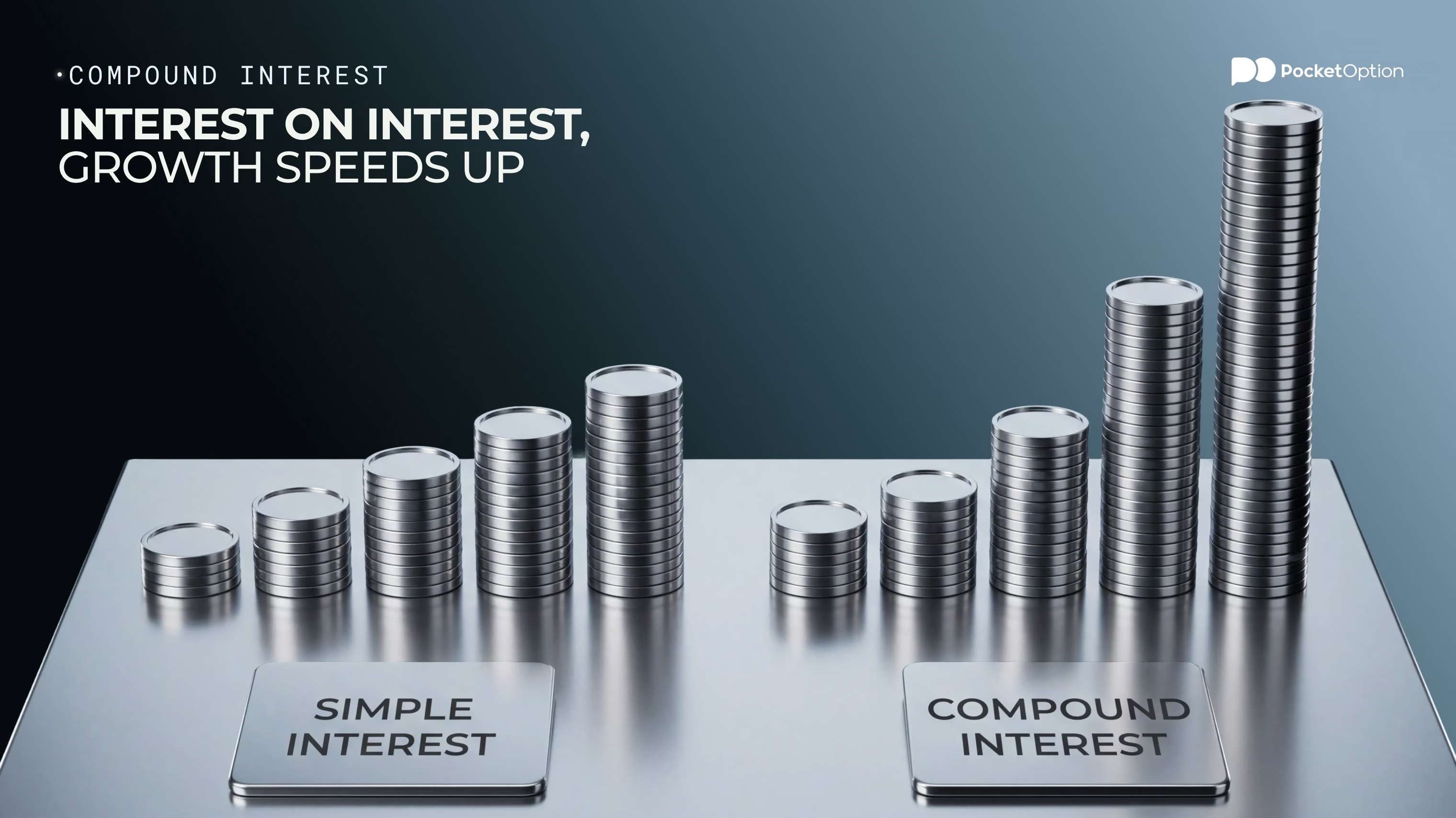
Compound interest is charged on the principal plus any interest already added, so the base grows over time: final amount = principal × (1 + rate ÷ n)^(n × years), where n is the number of compounding periods per year.
The same $1,000 at 5% for three years grows to $1,157.63 with yearly compounding and to $1,161.47 with monthly compounding. Daily compounding adds only about 35 cents more, so the extra gain shrinks as compounding becomes more frequent. On a debt, compounding works the same way against the borrower.
Interest Rate, APR and APY
Three figures are often confused:
Term | What it shows | Used for |
|---|---|---|
Interest rate | The basic yearly rate charged or paid | Loans and deposits |
APR (annual percentage rate) | The yearly cost of a loan including certain fees, without compounding | Comparing loans |
APY (annual percentage yield) | The yearly return including the effect of compounding | Comparing savings |
A savings account paying 5% compounded monthly has an APY of about 5.12%, and a loan with a 6% interest rate plus an upfront fee shows an APR above 6%.
How Interest Payments Work
On an amortizing loan, each fixed payment covers the interest due first, and the rest reduces the principal. On a $10,000 loan at 6% a year repaid monthly over three years, the payment is about $304.22. In month one, interest is $50 and $254.22 goes to principal; by the last month, interest is about $1.51.
Savings accounts work the other way: interest accrues daily or monthly and is credited to the balance at set intervals. Bonds pay interest as coupons, so a $1,000 corporate bond with a 4% coupon pays $40 a year, often in two payments of $20.
What Determines Interest Rates
For borrowers, the main factor is credit risk: a lender charges more when repayment looks less certain and less when the loan is secured by collateral, and longer terms usually cost more. For deposits and the wider market, rates follow the central bank's policy rate and expected inflation, which is why traders follow CPI data so closely. A fixed rate stays the same for the whole term, while a variable rate moves with a benchmark, so payments can rise or fall.
Other Meanings of “Interest”
Outside lending, the word has other uses. An interest can mean an ownership share, as in a 20% interest in a company. In derivatives markets, open interest is the number of futures or options contracts still open. In everyday speech, it simply means curiosity. This entry uses only the financial meaning: payment for the use of money.
Conclusion
Interest is the price of money over time: the borrower pays it, the lender or saver receives it, and principal, rate and time decide how much. Compare loans by APR and savings by APY, check whether interest is simple or compound and how often it compounds, and confirm whether a rate is fixed or variable before agreeing to it.
Start on a demo account.
Get StartedDisclaimer: This article is for informational purposes only and does not constitute financial advice. Trading involves risk, and losses can exceed initial deposits.
See more:Glossary