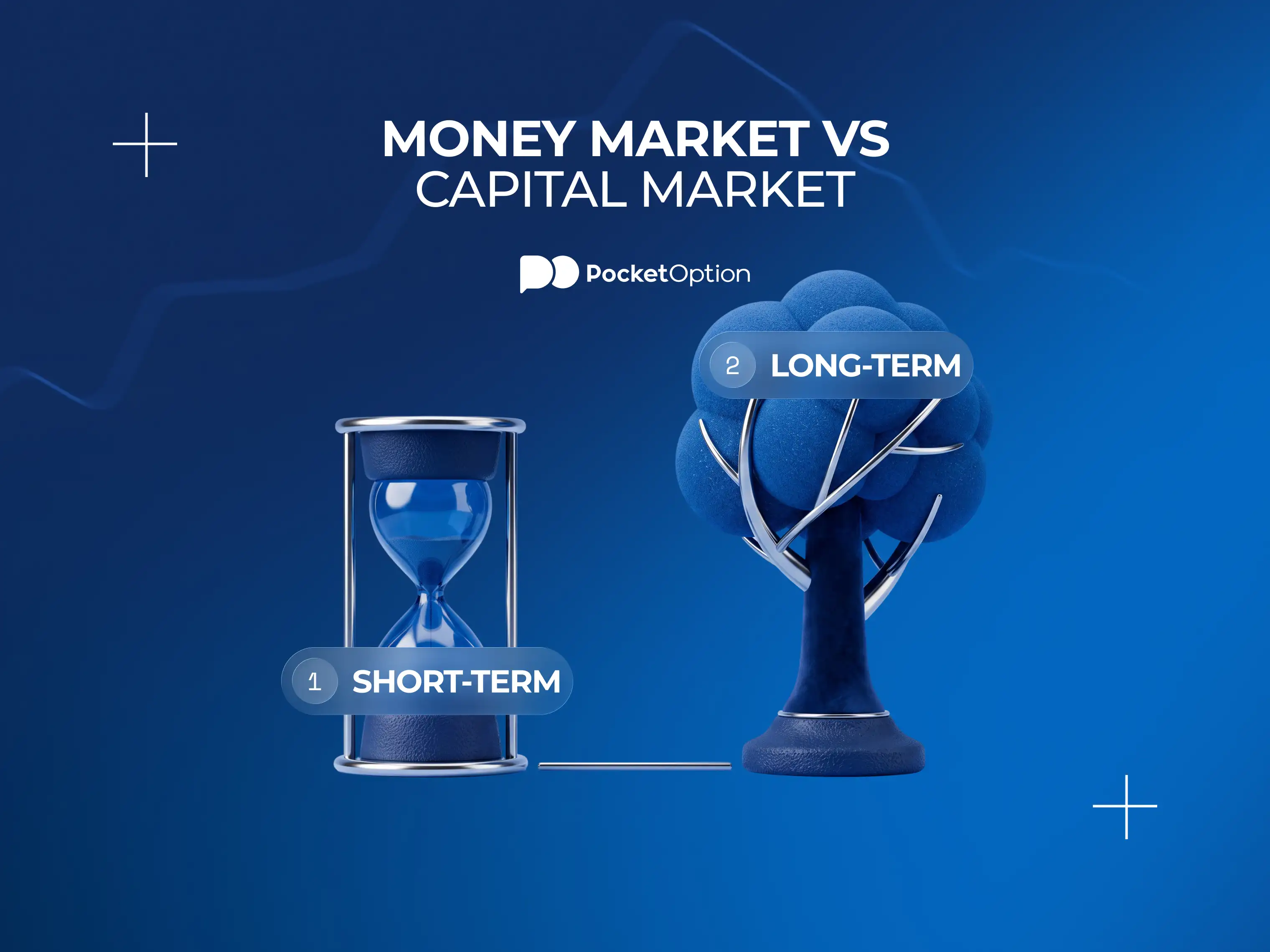
Money Market vs Capital Market: How Short- and Long-Term Instruments Translate into Pocket Option Assets
All financial instruments have their places on a time line. On one extreme are short-term investments, which are meant to mature in one year’s time and whose main considerations are safety and liquidity. On the opposite extreme are long-term investments, which have the objective of raising or putting out capital over a number of years and decades. The first category is known as the money market, and the second are the capital markets.

What Is the Money Market
The money market is that part of the financial system where short-term lending and borrowing occurs. The instruments that are traded in the money market are those that mature in a year or less, and in many cases considerably less than that.
The money market consists of mostly institutions, such as governments, banks, and corporations. The main objective of this market is the management of short-term liquidity, not to generate capital gains. The government uses treasury bills to finance its activities during the gap between two collections of taxes. A corporation will issue commercial paper to cover payroll expenses before its accounts receivables arrive. A bank will lend money overnight to a bank facing a shortfall in its reserves.
This difference in money vs capital markets is not just theoretical. This determines the behavior of the instruments, what influences their prices, and what kind of trading strategy to use in regard to them. The following article will reveal the difference between money market and capital market, identifies the instruments that define each one, and shows how the logic of short-term versus long-term translates directly into the assets and strategies available on Pocket Option.
What Is the Capital Market
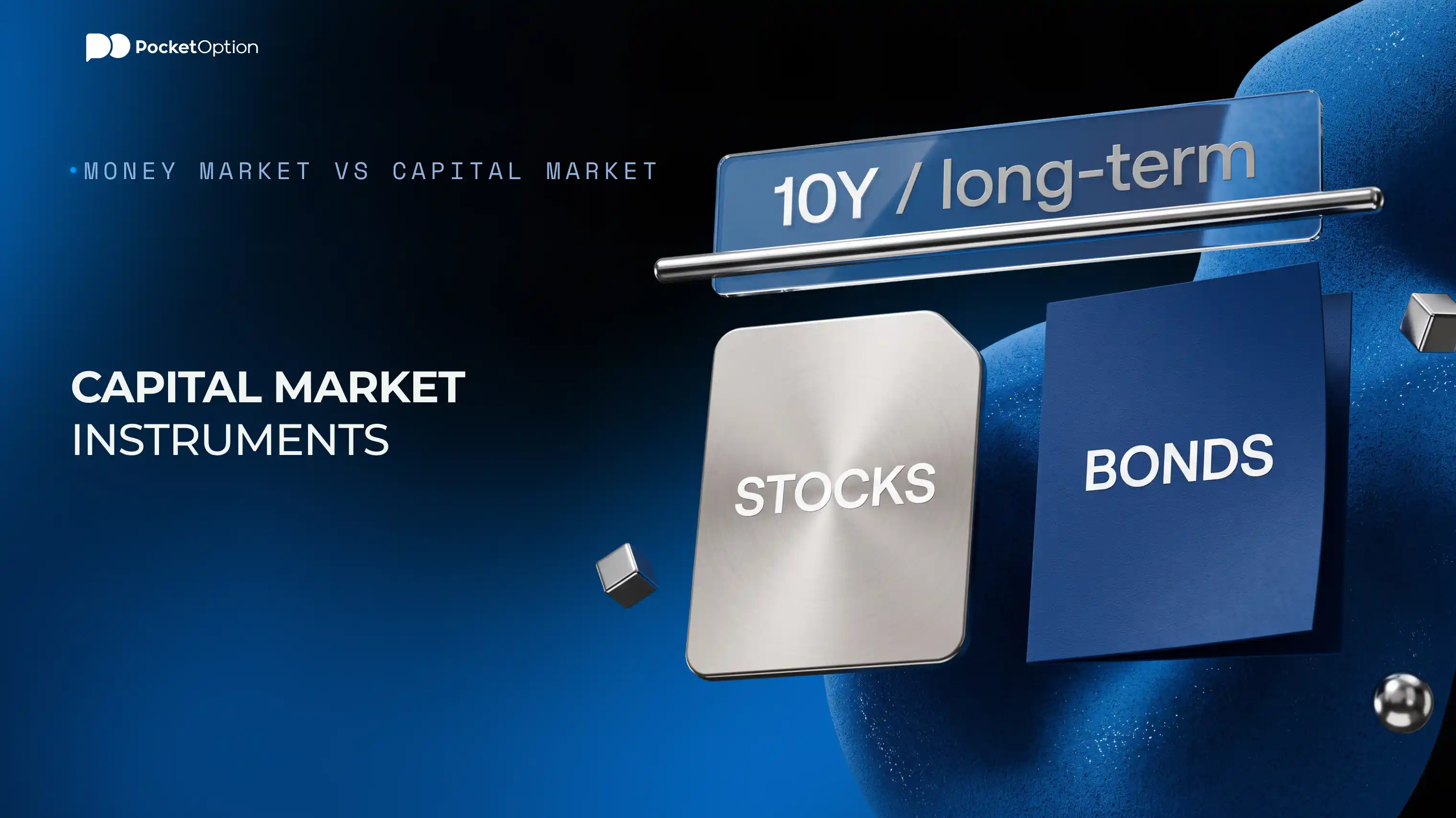
The capital market is the part of the financial markets where long-term securities are bought and sold. The stocks are listed on a stock exchange and bonds that mature after more than one year are typical capital market instruments. The role is entirely distinct from that of the money market - capital is raised for long-term investments.
In the case of issuing stocks by an organization on the stock exchange, they are raising capital through shares which will be held for many years to come rather than for a few days. In the case of issuance of a ten-year bond by a government, it is borrowing for the next ten years. All of these have a very different time horizon, risk profile, and expected return from the money market.
The capital market can further be subdivided into the primary market and secondary market. The retail trader basically works with the secondary market only.
Differences Between Money Market & Capital Market
Feature | Money Market | Capital Market |
|---|---|---|
Time frame | Less than one year (days-months) | More than one year (years-decades) |
Objective | Managing short-term liquidity | Raising long-term capital for growth |
Financial instruments | T-bills, commercial papers, repo agreements, CDs | Stocks, corporate & government bonds |
Risk level | Low | High (depends on financial instruments) |
Returns | Low (depends on yield) | High (capital gain & interest) |
Liquidity | High | Medium-high (equities high, some bonds lower) |
Major participants | Organizations, government entities, banks | Organizations, individual investors, traders |
Volatility | Low | Moderate to high |
The capital market vs money market distinction is not about which is better. It lies in which one would be suitable for the purpose. The former is suited to managing short-term liquidity while the latter is meant for wealth creation.
Money Market Instruments: T-Bills and Commercial Papers
A treasury bill is an instrument of short-term government borrowing at a discounted rate from its face value and repaid at par when it matures. A 90-day Treasury bill at $99.50 will be repaid at $100.00, thus earning an income of $0.50 in three months' time. The amount is small, but the risk associated with it is close to nil.
Commercial paper represents an unsecured short-term loan taken by companies to meet their immediate operational requirements. This can be anything from meeting wage expenses, stocking up inventory, and meeting accounts payable. The maturity period lies between 30 days and 270 days. There is an increased level of risk compared to T-bills, and the return takes care of this risk factor too.
Other money market instruments include CDs, repos, and banker’s acceptances. All of them share common traits.
Common Capital Market Instruments: Stocks and Bonds
Stocks reflect an ownership position in a business organization. They are traded on a stock exchange, have no specific maturity period, and earn income from capital gains (increase in price) and dividends (profits). There is more risk involved compared to money market securities due to changes in stock prices.
Bonds represent fixed-term securities with coupons. A corporate bond which has a 5% coupon and matures after 10 years pays 5% coupon every year and returns the principal amount on maturity. There are risks associated with bonds: government bonds are relatively safe while corporate bonds have the risk of defaulting, which is higher for financially weak firms.
What Pocket Option Assets Make Sense From a Short-Term Perspective
Pocket Option currency pairs best reflect the logic of the money market. The forex markets are motivated by interest rate differentials, central bank actions, and economic figures. These are exactly the factors which motivate the money market. A trade in EUR/USD for hours or days is influenced by the exact same factors as T-bill interest rates and interbank rates.
Quick Trading is a feature on Pocket Option in which one trades fixed-expiration contracts for seconds and minutes. This is the shortest duration available for trading on this platform and is ideal for those traders who would like to assess their reactions to fast-moving prices.
On one of the best trading platforms for retail
Get StartedWhat Assets of Pocket Option Suit Long-Term Approach?
The equity-based assets, commodity-based assets (such as gold, oil), and index-based assets (like S&P 500, DAX) available on Pocket Option are the most similar to the capital market approach. These assets are affected by long-term trends: corporate performance, supply-demand dynamics, macro cycles, and investors' sentiment on a weekly/monthly basis.
Trading using the MT format in Pocket Option, which is characterized by unending positions with manual stop-loss and take-profit control, is more appropriate for these types of assets. The trader can remain in the trade for days or even weeks as he adjusts according to the changing fundamental scenario.
Matching Trading Strategies to Correct Time Frame
The money market and capital market distinction should inform how a trader selects instruments and strategies on Pocket Option:
Short term (based on money market logic): forex pairs, Quick Trading, scalping and day trading strategies, 1-minute to 1-hour time frames, tight stops, quick exit.
Intermediate (based on capital market logic): stock contracts, commodity contracts, indices positions, MT-based trading, swing trading strategies, 4-hour to daily time frames, wider stops, patience.
Combining both time frames without knowledge of that fact may be one of the main sources of confusion. For example, a trader uses a 5-minute scalping strategy on a commodity contract based on monthly supply data. He works on an incorrect time frame.
Paper trading and backtesting
Try Demo AccountConclusion
Money market vs capital market is one of the basic classification systems in finance. It draws the line between instruments meant for short term liquidity and those meant for long term growth, and the classification is applicable in trading as well: the tradable assets available on Pocket Option fall into both categories and the chosen strategy should be aligned with this categorization.
Currency pairs are money market instruments as they are governed by interest rate differences and short term information. Stocks, commodities, and indices are capital markets instruments as they are governed by fundamental cycles. Knowing how the instrument works is the first step towards picking the appropriate timeframe and strategy.
Begin by using the demo account. Try out both horizons. Let the information from your journal tell you which works for your personality and has good expectancy.
Join the community
Sign Up TodayRisk Disclaimer: None of the details presented in the article should be construed as financial advice. Trading carries high risk, and you can lose all of your deposited money. The categorization of the instruments as money market instruments and capital market instruments is for educational purposes only and does not mean that the instrument suits your trading style. Past performance is no guarantee of future success.
See more:InterestingTrading Strategies