What Does Amortisation Mean and How Is It Applied in Finance?
Amortisation means spreading a cost or a debt over time. The word turns up in two places: loan repayments and accounting for intangible assets. Both follow the same idea of reducing a value in planned steps.

What Does Amortisation Mean: Two Contexts
The amortisation meaning depends on where you meet the word:
Loan amortisation: paying off a debt through regular payments that cover both interest and principal.
Asset amortisation: writing down the cost of an intangible asset over its useful life.
You'll also see the US spelling, amortization. It's the same word.
Amortisation of Loans: Splitting Principal and Interest
With an amortising loan, you pay the same amount each period. Early payments are mostly interest, later ones mostly principal, and the final payment brings the balance to zero.
Take a $10,000 loan at 6% a year, repaid over 12 months. The monthly payment is about $860.66. In month one, interest is $50 (0.5% of $10,000), so $810.66 goes toward the balance.
Many bonds work differently, paying only interest until maturity, as this guide to corporate bonds explains.
Amortisation of Intangible Assets
Intangible assets have value but no physical form: patents, software licences, copyrights. When a company buys one, it spreads the cost over the asset's useful life instead of expensing it at once.
Each year's charge is booked as amortization expense, and the asset's balance sheet value falls by the same amount. Some analysts strip intangibles out altogether, as this explainer on debt to tangible net worth shows.
The Amortisation Formula
For intangible assets, most companies use the straight-line method. The amortization formula is:
Annual amortization expense = (Cost - Residual value) / Useful life
Residual value is usually zero for intangibles. Useful life can be shorter than legal life: a patent may be protected for 20 years but useful for only 5.
A Worked Example with Amortisation Schedule
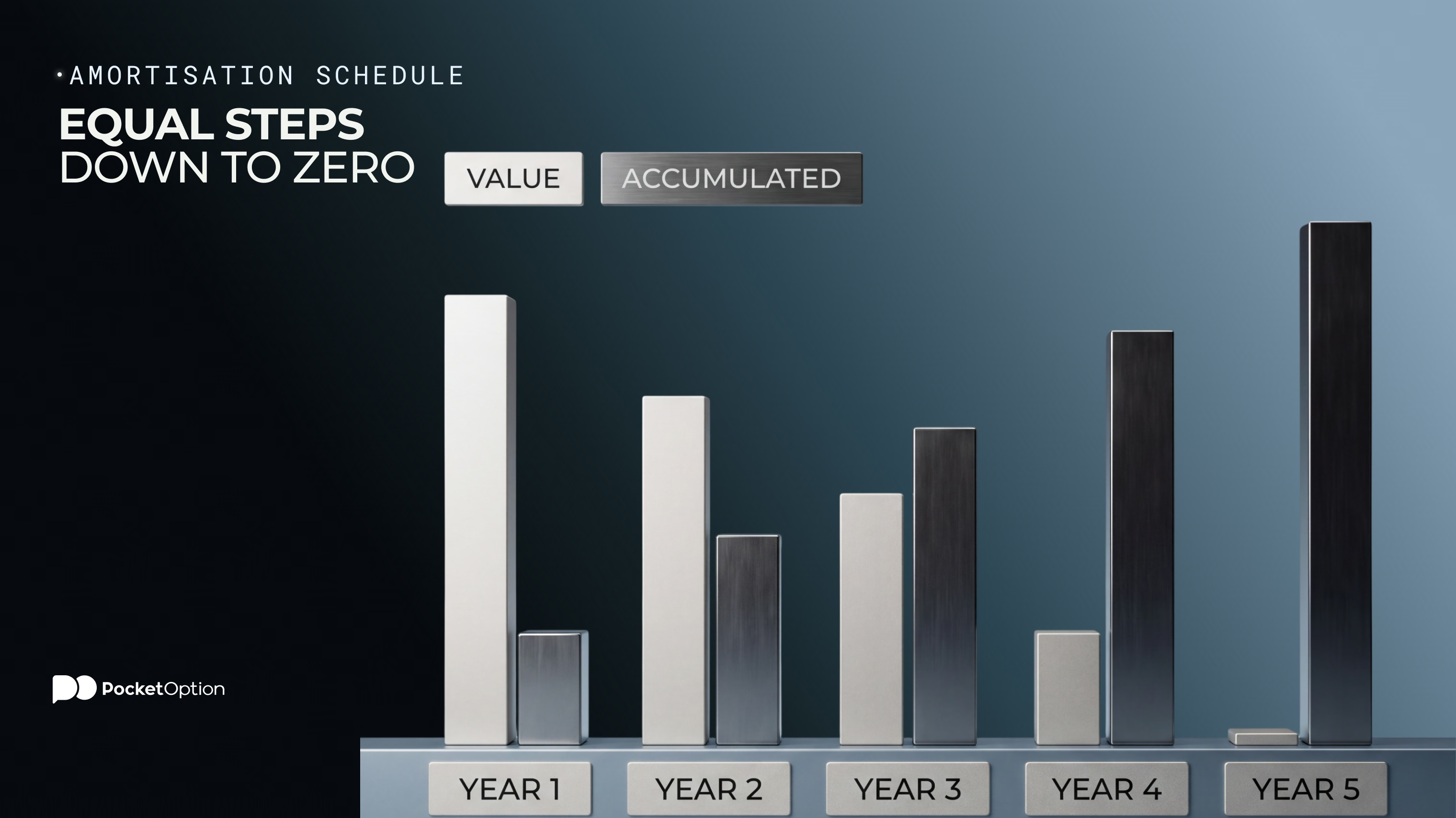
A company buys a patent for $100,000. It expects to use it for 5 years, with no residual value. The yearly charge is ($100,000 - $0) / 5 = $20,000.
So what is an amortization schedule? It's a table that shows how the value is written down period by period. Here's the one for this patent:
Year | Opening value | Amortisation | Accumulated | Closing value |
|---|---|---|---|---|
1 | $100,000 | $20,000 | $20,000 | $80,000 |
2 | $80,000 | $20,000 | $40,000 | $60,000 |
3 | $60,000 | $20,000 | $60,000 | $40,000 |
4 | $40,000 | $20,000 | $80,000 | $20,000 |
5 | $20,000 | $20,000 | $100,000 | $0 |
A loan schedule looks similar, with columns for interest, principal and balance. The amortization schedule definition is the same in both cases: a period-by-period record of a balance shrinking to zero.
Amortisation vs Depreciation: Key Differences
Both spread a cost over time, but they apply to different assets.
Feature | Amortisation | Depreciation |
|---|---|---|
Asset type | Intangible: patents, licences, software | Tangible: buildings, machinery, vehicles |
Residual value | Usually zero | Often included |
Common methods | Mostly straight-line | Straight-line, declining balance, units of production |
Rules also differ by region. Under IFRS, and for most US public companies, goodwill isn't amortised but tested for impairment. UK companies reporting under FRS 102 do amortise it, and US private companies can elect to. Tax rules differ again by country. To see how company results feed into share prices, read this simple guide to how the stock market works.
Conclusion
Amortisation is about spreading a value across time, whether that's a loan you repay or an intangible asset you write down. The formula is simple, and a schedule makes every step visible.
Know what drives reported profit.
Get StartedWhen you read company results, check how much of the costs are amortisation. It's a non-cash charge, so profit can look weaker than cash flow.
Disclaimer: This article is for informational purposes only and does not constitute financial advice. Trading involves risk, and losses can exceed initial deposits.
See more:Glossary