Non-Deliverable Forwards: How Cash-Settled Contracts Work for Restricted Currencies
Some currencies can't just be easily bought, they are restricted. For those, the market often settles forwards in cash, through paying out only the gap between an agreed rate and an official fixing. Those are so-called ‘non-deliverable forwards’, and it can be important in forex to understand exactly how those operate.

What Is a Non-Deliverable Forward (NDF)
A non deliverable forward is a currency forward where the two currencies in fact don’t change hands. Two parties agree for a rate today, to use at some point down the line (same as for a regular forward). But when that date comes, this agreed rate is held up next to an official reference rate. Whichever side is out of the money, pays the other one the difference. This difference quite often is paid in US dollars, and not in the actual currencies.
So the short answer to what is NDF comes down to it being a forward that settles up the gain or loss, and skips the handing-over part. In actuality here, nobody gets sent rupees, rubles, won, or reais. The only ‘moving’ currency is a freely convertible one, that pays the difference. Restricted currencies are merely used as the measuring stick. This way, the settlement still comes, and there’s no need to risk anything from regulators, governments, or other restricting parties.
To look up the basics, you can read our introduction to forward trading first. What NDFs add on top here is the cash-only settling layer in ‘normal’ currency, and the fixing rate.
Why NDFs Exist for Restricted Currencies
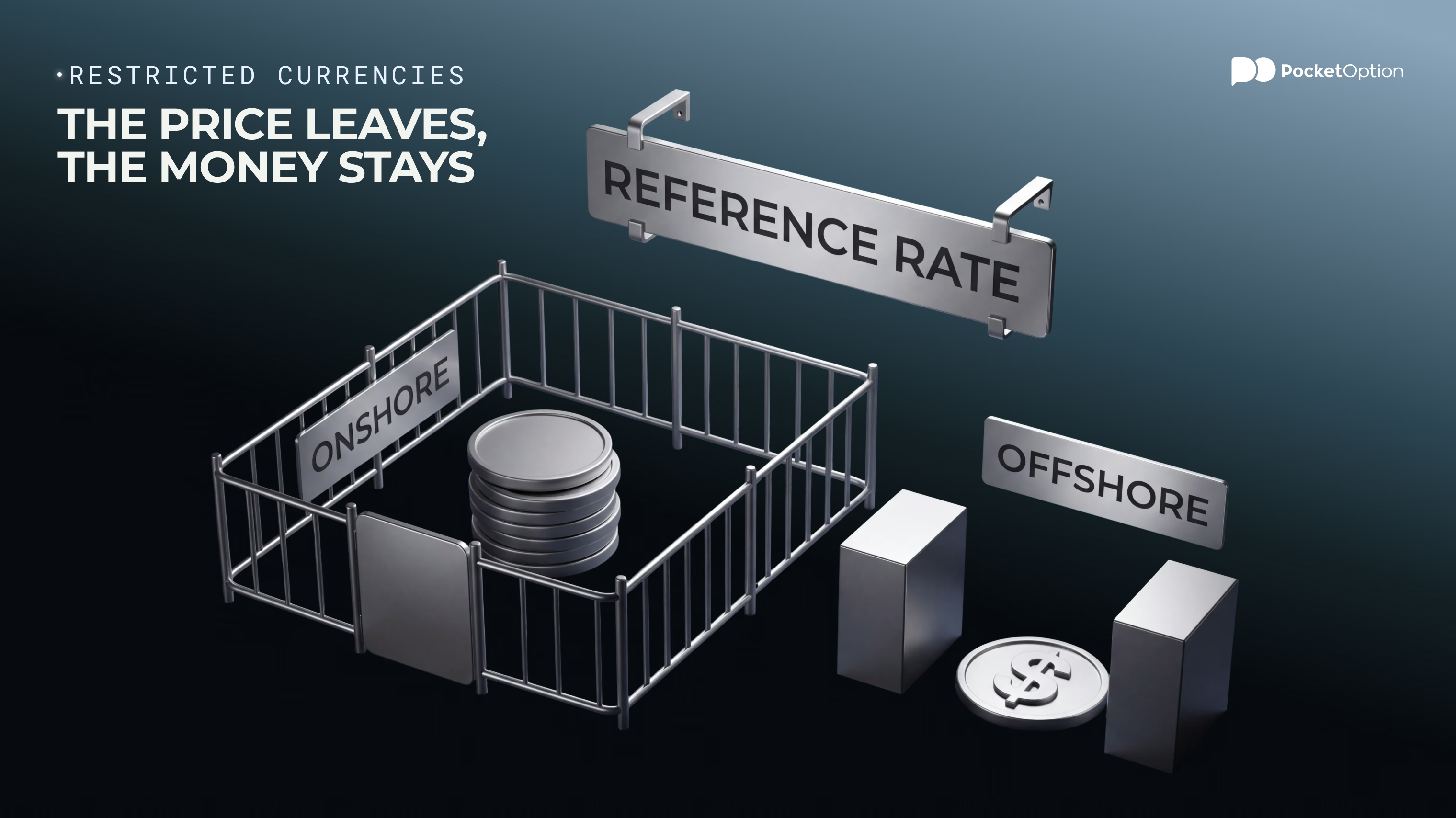
A deliverable forward needs the currency itself to be there at the end of it. Some of those currencies are a problem. The local money can be not available, or highly restricted. A fund in London that sits on Indian bonds, for instance, might not want (or be capable of) buying rupees forward onshore.
So the NDFs are the way around it. Nothing needs to be delivered, the currency that’s restricted doesn’t have to change hands. The contract works perfectly fine with just a reference price for such currency. And the two parties (who may both be offshore) just settle the difference in EUR, GBP, or USD. That's how some restricted currencies, called non deliverable currencies, get to actually participate in global markets, without anybody laying a finger on them.
Key Contract Terms: Notional Amount, NDF Rate, Fixing Date
Every NDF gets pinned down with a few terms when the trade is agreed upon, such as:
Term | What it means |
|---|---|
Notional amount | The size of the contract (usually in USD). It’s not exchanged, it only scales the settlement. |
NDF rate | The forward rate agreed upon on the trade date. For instance, 88.00 rupees per dollar. |
Fixing date | The day the official reference rate is read. |
Fixing rate | The official spot reference rate on the fixing date (from a source that’s stated in the contract). |
Settlement date | The day the net payment will have to be made. |
Settlement currency | The non-restricted currency the difference is paid in (usually USD). |
How NDF Settlement Works Step by Step
From trade to payment, NDFs go through such stages as:
The trade gets agreed upon. Such terms as notional, NDF rate, fixing date, etc, are all named in the contract.
Nothing moves, till the fixing date. No payments usually fall due beforehand.
On the fixing date, the official reference rate gets read.
The gap between NDFs rate and fixing rate is multiplied by the notional. Thus, a gain or a loss in the restricted currency is made clear.
That gain or loss gets turned to dollars (at the fixing rate).
On the settlement date, a few days after the fixing date, the losing side pays the winning one that dollar sum, and thus the contract is completed.
The formula for figuring out actual settlement sum goes like this:
Settlement (USD) = (Fixing rate - NDF rate) x Notional / Fixing rate
A positive result here gets paid to the party who bought dollars forward. A negative one gets paid by that party to the side that sold dollars forward. In reality this is simpler than the complex name of non deliverable forward may suggest.
A Worked Example: USD/INR Settlement
Figures below are just for show, not current market levels. Picture a company outside India due to be paid in rupees by a local customer in three months and wanting cover in case the rupee weakens. As it can't easily get at an onshore forward, it buys dollars and sells rupees through a three-month USD/INR non deliverable forward.
Terms are a notional of $1,000,000 and an NDF rate of 88.00 rupees per dollar, fixing off the official reference rate two business days ahead of settlement.
Say the rupee goes soft and the fixing comes in at 88.90. The dollar now buys 0.90 rupees more than agreed, so on the notional that's a gain of 900,000 rupees for the company. Turned into dollars at the fixing, 900,000 split by 88.90 comes to $10,123.73, and the bank on the far side pays the company that sum on the settlement date.
Meanwhile the rupees coming in off the customer are worth less in dollars, by roughly the same amount. Gain happens on the NDFs, and loss on the business side, the two more or less cancelling each other out. That's the hedge doing what it was supposed to do.
Now flip it around. The rupee goes up, the fixing lands at 87.40. The sum goes (87.40 - 88.00) x 1,000,000 / 87.40. This comes out to minus $6,864.99. So the company has to pay the bank $6,864.99. Its rupee takings are now worth more in dollars, and that covers the payment, give or take. The hedge took away the upside, but it also pretty much nullified the downside. This is exactly the trade-off any forward should make.
Which Currencies Commonly Trade as NDFs
The busiest NDF currencies are mostly found in Asia and Latin America. In BIS turnover surveys the Korean won, Indian rupee, Taiwan dollar and Brazilian real have tended to sit at or near the top, with the Chinese yuan, Indonesian rupiah and a few more behind them. The NDF currency list below covers the ones quoted often, plus the reference each one usually fixes off.
Currency | Code | Region | Typical fixing reference |
|---|---|---|---|
Chinese yuan (onshore) | CNY | Asia | PBOC daily central parity (Reuters page SAEC) |
Indian rupee | INR | Asia | FBIL reference rate |
Korean won | KRW | Asia | Seoul market average rate (Reuters page KFTC18) |
Taiwan dollar | TWD | Asia | Taipei Forex Inc. fixing (Reuters page TAIFX1) |
Indonesian rupiah | IDR | Asia | Bank Indonesia JISDOR rate |
Brazilian real | BRL | Latin America | Central bank PTAX rate |
Chilean peso | CLP | Latin America | Central bank observed dollar rate (dólar observado) |
Colombian peso | COP | Latin America | Official market rate (TRM) |
Take the table as a snapshot and not a rulebook. Which of the non deliverable currencies count as NDF currencies at any one time shifts about as capital controls tighten or loosen, and fixing sources get swapped out now and then (the rupee moved from an RBI rate over to the FBIL rate in 2018). What any given bank offers can change too, so the contract terms always win out.
NDFs vs Standard Deliverable Forwards
On the pricing end, the two are close to being identical. A deliverable forward's rate comes off the spot rate and the interest rates in the two currencies, the tie-up laid out in this explainer on how rate differentials link spot and forward rates, and NDF rates set off from the same place.
Where they part ways, though, is around the price. A deliverable forward has both full amounts changing hands. A $1,000,000 contract would mean that a million dollars will be heading off one way, and the full value in the other currency will be heading back. Meanwhile, a non deliverable forward has to complete just one payment, and often a small slice of the notional, at that. The difference gets paid from the losing side to the winning side, and that’s about it.
This simplified process makes NDFs lighter on settlement risks, and easier usable offshore, which is part of the point.
How Businesses Use NDFs to Hedge Currency Exposure
Most NDF users have got a currency exposure they can't hedge onshore, or can't hedge cheap. Typical cases go like this:
An exporter outside Brazil, billing in reais, locks a dollar value in for payments due next quarter.
A fund sat on Korean or Indian bonds hedges the currency part of the return, so what's left over is mostly the bond part.
A multinational whose subsidiary earns in a restricted market, wanting to know what those profits will be worth in dollars before they get sent up the chain.
Banks covering the NDFs they've written up for clients? A sizeable slice of the volume, as it happens.
Common thread is the business keeps changing its real money onshore at whatever spot rate applies, and the non deliverable forward runs alongside as a separate, offsetting contract in dollars. If the fixing tracks the rate the business really converts at, gains and losses on the two roughly cancel each other. If it doesn't, a bit of the risk is left over, and that leftover is worth sizing up before the hedge goes on.
Risks of Using NDFs
An NDF hedge still carries market risk on the contract proper. If the currency goes the other way from what the hedge guards against, the NDF loses money, sometimes a good deal of it, even whilst the business side gains. That's all fine for a hedger sat on the matching exposure. For anybody using an NDF as a stand-alone position, it's an open bet on a currency that capital-control decisions can shove about overnight.
Counterparty risk comes down to most NDFs trading over the counter. If the other side goes under ahead of settlement, the gain on the contract might never get paid. Clearing has spread since the rules brought in after 2008, and a good many NDFs between big banks get cleared now, but plenty of client trades still don't.
Then there's fixing and basis risk. Payout hangs off one published number on one day. If the fixing is held up, messed about or replaced, the fallback terms kick in, and if the fixing differs from the rate the business really gets onshore, the hedge won't fully cover the exposure. The position-sizing and limit-setting habits in this guide to controlling risk when trading cryptocurrencies come out of a different market but carry over well enough, the core question being the same one, how much can go before the position gets shut.
Conclusion
Strip a non deliverable forward right down and it's one number checked against another on one morning: 88.00 agreed, 88.90 published, $10,123.73 paid over in dollars a couple of days after. Not one rupee moved at any point. That lone payment is the whole contract, which is how come the fixing source, wrote into the confirmation on day one and scarce looked at again, ends up mattering more than anything else in it.
Virtual funds, real market behavior.
Try DemoDisclaimer: This article is for informational purposes only and does not constitute financial advice. Trading involves risk, and losses can exceed initial deposits.
See more:Education