Capitalization Rate Meaning: How Cap Rate Works in Real Estate and What It Tells Investors
Two buildings can carry the same price tag, but still pay out very different amounts. Cap rate is the one number that shows that gap, before anything else gets looked at. This is an important metric to understand in real estate.

What Is Capitalization Rate: Definition
The capitalization rate is the yearly income that a property brings in, held up next to what the property is worth. This is not complicated, but is rather important. Ask what does cap rate mean and the short answer is, it’s a yield that this asset is currently giving you.
This metric mostly gets used as a sorting tool. You intend to get, let’s say, 6-8% cap rate, not higher (too risky), and not lower (too low yield). Then you go through nine listings in one afternoon, and throw out the ones that do not clear some rough threshold, and only then start reading leases and choosing which one fits the best. What is a cap rate good for is narrowing the pile down, not for final settling anything.
Cap rate meaning shifts a little depending on who is using the metric. An appraiser treats it as a market number, pulled out of recent sales nearby. A private buyer, though, may treat it as a rough return figure on money they are about to spend. Same sum either way, but different reason for calculating it out. Rather similar logic sits under a risk reward ratio on a trading screen (just with different inputs feeding it).
Plenty of people that are searching for what is capping in real estate also land on cap rate explanations, by mistake. It’s valuable to know that ‘capping’ is something else entirely. It’s a commission arrangement inside a brokerage, where an agent pays the firm a fixed amount over the year and keeps the rest above it. It has nothing to do with yields, even though ‘cap rate’ and ‘capping’ sound similar.
The Cap Rate Formula
The capitalization rate formula is short:
Cap Rate = (Net Operating Income / Property Value) x 100
Property value is established at the purchase price, so it’s usually easy to get. ‘Net operating income’ is where all the work lies. Here, you need to calculate the rent, plus include any other money the building may collect over a year period, less what it costs to run. Mortgage payments do not come off from this number. Neither does depreciation, or your personal tax. Which is deliberate, as the cap rate formula is built to describe the building and not its owner.
What belongs in operating expenses here:
Property taxes, insurance
Management fees
Repairs and upkeep
Utilities the owner picks up (rather than the tenant)
A vacancy allowance, or a credit loss line.
What stays out is loan interest, principal, income tax, and big capital items such as new roof. Taxes, insurance, management, repairs, they all come off before the number means much at all. Two people can look at one building and land on different NOI figures anyway, because one of them counted a management fee (that nobody actually pays), and the other one did not bother.
Step-by-Step Calculation Example
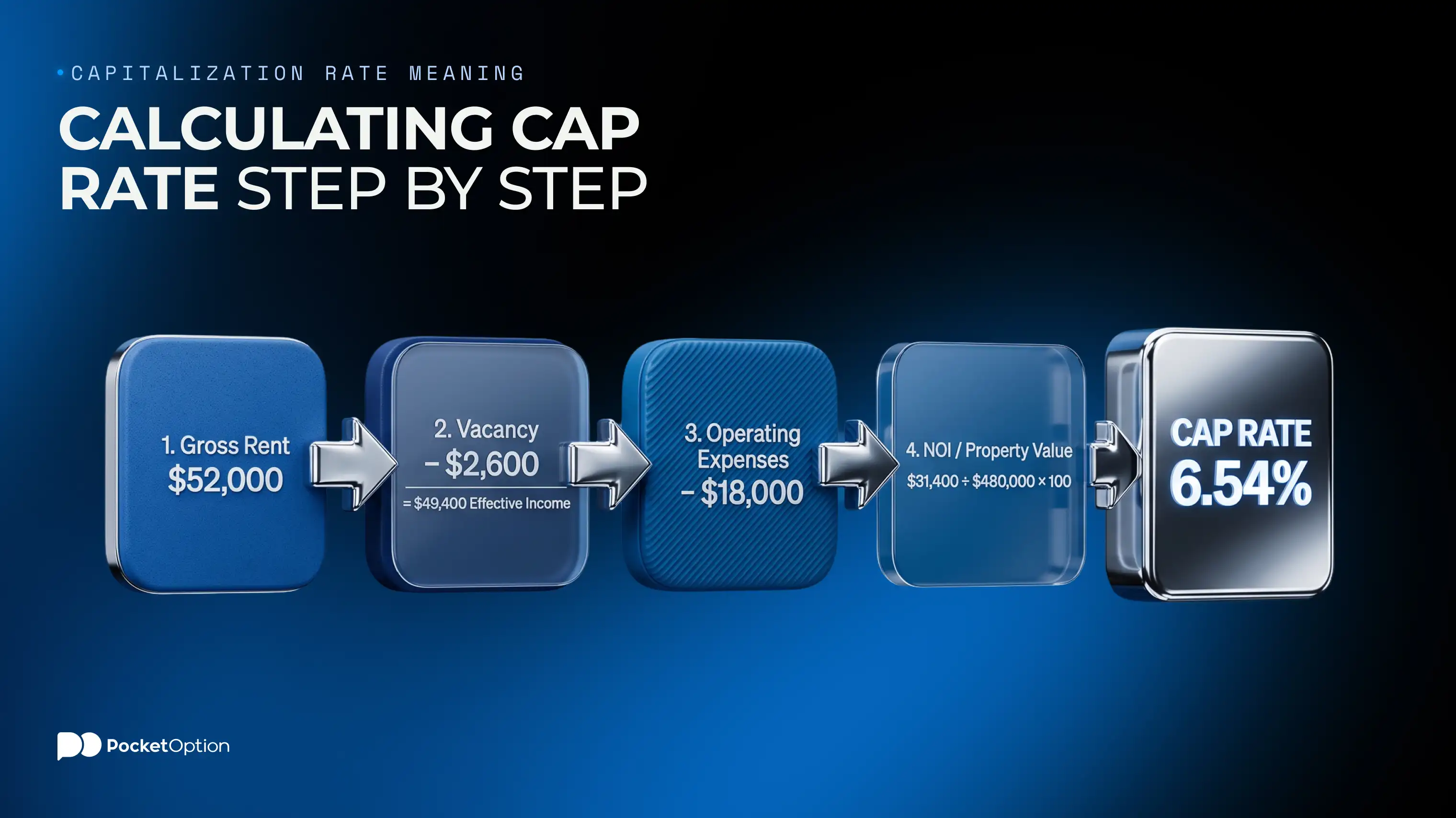
Let’s calculate cap rate for small apartment building, with asking price of 480,000 dollars.
Calculate possible gross yearly rent. Six units at $720 a month would be $51,840, so let’s say $52,000 is possible.
Take off vacancy time. Five percent vacancy rate is minus 2,600 to your earnings. This would leave us $49,400 of effective income.
Add up what the building costs to run. Taxes are $7,200, insurance is $2,400, management $3,900, repairs and upkeep around $4,500. Total $18,000.
Subtract upkeep from gross income. 49,400 - 18,000 gives net operating income of $31,400.
Split this by the price of the building, and finally multiply by 100 to get the percent value. 31,400 divided by 480,000 comes out at 0.0654, so it’s 6.54 percent.
So what is the capitalization rate on this building? Here, it’s 6.54 percent, which is about average for the developed world. If this is not a risky investment, then it might be worthwhile to look at buying it. If the cap rate turned out to be at 2.5 percent, this would be a different story entirely: in the best case, this investment would pay off for you in 40 years.
This is how to calculate cap rate start to finish. Also, calculating cap rate backwards works just as well. If buildings of that sort in that area are trading near 6.5 percent rate, and the NOI is 31,400, then 31,400 divided by 0.065 puts the rough value of a building at around $483,000. Appraisers do this constantly, to understand the price they should put on real estate.
What a High Cap Rate Signals
‘High’ is relative, of course. Eight or nine percent in a market where everything else changes hands at five is rather high. But the first question in this case is always ‘why’. There can be a multitude of reasons for such suspiciously high figures, like:
Demand in the area is slipping down, current rents are not expected to hold
The tenants are shaky: they have short leases, or there’s one large tenant who could walk away
The building is old and a large repair bill is due
The property carries more risk by nature, possibly from some insurance situation, like a wildfire hazard, or from being in a rough neighborhood.
A high number in cap rate real estate terms is the market pricing risk in. Buyers want more income per dollar, because they’re not sure that this level of income is dependable. Occasionally they are wrong, and the thing really is mispriced. But quite often the discount is there for a reason, and so you shouldn’t ignore it.
This is also part of why a spread of real estate investment trusts appeals to people who want property exposure without running this analysis building by building. Sometimes risks are there, but it’s hard to understand what the specific risks are, and so the entire thing gets left to professionals with high-grade analytic tools to figure out.
What a Low Cap Rate Signals
Low cap rate shows the potential returns (the yield) is not great. But there should also be reasons for that. Like, having rate of just 3-4% often means buyers are rather confident, think this is a very low-risk investment, and are competing with each other to park their money in this area.
Prime city locations in respectable, safe countries are usually at around this level. Newer buildings with long leases and good tenants. Money is paying up for the calm and the safe.
The catch is that a low cap rate leaves no cushion to you. If rents drop, tenants leave, or expenses pile up, this 3% yield may drop and turn into something that no longer covers the loan you got to buy the building, for example. High cap rate assets often have room to soak up a bad year. But low cap rate assets mostly do not, so they are relying on the ‘bad year’ to never show up.
Cap Rate vs Cash-on-Cash Return
These two metrics get mixed up a lot. The main difference between them is, cap rate ignores your financing. Cash-on-cash return is the opposite, and mostly about your financing.
Cap rate puts NOI over the full price of the property. Meanwhile, cash-on-cash puts your cash flow after the mortgage first (over the actual cash you handed across at closing).
Take the same building, worth $480,000. It has NOI of 31,400. If you pay cash, the two numbers sit close. But say if you put 25% down instead (~$120,000 upfront), borrow the rest, and carry a loan of $23,000 a year. Now your cash flow (after debt) is just $8,400 here. Against $120,000 of your own money that would be a 7%, which is above the 6.54% base cap rate. Large difference!
Metric | What it measures | Financing included | Time frame |
|---|---|---|---|
Cap rate | Yield on the asset itself | No | One year, as it stands |
Cash-on-cash | Yield on the cash you put in | Yes | One year, as it stands |
IRR | Annualised return across the hold | Yes, if modelled | Whole holding period |
Gross yield | Income before costs, over price | No | One year, as it stands |
Cap Rate vs IRR
Cap rate covers one year. IRR covers the whole hold, so it is a different animal.
IRR takes every cash flow, the purchase, the rent each year, the capital spending, and even the eventual sale. Then it finds the actual annual rate that makes all of it balance out. That’s why a property can show a modest cap rate, but a strong IRR (if you sell it higher, for instance). Or do the reverse: decent cap rate, but poor IRR. This can happen if the income was fine, but the asset ended up being worth less at the end, than it was at the start.
Value at risk and methods like it exist partly for this reason, too. People know that point estimates on their own tend to flatter the plan. IRR has to ‘bake in’ assumptions about the future that nobody can predict perfectly, like the price you’ll actually be able to sell the unit for. Cap rate though has the opposite problem: it is telling you a significant amount about today’s potential earnings, but is not as clear about everything that may come after.
Cap Rate vs Gross Yield
Gross yield is the ‘crude’, unpolished version of the metric. Annual rent over price, with nothing taken off yet.
Let’s take our previous example. $52,000 over $480,000 means the yield is 10.8% gross. The cap rate on that same building came out at 6.54% though. That difference, more than four points of it, is what running the place actually costs, year over year.
For a first glance at a listing site, gross yield is fine. But it slowly falls apart when two buildings with different expense profiles get compared. For example, property where the tenant pays everything, vs the one where the owner pays for everything. They both can show an identical gross yield, but real returns over a long period of time are nowhere close to each other.
Virtual funds, no capital at risk
Open Demo AccountConclusion
Our 6.54% number discussed in this article came from one building at one asking price. If the seller drops the price of the real estate to $440,000 tomorrow, the exact same income now becomes 7.1% instead. The rate moved because the price moved. This is what a cap rate can imply: if what somebody is asking lines up well with what the building actually can earn. For real estate transactions aimed at profit, this metric becomes rather important.
Disclaimer: This article is for informational purposes only and does not constitute financial advice. Any investment carries risk, so DYOR before purchasing anything.
See more:Education