5 Pocket Option Payment Methods: which one will you choose?
You've made your decision to use this platform. The only problem is to determine whether your chosen way of transferring money is supported. This article shows you all the five categories of Pocket Option payment methods, what kind of deposit they suit, the minimums, and one withdrawal requirement that may become unexpected for you. It also answers the question about whether PayPal works for the platform, so you won't have to wait for the end of the article.

Overview of Pocket Option Payment Methods
There are more than 140 payment options that can be used to deposit on the platform. The total number may seem too large to be useful until you realize that they can be divided into five groups and you have to choose only one of them.
Category | Examples | Typically suits |
|---|---|---|
Cards | Visa, Mastercard, Apple Pay | A first deposit, something familiar |
E-payment services | Volet.com, WebMoney | Separation of trading funds from the bank account |
Cryptocurrency | Bitcoin, Ethereum, Tether, Solana | Speed and bank bypass |
Local payment systems | UPI, SPEI, M-Pesa, MTN, Airtel, Wave | Payment in the native currency without conversion |
Bank transfer | Transfers in several currencies | Large amount of money and nothing else fits |
Two numbers work for all five categories. The minimum deposit starts at $5, and deposits from the list on the platform's payment page are displayed with 0% commission. The list is not identical in every region, so the five categories are much more important than the logos themselves.
One more thing to check before you dive deeper: Pocket Option does not provide its services to residents of the EEA countries, the USA, Israel, the UK, the Philippines, Japan and Brazil. If you live in any of these, you don't have to solve the problem of the payment method at all.
Method 1: Debit and Credit Cards
Most people start with cards, since all the details are in your wallet and you don't need to create anything.
Visa and Mastercard cards are supported, and Apple Pay appears along with them for those who would rather not enter a card number. Deposits are usually credited quickly, so cards are the default option for the first deposit.
Two facts that should be noted: the card should be in your name, since the platform checks the ownership of the payment method. Also, some banks consider deposits to trading platforms as cash-like transactions, so you have to check the policy of your bank.
This article sticks to the comparison level. For more details you can find a dedicated article on how to deposit money with a debit card.
Method 2: E-Wallets
The main idea of e-payment services is that they sit between your bank and the platform, and that is their selling point.
Volet.com and WebMoney are the two e-payment services that stick out. You charge the wallet once and make transfers to and from the platform without involving your bank account. It is the neatest solution among the Pocket Option deposit methods for those who prefer to keep trading funds in a separate place.
The trade-off is an additional account to manage, with its own verification and its own fee schedule. That schedule belongs to the wallet provider and not to Pocket Option, so you have to read it on the wallet's website rather than assume that 0% commission on deposits makes the whole journey free.
Also, e-wallets are usually the most convenient way to withdraw, for one simple reason that will be discussed further: you usually withdraw in the same way as you made a deposit.
Method 3: Cryptocurrency
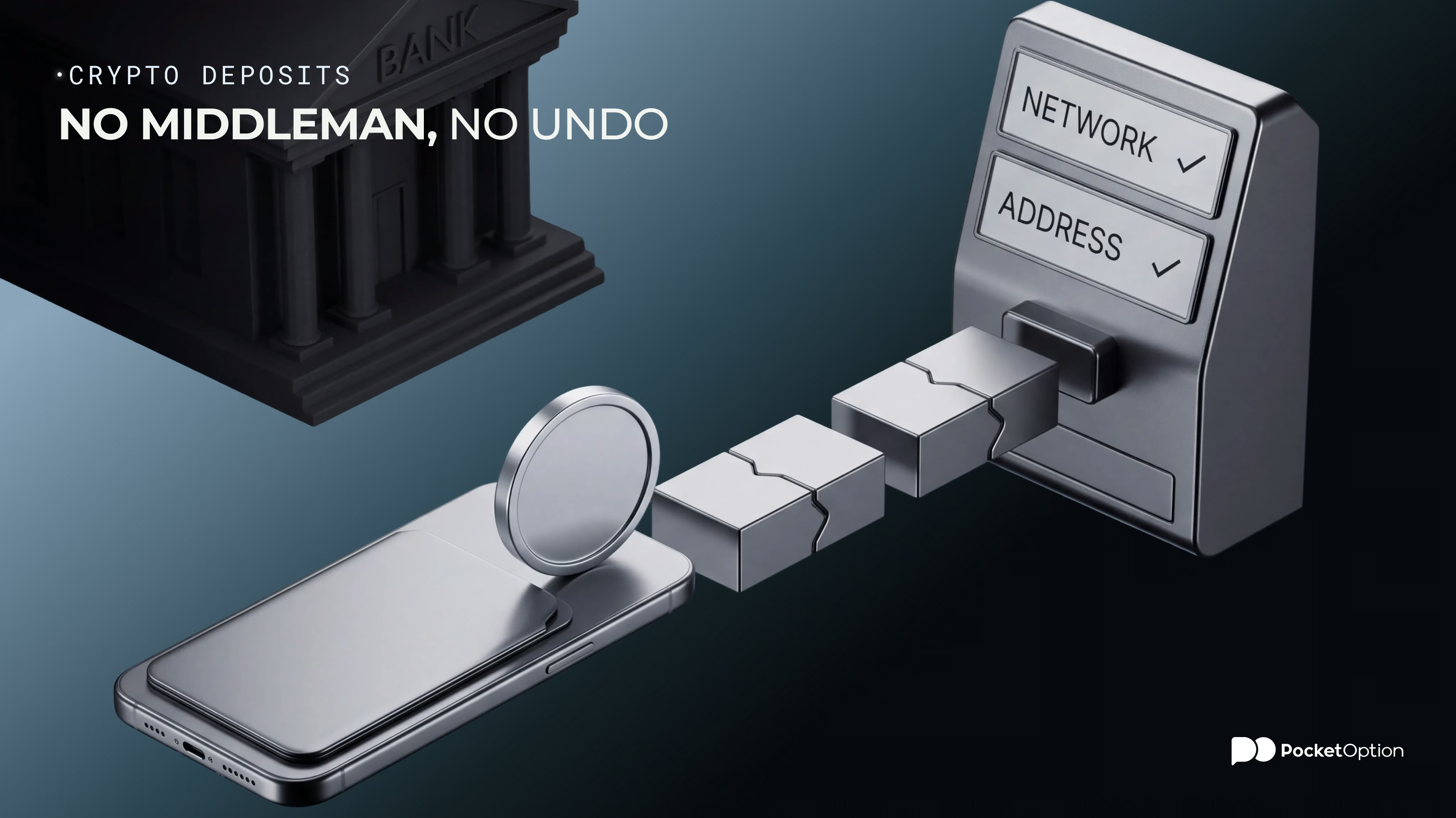
It is the broadest category on the list, with the options of Bitcoin, Ethereum, Tether, Solana and many other cryptocurrencies.
Its appeal is that there is no bank in the middle, so transactions are not limited by the working hours of the banks or a card processor. Stablecoins such as Tether are particularly popular for one reason: your balance does not move while the transaction is being processed, which is not the case if you send Bitcoin and its price shifts in the meantime.
Network fees are the cost of using this deposit method and they do not depend on the amount that you deposit but on the congestion of the network. A small deposit can carry a disproportionate cost on a busy network, so you better check it before the transaction rather than after.
Another drawback is that mistakes in crypto are the least recoverable: you can make a transfer to the wrong address or on the wrong network and your money will be gone, with no chargeback available. So if you are going to use crypto deposits for the first time, you better read this guide to choosing a crypto wallet for deposits and withdrawals before you make a first transfer.
Method 4: Local Payment Systems
This is the category that makes the list run past 140, and it gives you a chance to use the payment method you use every day.
It includes such national instant-payment solutions as UPI in India and SPEI in Mexico, as well as mobile money services including M-Pesa, MTN, Airtel and Wave in several African markets. The practical advantage is that you pay in the native currency and do not lose money in an unintended conversion.
Availability is the downside. The methods are available only for the corresponding regions, so the list that you can see at the cashier can differ from any list you can find online, including this one. Consider the cashier the final source of information on what payment methods you can use.
Method 5: Bank Transfer
This is the slowest deposit method and the last resort for most people, which is generally right.
The transfer is available in several currencies. The reason to use it is size: you may need a method that can move a big amount without the limitations of a card or wallet. The reason against is time, since the transfer depends on two banks and their working hours rather than on the platform.
It is the prudent last resort if nothing else in your country works, and rarely the best solution if something else does.
No deposit demo account
Try DemoDoes Pocket Option Support PayPal
No. PayPal is not included in the list of supported payment methods and it does not appear anywhere on the platform's payment methods page.
Requests about Pocket Option payment methods PayPal are common enough to be answered directly, rather than leaving you to search the list for a logo that does not appear there. PayPal limits the merchants it serves and trading platforms are rarely among them, so its absence is not a surprise in this industry.
If PayPal is your usual payment method, the closest substitutes are the e-payment services covered above, which work the same way from your side: you fund the wallet, then move money to the platform from there. Volet.com and WebMoney both fill that role. Apple Pay is the other option if what you liked about PayPal was not having to type card details.
Minimum Deposit and Fees by Method
The headline figures do not change by category, so this section is shorter than you think.
Item | What applies |
|---|---|
Minimum deposit | From $5 |
Minimum withdrawal | From $10, and depends on the method |
Platform commission on deposits | Displayed as 0% on the payment methods page |
Withdrawal processing | Typically 1 to 3 business days, varies by method |
Third-party costs | Possible network fees on crypto, provider fees on wallets, bank charges on transfers |
The last row is the most important one. It is a common mistake to think that zero commission on deposits means zero fees. It means only that the platform does not take any fees, but the third party may. The fee you should calculate is the fee of whoever sits between your money and the platform.
A minimum deposit from $5 is low enough to be used as intended. Make a deposit in a small amount and make a withdrawal soon after, so you have tested the full round trip before any amount you care about is involved.
Withdrawal Rules: Why the Method Must Match
And here is the part that may catch people out. Pocket Option withdrawal methods mirror your deposits: the money returns through the same channel that was used to deposit.
It is not an arbitrary requirement. Returning money to the source is a standard anti-money-laundering measure used by regulated financial institutions, since it stops a platform from being used to move money out of one instrument and into a different one. Every broker you will deal with will require something like this.
Consequences of this requirement are the following:
You have to think about the withdrawal while selecting the deposit method. A method that is inconvenient to receive money into is not the right method to deposit with, even if you find it very convenient to pay from.
Your deposits may be made from several sources, and your withdrawals can be split accordingly rather than arriving as one payment.
Verification is required before your first withdrawal, not after it. Be prepared to provide your government ID, proof of address and confirmation that the method belongs to you. A large withdrawal may raise questions about the origin of the funds.
Make your verification when you open your account, while nothing is pending yet. Leaving it until you want money out is what stretches the wait.
Processing time is the typical one to three business days, with the exact placement in that range depending on the method used. Business days are important: a request filed late on Friday night is not the same as one filed on Tuesday morning. For more detailed information on payouts you can refer to the article on whether Pocket Option pays real money.
Deposits start from $5.
RegisterWhich Payment Method Should You Choose
Consider how you want to withdraw money, not how you want to deposit it.
If you are making your first deposit and don't want to use any additional services, use a card. It is the most convenient and familiar option.
If the payment system of your country is available, use it. This eliminates the problems of currency conversion and uses rails you already know.
If you want speed and no bank in the chain, use crypto, and consider a stablecoin if you prefer your balance not to move during the settlement.
If you want trading funds to be separate from your bank account, use an e-payment service and accept the additional account as the price of that separation.
If the amount is large or nothing else fits, use a bank transfer and expect a longer processing time.
Regardless of the payment method you select, the amount is more important than the method. Trading involves the risk of losing your deposit, and losses are a normal part of trading rather than an indication of something being wrong. The payment method affects only the way your money travels to the platform and does not influence how the trading goes.
Conclusion
Start your interaction with the platform with a $5 test before you make the full deposit.
This one habit is more important than everything else in this article. Start with the minimum deposit, make your verification when there is nothing pending, then make a small withdrawal and see how long it actually takes for your method, in your country, through your bank. You'll get more information than from any comparison table, including the one in this article, and you will get it at a point where being wrong costs you five dollars. The method that processes your payments most smoothly is the method to rely on for everything afterwards.
Disclaimer: This article is for informational purposes only and does not constitute investment advice. Trading involves a substantial risk of capital loss and may not be suitable for all investors, so you should only deposit funds you can afford to lose. Payment options, limits, fees, and processing times are set by the platform and its payment providers and can change, so please confirm the current details in your account before depositing.
See more:Product Guides