Introducing Ultrade: Trade for Free, Keep All the Profits
The Pocket Option Ultrade feature answers a pretty simple question: what if a real trade didn't need your own money outright? No deposit involved. Real market prices, whole way through. Whatever profit shows up basically stays put. This guide gets into how the thing actually works, roughly where the limits sit, and how it fits between demo practice and full live trading.

What Is Ultrade
The Pocket Option Ultrade feature works out to something like a voucher for one trade, give or take, kind of a stand-in for the usual way things go. Instead of funding a position with money pulled out of an actual balance, a trader flips the thing on, and that bonus handles the trade from there instead. Real market prices. Real execution. Nothing faked. Not the chart. Not the asset list. Only the funding side of things ends up looking different, and that's pretty much the whole trick that Ultrade Pocket Option users keep going on about.
Get the forecast right and the profit ends up going into the real account, the whole amount, kept by whoever placed the trade. If the forecast turns out wrong, nothing personal gets lost, since no personal deposit was ever backing that particular trade to start with. That's roughly the whole setup once the marketing language gets peeled back off of it, and there was not all that much of it to peel off in the first place. No catch hiding underneath it, either, at least not one that isn't spelled out somewhere in the fine print.
Picture the whole thing playing out. A trader grabs hold of a $50 Ultrade bonus from some weekend promotion deal, opens up the platform, and picks out a currency pair that was already sitting there on their watchlist. The chart, the timer, the payout percentage shown before confirming, none of that looks any different from a normal trade funded out of pocket. The only bit that's missing is the part where money has to leave a personal balance just to open the thing up. Any Ultrade review that skips over this part isn't describing the same feature.
How Ultrade Differs from Demo and Regular Live Trading
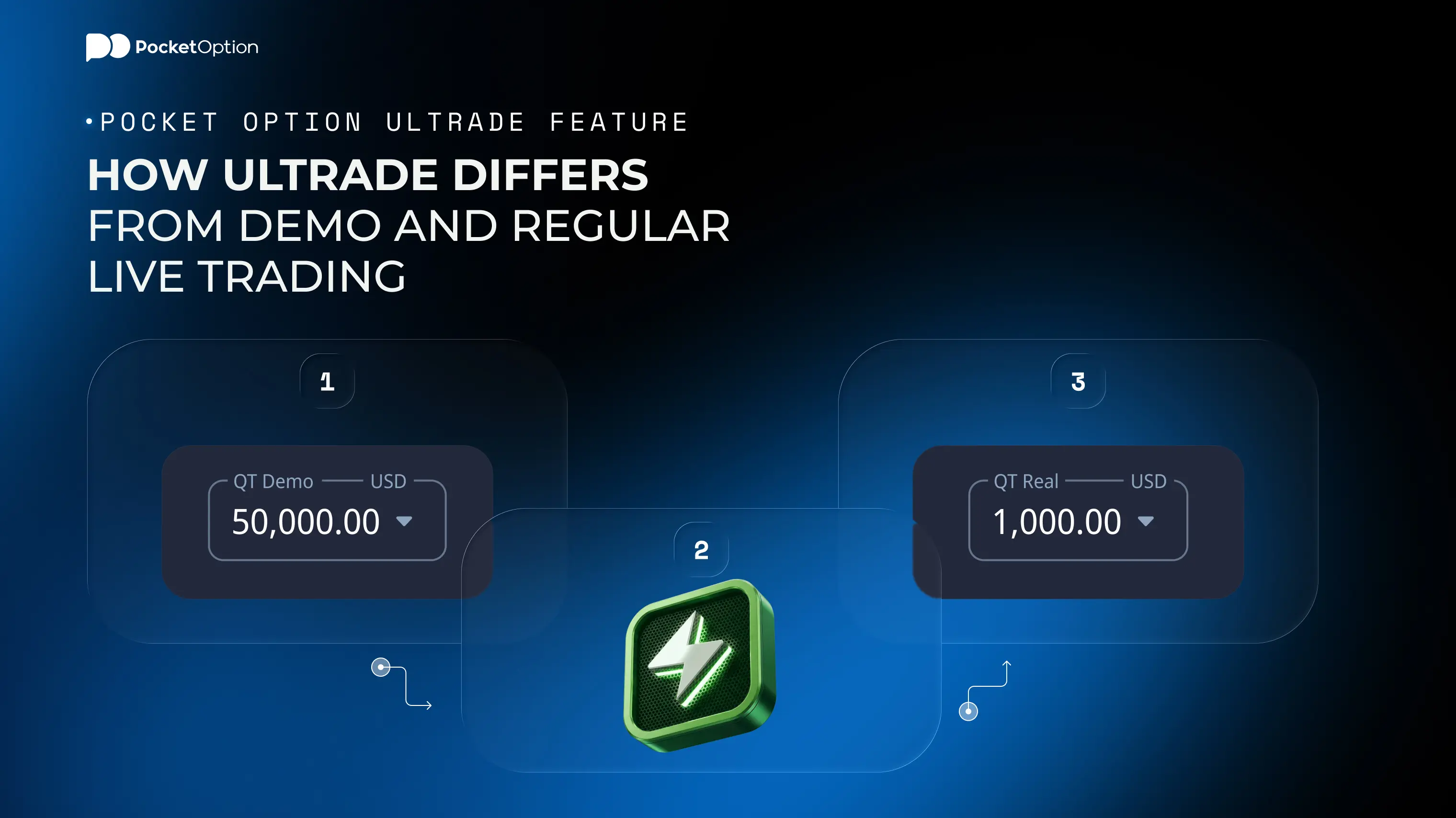
Working out how Ultrade Pocket Option trading is different from both demo and live modes comes down to about three things, roughly: what's funding the trade, what's genuinely sitting on the line, and what the whole thing can end up paying out. A demo account runs on virtual funds that just get reset whenever needed, and none of that stuff ever touches a real balance either way, not even a little. A live trade uses money that came out of a deposit, so a loss takes away something real. Ultrade sits somewhere in an odd middle spot: real prices and real profit, kind of like live trading works, but no personal capital sitting behind the position, which puts the whole thing closer to demo in that one particular respect.
Feature | Demo Account | Ultrade | Live Account |
|---|---|---|---|
Funds used | Virtual balance | No personal deposit, bonus-funded | Real deposited funds |
Real market prices | Yes / real-time market data | Yes | Yes |
Profit if forecast is correct | Simulated only | Real, credited to account | Real, credited to account |
Risk to personal capital | None | None | Full risk of the trade amount |
Withdrawal eligible | Not applicable | Yes, standard verification applies | Yes, standard verification applies |
Terms tied to specific Ultrade offers can change with ongoing promotions. Checking the current listing inside the Market gives the most accurate picture, here and elsewhere.
This overview of Pocket Option's own demo account gets into what practice mode is genuinely good for, which mostly just comes down to building up some familiarity with the interface and trying an idea out before anything real is riding on it. The Pocket Option Ultrade feature picks up more or less where that leaves off. It adds in the mental weight that comes with a real trade, something a demo balance just can't fake no matter how realistic the numbers happen to look, all while still keeping personal funds completely out of the whole equation.
None of the three modes is strictly better than the others. They're answering different questions. Demo answers can I even use this platform properly. Ultrade answers can I actually call a market move when something, even something borrowed, rides on the outcome. A funded live account answers the harder question neither of the other two can: can this get done consistently, with actual money, over and over.
How to Access Ultrade Step by Step
Getting hold of an Ultrade Pocket Option bonus happens in one of two ways, and neither one calls for a deposit up front. Both simple enough to get through in a few minutes flat, give or take.
Watch for it as a reward. Pocket Option hands these bonuses out through promotions, events, and notifications, more often to traders who are already fairly active on the platform.
Or buy one directly. Open the Market section, go to the Trading tab, and look for Ultrade listed among the available items there.
Pick a size. Ultrade bonuses come in preset trade amounts, commonly something like $10, $50, or $100, and the Gem cost scales up depending on whichever size ends up getting picked.
Confirm the purchase, then go to the Purchases section and switch it on before opening the actual trade.
Place the trade like normal from there. Pick the asset, set the direction, confirm the amount, and submit it, pretty much the same steps as any other order on the platform.
That's basically the whole process from start to finish. No extra ID-checking step just for the Pocket Option Ultrade feature, no separate menu buried three screens deep somewhere in the app. The only real decision a trader ends up making along the way is which size to claim or buy, and that choice is worth treating with about the same care as sizing a normal live trade, even though the money behind it works in a completely different way.
See if one's waiting for you.
Get StartedEligibility, Limits, and Conditions to Know
A handful of conditions shape how far the Pocket Option Ultrade feature stretches, and they're worth reading through before just assuming the thing behaves exactly like a regular deposit would. A closer look at Pocket Option's bonus rules covers how this kind of thing typically gets set for items claimed through the Market, Ultrade included.
Trade size gets locked in at whatever denomination was claimed or purchased, not something that can be changed around afterward.
Regional access follows the platform's usual restrictions. Pocket Option doesn't offer service to residents of the EEA, the United States, Israel, the United Kingdom, the Philippines, Japan, or Brazil, and that applies to Ultrade Pocket Option accounts the same way it applies to everything else on the platform.
Pulling any profit earned through Ultrade out still has to go through the platform's standard identity-checking process, the same one used for any live withdrawal, meaning an ID and proof of address get handed over before funds move anywhere. Withdrawal can also fall under the platform's standard bonus rules on top of that, and that sometimes brings a turnover requirement into play before the amount clears for cashout.
There's no set daily cap written down anywhere, but Ultrade bonuses have to get earned or bought one at a time, so the practical ceiling ends up being whatever a trader can build up over time.
Each bonus covers exactly one trade. One size. Nothing combines.
Unused Ultrade bonuses can just sit in the Purchases section until they get switched on, though specific offers sometimes come with an expiry window worth checking before assuming one will still be sitting there next month.
None of this is all that unusual for a bonus-style feature. Most trading platforms end up attaching some version of these same conditions onto anything given away rather than deposited, and Pocket Option isn't some special exception worth extra suspicion just because the whole mechanism happens to be a bit newer than a standard deposit bonus. Verification review for any withdrawal, Ultrade profit included, usually takes something like 24 to 48 hours once the paperwork gets handed in through the Profile section. Not instant. Rarely much longer, either.
How Profits Work with Ultrade
Profit works out about the same way it would on any winning trade, figured out as a percentage of whatever preset amount got tied to that particular Ultrade bonus in the first place. Win the forecast, and the payout lands in the real account balance, available the same way any other trading profit would be. No separate profit account. No delay. Nothing specific to the Pocket Option Ultrade feature slows any of it down.
A rough example probably helps here. Quick Trading payouts on Pocket Option can run up to somewhere around 92 percent depending on the asset and the timing, shown before a trade gets confirmed. Applied to a $50 Ultrade bonus, getting the forecast right at that upper end would put somewhere around $46 in profit into the real account, on top of the bonus itself just disappearing either way once the trade wraps up and closes out. A lower payout percentage, which happens fairly often depending on market conditions, would obviously put less into the account. Higher volatility assets sometimes show higher payout percentages too, though that generally comes paired with a tougher forecast to nail down in the first place.
Worth being pretty direct about one thing here: a $10 Ultrade bonus can only ever really produce a $10-scale profit, nothing bigger than that, no matter how the trade goes. Not a path to a huge payout. Not out of thin air. It's more a way to test out a forecast with real stakes attached to the outcome, minus the part where getting it wrong costs anything personal. Profit is real here. It can also matter quite a bit on the psychological side even at small sizes, and it stays bounded by whatever size the bonus happened to be, since no strategy out there changes that ceiling.
Using Ultrade as a Bridge from Demo to Live Trading
Demo trading teaches the mechanics side of things: reading a chart, putting in an order, figuring out what the numbers on the screen are supposed to mean. What it can't really teach is what it feels like once a trade has real stakes, since a demo balance resetting back to its starting point takes away exactly the part that matters most. Ultrade Pocket Option trading closes up some of that gap. The stakes are real, even though the money funding the trade isn't personal money.
This guide to live trading on Pocket Option gets into what changes once actual deposited funds come into the picture, and most of that stuff still applies once Ultrade bonuses run dry and a trader moves over to a fully funded live account. The adjustment tends to feel smaller for someone who has already watched a real trade play out, even just a handful of times, than for someone jumping straight in from a demo balance that never really mattered to begin with.
There's a rough sequence worth following here: demo first, until the interface and the basic mechanics stop needing conscious thought. The Pocket Option Ultrade feature next, whenever one happens to become available, to feel out what a real outcome does to decision-making under a bit of pressure. A small funded live account after that, sized deliberately small, once both of the earlier stages feel comfortable rather than stressful. Skipping straight from demo to a large live deposit tends to skip right past the exact lesson Ultrade is built to teach. Rarely a good reason to rush any of these three stages. Each one is short. Quick, even.
Ultrade and Pocket Option's Gems and Rewards
Ultrade bonuses inside the Market get picked up with Gems, sometimes labeled crystals depending on which part of the platform they happen to show up in, and these work more or less as Pocket Option's own internal reward currency of sorts. Gems don't get bought with real money directly, not in the usual sense. They get earned instead, which ties the whole Ultrade Pocket Option system back into the platform's broader activity-reward setup, rather than the thing being treated like some separate, isolated feature just sitting off on its own somewhere.
Trading activity and achievements. Active trading earns experience and Gems right alongside it, without needing any extra steps at all.
The weekly Gems lottery thing, which pays out some random amount to entrants each week, win or lose on the trading side being entirely separate from that.
Mining, which involves buying a mining license in the Market and picking up Gem fragments through social trading, letting copy-trading activity contribute Gems over time in the background without much effort.
Buying or exchanging directly. Gems can get purchased with account balance, or unwanted bonuses and items can get traded in for Gems instead of just sitting there unused.
The mining option is worth a second look specifically because it runs on automation. How Pocket Option's bonus system works covers the mechanics in more depth, but the short version is that mining ties Gem collection to trades placed by other people, through a licensed, semi-automated process rather than a trader's own manual calls. Convenient enough, sure, though it's still worth treating any automated feature as something to check in on every so often rather than set up once and just forget about entirely.
None of these earning paths rule each other out either. A trader who's already fairly active, entering the weekly lottery out of habit, and running a mining license in the background tends to build up Gems faster than someone leaning on just one method, simply because the sources stack on top of each other instead of competing. Entering the lottery costs nothing extra beyond just having an account. Mining does carry a license cost up front in the Market, which is worth weighing against how many Gems it realistically ends up returning before buying one on impulse. More Gems, generally speaking, means more Ultrade Pocket Option bonuses within reach without having to spend real money on them directly.
Common Questions and Misconceptions
A couple of misunderstandings come up often enough that they're worth addressing head on. Anyone reading an Ultrade review before trying the feature out themselves will probably run into one of these sooner or later. Worth clearing them up once, plainly, rather than letting them just linger around.
Ultrade isn't the same thing as a deposit bonus. A deposit bonus adds funds on top of money a trader already put in; the Pocket Option Ultrade feature replaces the need to put money in at all for one specific trade.
Losing an Ultrade trade doesn't cost anything personal. It doesn't touch a real deposit, since none was ever used to open that trade in the first place.
Ultrade profit isn't unlimited. Not guaranteed either, for that matter. Profit stays capped by the bonus size, and nothing about Ultrade changes the odds of some given forecast turning out correct.
Ultrade isn't some permanent replacement for a funded account. It's available whenever a bonus gets claimed or bought, not as an ongoing way to keep trading indefinitely without ever depositing anything at all.
Conclusion
Ultrade is a pretty narrow, specific sort of tool, when you get down to it: a way to place a handful of real trades without any personal capital sitting behind them, pick up something useful from the outcome either way it goes, and keep whatever profit happens to show up along the way. It isn't a stand-in for a funded live trading account, and it isn't some shortcut to steady income either. Most Ultrade review write-ups tend to stop around here, but the boundaries are worth being upfront about too. Used for what it is, a low-stakes way to feel out live market conditions before committing real deposits, the Pocket Option Ultrade feature does that job reasonably well, all things considered.
The value here sits less in any one single trade and more in what the whole thing teaches about the gap between just knowing something and actually going out and doing it with real conditions attached to it. That gap can end up feeling smaller after a few Ultrade trades than it did before them. Not gone. Just smaller. That's more or less the entire pitch, once the marketing language gets stripped back out of it.
Set up your account first.
Register NowDisclaimer: Trading involves significant risks of capital loss and may not be suitable for all investors. Past performances do not guarantee future results.
See more:Platform updates