
Porter's Five Forces Analysis: How the Model Works, Key Components and Real-World Use
Some industries are profitable by their nature whereas others tend to struggle despite good management. The reason behind this phenomenon lies in the structural nature of industries and not in their management. This model is used to identify the structure of an industry. It breaks down an industry into five competitive forces and measures the intensity of these factors.

What Is Porter's Five Forces: Definition and Origin
In short, what is porter's five forces? The model helps to understand how profitable an industry is expected to be for its businesses depending on five competitive pressures.
It was created by Michael Porter, a young Harvard Business School professor back in 1979. His article How Competitive Forces Shape Strategy was published in Harvard Business Review. In 1980, he wrote a book entitled Competitive Strategy and further clarified the idea in Harvard Business Review in 2008. Nearly 50 years have passed since its introduction but this framework is still taught in the same way as it was back then.
You will find this term called the five forces framework, the porter five forces model, the porter 5 forces model, the porter's 5 forces model, the porters 5 forces model, or just a 5 force analysis. In all cases, you refer to the same model of analyzing five pressures.
It is important to know that the central message behind this framework deserves to be presented openly. Indeed, the profitability of an industry is defined not by how fiercely companies compete on prices but by the structure of the industry. Rivalry is one of the five pressures but not the whole picture. To apply the five forces framework correctly, you should not treat it as a model of competition alone.
The Five Forces at a Glance
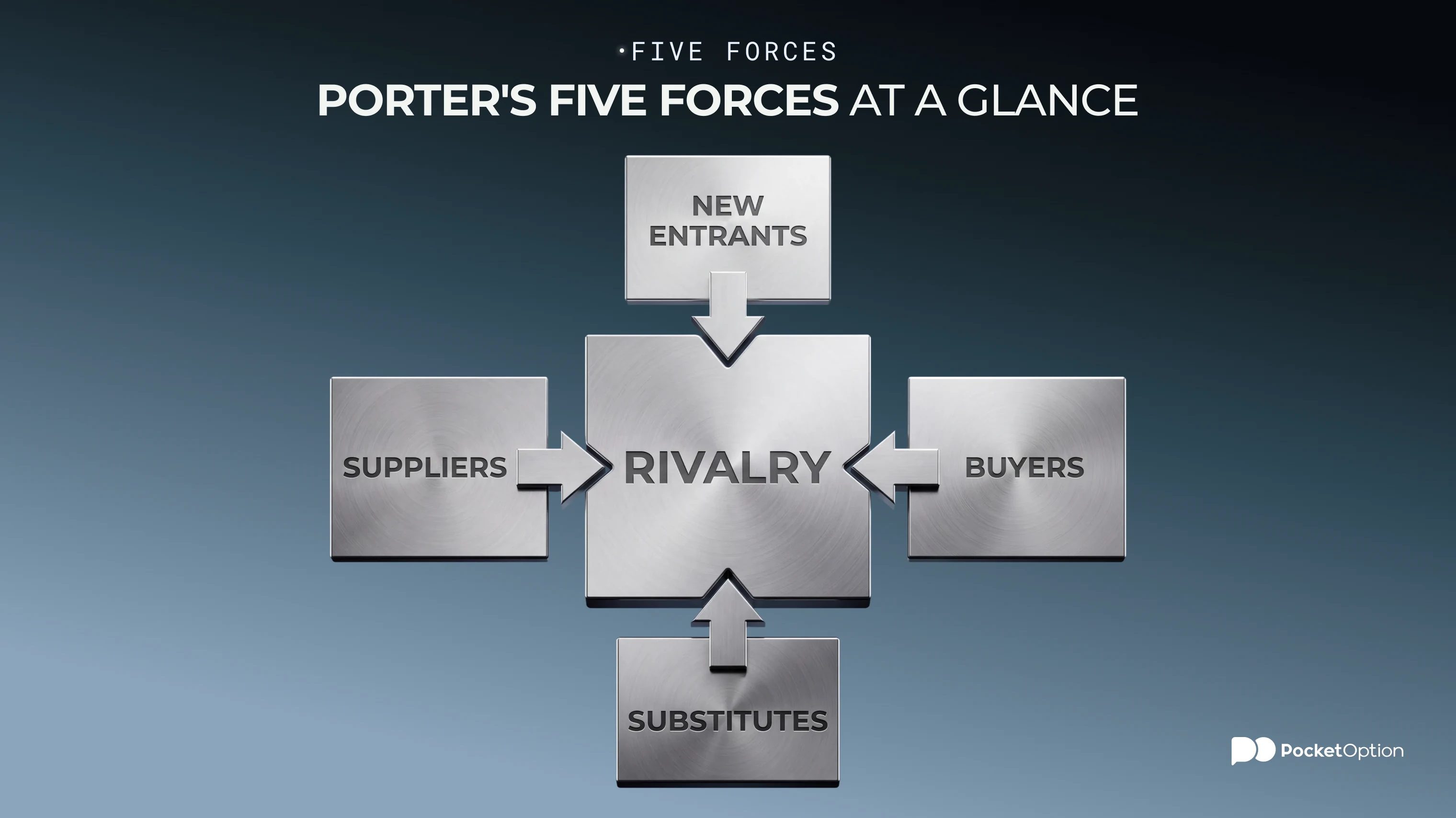
Below is the table representing the whole model on a single screen. As you can see, each force tries to answer the same underlying question but from a different perspective. Which groups of entities are able to reduce the profits of the businesses operating in a certain industry?
Force | The question it asks | Strong when | Effect on profits |
|---|---|---|---|
Threat of new entrants | How easy is it to get into this business? | Barriers are low and capital requirements are small | Sets the cap on prices, since attractive returns invite entry |
Supplier power | Are suppliers able to dictate conditions? | Few suppliers, unique inputs, high switching costs | Reduces margins from the supply side |
Buyer power | Are buyers able to dictate conditions? | Few large buyers, undifferentiated product | Reduces margins from the price side |
Threat of substitutes | Is the need possible to meet with something else? | Another product fulfills the same function more cheaply | Places a cap on pricing possibilities |
Rivalry | How fierce is the struggle between rivals? | Many similar companies, slow growth, high exit barriers | Drives prices down and raises costs |
The main benefit of conducting a five forces analysis is that you are required to evaluate all five pressures even if one seems to be the main one. An industry can be strong on four forces and ruined by the fifth. You should work through all five competitive forces.
Threat of New Entrants
This force refers to the possibility of entry but not to the reality of entry. Even though no companies were entering the market for years, the threat is still present if the companies in an industry manage to keep prices low enough to keep new entrants away.
To assess this pressure, consider the following factors:
Economies of scale. If efficiency requires being large, a new entrant needs to enter big and lose money, or enter small and accept worse efficiency.
Capital requirements. Building a semiconductor fabrication plant requires billions; building a consultancy requires a laptop.
Switching costs. If customers face significant costs switching to another provider, a new entrant must offer a significantly better deal to cover them.
Access to distribution. Shelves, app stores, and dealer networks are limited and occupied by incumbents.
Advantages of being an incumbent not related to scale: proprietary technology, favorable locations, and accumulated brand.
Government policy. Licenses, spectrum, banking charters, and safety approvals can prevent any entry to the market.
Expected retaliation. If new entrants expect that incumbents will start a price war, they may decide not to get into the market.
Notice the difference in the dynamics of these factors. While capital requirements are a fixed barrier, expectations are subject to change.
Bargaining Power of Suppliers
Suppliers are able to capture the profits of companies by raising prices, lowering quality, or transferring costs to them. The question here is to what extent suppliers can do it.
Concentration. If there are few suppliers and many buyers, they will be able to set the terms. On the contrary, if there are many suppliers and few buyers, it is unlikely.
Differentiation of the input. A commodity can be purchased from anywhere, while a customized component designed for a specific product cannot.
Switching costs. If the production line has to be retooled to work with another supplier, switching is slow and expensive.
The threat of forward integration. If suppliers could plausibly compete with you directly, they will be in a better position during negotiations.
How much the supplier needs you. An industry that accounts for a small share of a supplier's revenue has little to bargain with.
The labor force is considered a supplier in this context and it can also capture the profits of businesses according to the principles described by the model.
Bargaining Power of Buyers
The buyer power resembles the supplier power but in relation to outputs. Strong buyers put down prices, raise service standards, and pit competitors against each other.
Buyers gain leverage when there are few of them, when they are large compared to sellers, when products are standardized so that they can be substituted, and when switching is not costly. Their position is stronger still if they could credibly produce the product themselves. A supermarket chain negotiating with a food producer has all of these working in its favour at once.
There is an additional dimension here, which is sensitivity to prices. Buyers may be powerful and not interested in exploiting their power if the purchase is insignificant for their budget or if the quality matters more than price. Buyers negotiating with an industrial component manufacturer will behave differently if this component represents 10% of the product cost rather than 50%.
Consumers can act like a group of buyers despite the lack of importance of a single individual consumer. Online price comparisons gave each consumer something close to institutional buyer power in several retail segments without altering the size of purchases.
Follow the companies you have studied.
Get StartedThreat of Substitute Products or Services
This force is considered the hardest one to analyze because the substitutes come from outside the industry and thus outside your consideration.
A substitute is a product fulfilling the same function in a different way. Video conferencing is a substitute for business air travel. Streaming is a substitute for going to the cinema. Tap water is a substitute for bottled. In all cases the substitute is not a competitor in the traditional sense since it comes from an industry with a different economic environment and cost base.
A substitute sets a cap on pricing possibilities when it delivers most of the same benefit at a fraction of the cost. This threat is determined by the price-performance ratio it offers, and the ceiling is set by something the industry cannot influence.
As in any other case, switching costs matter. A substitute can be cheaper and better but fail to replace the incumbent if the costs of switching are high enough. This is how old technologies survive longer than it is economically justified.
The practical advice is to consider the function but not the product. Those companies which defined themselves as producers of a certain product failed to predict the appearance of substitutes.
Rivalry Among Existing Competitors
It is this force which comes to mind at first but it is only one-fifth of the framework. Rivalry includes price wars, advertising battles, competition for service, and innovations.
It becomes intense when the number of competitors increases, especially when they are similar and none of them can impose discipline on the other. It is also driven by slow industry growth because the only way to grow in this case is to grab market share from the competitors. And finally, high fixed costs relative to variable costs cause price rivalry because any sale over the variable cost looks good.
High exit barriers make the rivalry worse. Specialized assets, redundancy obligations, and the reluctance of managers to give up make unprofitable firms stay in the market and fight.
Low differentiation makes it worse. If your product is interchangeable with the competitor's product, price becomes the only tool.
Perishable capacity makes it worse. An airline seat cannot be resold tomorrow and companies are forced to sell them for less and less.
Diverse strategic objectives make it worse. A state-owned competitor which is more interested in jobs than in profits will not react to the pricing logic.
Not all rivalries are destructive. Competition on features, service, and brand expands the market and leaves everyone better off. Price rivalry is the kind of competition which directly transfers value from producers to consumers.
How the Five Forces Determine Industry Profitability
The five forces are not simply added together. Industry profitability comes from their combined effect, and the strongest force or forces usually carry the most strategic weight within that combination.
This is the meaning of the framework. An industry with low barriers of entry, no substitutes, powerless buyers and mild rivalry may still be unprofitable if a single supplier controls an essential input, because that one pressure is severe enough to shape the outcome even where the others are favourable. This is why a five forces analysis looks for the pressures that bind hardest rather than producing an average of five ratings. What it does not mean is that the other forces stop mattering, since they determine how much room remains once the strongest one has taken its share.
It also explains the puzzle why two companies performing equally well in terms of management may post very different returns. Most of the difference is caused by the structure of the industry and not the management, and the five forces model is an argument that where you compete matters at least as much as how well you compete.
A company performing well in an unfavorable industry is a harder proposition than a mediocre company in a favorable industry, and a five forces analysis helps you to see the whole structure you are dealing with before opening the financial statements.
No deposit needed to start.
Try DemoWhy Industry Structure Changes Over Time
The five forces reading describes the structure of the industry at a certain point. These structures change over time either slowly or fast, and the conclusions drawn five years ago can describe a quite different industry today.
Technology is always the major driver. It lowers entry barriers removing the need in physical distribution or expensive infrastructure, and it raises them requiring scale in data or network effect. Both changes happen, sometimes in the same industry at different points of time.
Regulations directly redraw industry boundaries. Deregulating an industry can make a comfortable structure brutal within a few years, and new licensing requirements can do the reverse.
Consolidation changes the power balances mechanically. When buyers consolidate, supplier power falls without the suppliers doing anything wrong. Industries regularly fluctuate between fragmentation and consolidation and the five forces fluctuate along.
The practical conclusion is to date your analysis and revisit it. The mistake of treating the conclusions of the five forces framework as immutable is the most common way of misusing it. This topic was discussed by Porter himself in his 2008 article.
Real-World Example: Applying the Model to an Industry
Commercial aviation is the classic example of the model in use since all five pressures act against the industry. It is the most illustrative example of an unfavorable industry structure.
Force | Airline industry | Why |
|---|---|---|
New entrants | Moderate to high threat | Planes can be leased, routes can be opened, and staff can be hired quickly |
Supplier power | High | Two major suppliers of aircraft, unionized pilots, monopoly airports, external prices for fuel |
Buyer power | High | Price comparison sites made price the deciding factor for the leisure traveler |
Substitutes | Moderate | Rail on short distances, video conferencing in business travel |
Rivalry | Very high | Perishable seats, high fixed costs, low differentiation, high exit barriers |
If you apply the same test to the industry of branded soft drinks, almost all lines will be inverted. Entry is blocked by distribution and decades-long brand building; suppliers provide commodity inputs; buyers are fragmented retailers; substitutes exist but lack powerful brands; rivalry is mostly about marketing. Similar management, opposite structural position, and profitability follows the structure.
That contrast is why this framework belongs to fundamental analysis and not to the adjacent area. Applying it before examining the financial performance of a company allows you to understand the challenges which this company faces. If you are new to investing and stock purchasing, you will find a guide on how the stock market works, and the industry reading fits naturally alongside fundamental analysis of stocks.
Limitations of the Five Forces Model
The model has serious limitations and knowing them is an important part of applying it properly.
It is a snapshot. The framework describes the industry structure at a certain point of time and has no mechanism for the prediction of future changes.
It assumes that industries have definite boundaries. Sometimes they do not, and the determination of the right industry becomes a subjective judgement.
It does not consider complements. The products which increase the demand for yours, like software for a hardware platform, are not included in the list of five forces, and some say that they deserve to be the sixth force.
The model was developed for a different time period. The 1979 version presupposed relatively stable manufacturing industries and is not as good with rapid technological disruption.
It says nothing about individual firms. Two companies in the same industry are exposed to identical forces but perform very differently, and that is what the resource-based view of strategy was developed for.
There is also a limitation specific for investors. The five forces analysis helps you to understand the structural attractiveness of the industry. It says nothing about whether the share of a company in this industry is priced correctly, about its liquidity, or about the volatility of its movements. That is another issue, and it matters most at the smaller end of the market, as the guide to penny stock risks and liquidity sets out.
All of these things do not make the framework useless but imply that it is only one of many inputs.
Conclusion
Work through all five forces, then identify which of them binds hardest.
That ordering follows from the way the framework works. Industry profitability is produced by the five pressures acting together, so a complete reading matters, but the pressures are rarely equal and the strongest one or two usually decide where strategy has to focus. Most people complete all five, give each a rating, and come away with an averaged impression that flattens the differences between them. Finish the analysis, then ask which force is doing the most damage, why it is strong, and what would have to change for it to weaken. Those questions are worth more than the filled-out matrix, and you can only ask them once the matrix exists.
Disclaimer: This article is meant to provide information on the topic only and should not be interpreted as investment advice. Trading and investing are associated with substantial risks, including the risk of losing part or the whole of the capital involved.
See more:Knowledge baseTrading