
Investment Guru's Guide to Best Cheap Stocks for Options Trading
Low share price and existing options are two unrelated attributes. A lot of stocks below $20 have no options, and a lot that do have options chains so thin that entering and exiting costs more than the trade was worth. This guide explains what “cheap” means and why share price is not the proper screen for an option underlying, what needs verification in a chain before you trade, and it names no specific stocks to buy because the point is the process.

What Makes a Stock “Cheap” for Options Trading
There are two meanings for the same term, used interchangeably, and the confusion stems from that.
Cheap by price. The share price is simply a low number, which makes an $8 stock cheap in this sense regardless of its overall valuation.
Cheap by valuation. A low price relative to earnings, assets, or cash flows. A $400 stock can be cheap by valuation, and an $8 stock can be expensive.
When people search for the best cheap stocks for options trading, they almost always refer to the first meaning of the term, but it's important to distinguish between them, as the second one is the meaning connected to whether the company does well.
Share price does matter for one mechanical reason: the number of shares per contract. A standard US equity option contract represents 100 shares, hence a $15 stock will provide an exposure of $1,500 per contract, against $15,000 on a $150 stock. A lower share price therefore means smaller position increments, which genuinely helps a small account. But the share price tells you nothing about the quality of the underlying.
Why a Low Share Price Doesn’t Make a Good Options Underlying
For starters, there's a reason many inexpensive stocks do not have option chains at all. Options are listed only when the underlying satisfies certain criteria established by the exchange. NYSE Arca Rule 5.3-O requires, absent exceptional circumstances, at least 7,000,000 publicly held shares, 2,000 shareholders, trading volume of 2,400,000 shares over the previous twelve months, and a price of at least $3.00 for the prior three consecutive business days, with a higher $7.50 floor for securities that are not covered securities.
It's the price floor that excludes most inexpensive stocks from having any options listed on them. Searching for the best cheap stocks for options trading under $20 really means looking within the relatively narrow range from $3 to $20, and as you go further down, the chains grow thinner.
When options are available on an inexpensive stock, premiums on them are low in absolute value, thus a five-cent spread represents quite a big percentage of the price. Chains are often short, with few strikes and monthly expiries only. Options liquidity, not the price, makes a stock a proper choice for options trading.
Options Chain Checklist: What to Verify Before You Trade

Use this checklist for the specific strike and expiry you plan to trade, not for the chain as a whole. Liquidity is concentrated in a handful of specific contracts, and the one you need may not be among them.
Contract volume: the number of contracts traded on that particular strike today. A zero volume means you are alone at this game.
Open interest: the number of contracts outstanding. It is updated once a day rather than in real time, so use it to gauge standing interest and use volume for what is happening now.
The spread as a percentage: the bid ask spread options traders should care about is the one on the contract, not on the underlying. Five cents on a $0.20 option is 25% of the price, but the same five cents on a $4.00 option is barely over 1%.
Strikes near the money: enough of them around the current price so you have a choice rather than taking whichever one exists.
Expiries: whether weeklies are available or not, and how long the chain is.
Depth at the quotes: how many contracts are standing at the bid and ask. A tight spread on one contract is not a tight spread on twenty of them.
A spread is paid twice, both when entering and when exiting, so estimate the cost of the round trip before considering the contract cheap enough.
Where to Check Options Liquidity Yourself
This does not require any paid data source, though it requires opening the chain at the proper moment.
Open the chain at a free market data website and find the expiry you need, then compare it with your broker's platform, where the live bids and asks with size are visible.
Do this during market hours, because the spreads quoted outside them are usually wide and meaningless, and those are the times people usually look.
Focus on the actively traded options screens, which show volume across all the contracts and reveal where the activity actually sits.
Place a test order. If a limit order at the mid-point stands unfilled for minutes on one contract, you have your answer.
Re-check before exiting rather than making assumptions. The liquidity of a cheap name tends to vanish fast, especially at the exact time when you need to get out.
Fundamental Screening for Cheap Stocks
When searching for cheap stocks for options, a trader uses a completely different screen than when buying stocks to hold. The company still needs to survive until the expiration of your contract, and the main risk here is the value trap: a low multiple that becomes low because of falling earnings, not because of market mispricing.
The direction of revenue growth over several quarters, not just one figure.
The direction of margins. Growing revenue with falling margins is a warning, not a growth story.
The interest coverage ratio. Operating profit has to leave enough room for covering interest payments.
The cash burn rate. How long a company can sustain itself from the cash it has.
The number of shares outstanding. A steadily growing number is your shrinking slice of the pie.
The language in the filings. Going-concern wording and repeated restatements are the red flags here.
Below the options-eligible range there are penny stocks, which present a completely different set of risks and issues. If you decide to go there, study first this guide to penny stock risks, including low liquidity, high volatility and pump-and-dump schemes.
Cheap Single Stocks vs ETFs for Options
Quite a few traders prefer ETFs for options trading, and their reasoning has nothing to do with the company itself and everything to do with the options chain.
Broad ETF chains have more liquidity: plenty of strikes, plenty of expiries, tighter spreads, and far more open interest than a similar single stock.
There is no single-company event risk. An ETF does not report quarterly earnings and does not change its auditor overnight. When one holding inside it does these things, it barely makes any difference.
There are smaller moves: the diversification which removes single-stock risk also reduces single-stock moves, and that move was the attraction of the cheap stock in the first place.
The settlement differs: ETF options are typically American-style and settle in ETF shares, while index options are European-style and settle in cash.
Neither is better overall, but a deep ETF chain offers more convenience in trading at the expense of losing the specific move, whereas a cheap single stock can provide the move but at the expense of spread and increased risk.
Timing Entries With Technical Analysis
Options add another aspect of trading to the direction of the move: the timing. Being right on direction but a month late is the same as being wrong, as the contract expires in any case.
Find your levels in advance, so the strike follows the analysis, not vice versa.
Check where the implied volatility of the contract sits within its recent range. High implied volatility means you have to pay more for the same contract.
Find the next earnings date of the company. Holding a short-dated option through the earnings release is yet another bet on an unpredictable outcome.
Choose the expiry in line with the timeframe needed for your thesis, and add some margin. Entering the cheapest nearby expiry usually means losing despite being right on direction.
Try a free demo
Try DemoBasic Strategies for Cheap Stocks
Three strategies cover most of what is used on cheap underlyings. Every strategy has its worst-case scenario, and knowing it is the key.
Long call or long put. You pay a premium to get the right to buy or sell at the strike. The biggest loss you can have is the premium paid, and losing all of it is an ordinary scenario rather than an unusual one.
Covered call. You own 100 shares and sell a call against them. The premium is yours, and in return you give away the upside beyond the strike and keep the full downside risk of the shares.
Cash secured put. You sell a put and put aside the money to buy the shares if you are assigned.
The last strategy needs some explanation, as it is the one most often suggested for cheap stocks, and most often explained incorrectly. A cash secured put on cheap stocks means you have sold someone else the right to sell you the shares at the strike. You hold the obligation, not the right. If the stock falls, you buy the shares at the strike price while the market is lower, and your loss runs down toward the strike minus the premium collected. Putting the money aside does not reduce that risk. It just guarantees you can meet it.
Risk Management for Options on Low-Priced Stocks
Position sizing has to treat the full premium as an expected loss, not as the worst possible scenario. On a long option, losing the whole premium is an ordinary outcome.
Decide your position size as a share of your account in advance, before checking the premium, so a cheap option does not tempt you into taking more of them than you planned.
The time decay works against a long option every day, even if the stock stays flat.
Consider the risk of assignment. American-style equity options can be exercised at any time, and a short option that is in the money before a dividend is a common trigger.
Never add to a losing long option in order to lower the average cost. The expiry does not change.
Treat the exit spread as part of the cost of entry, because on a thin chain it frequently is.
Every trader faces losses at every account size. The guidelines above cannot prevent losses; they allow limiting the size of every individual loss so it remains survivable.
Trading Stock Price Moves on Pocket Option
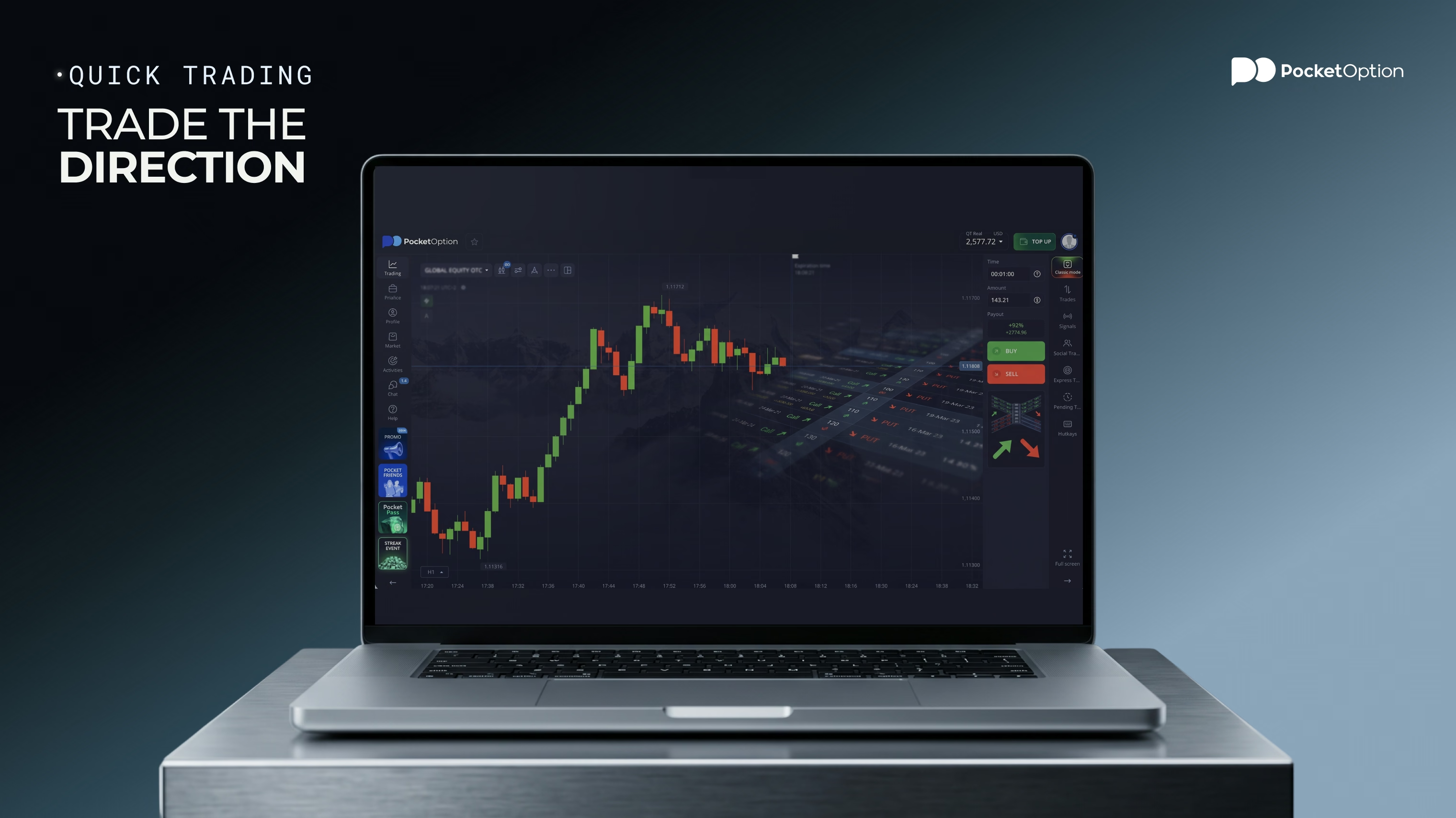
Now for the honest part: Pocket Option does not provide any listed stock options, so nothing from the chain checklist above will apply to the platform. There are no strikes, no expiry chains, and no premiums to analyze.
What it does offer is stock price movement through the Quick Trading tool. You choose an asset, set your trade amount and select the time of expiration, and the result depends on the direction of the price at expiry. The minimum trade amount is $1, and the maximum varies according to your profile level. The mechanism is explained in this guide to how to place a trade on Pocket Option.
Quick Trading is not classic exchange-traded options, and there is neither short selling nor ownership of the underlying stock.
The analysis applies, but the instrument does not. The levels, trend, and earnings dates matter, but the strike selection and implied volatility have no equivalent.
The available assets on the platform vary, so check for availability rather than assume the stock is there.
The platform does not provide services to residents of several jurisdictions, including the EEA, the United States, the United Kingdom, Israel, Japan, the Philippines, and Brazil. Since most cheap optionable stocks are US-listed, check your eligibility before researching the assets.
See available assets
Get StartedCommon Mistakes
Looking only at the share price and stopping there, which leads to holding a contract nobody will buy back.
Reading the open interest as current activity; it is updated only once a day.
Estimating the spread in cents rather than as a percentage of the premium.
Buying the nearest expiry because it costs the least, and then finding yourself with not enough time.
Believing a low share price caps the losses; in the case of a short put, the exposure runs all the way down.
Treating the demo account result as if it reflected real trading, where your own behavior changes.
Conclusion
The share price serves as a filter for position sizing, not as a measure of quality or tradability. What decides whether a cheap stock is worth trading options on is the chain: the activity at the strike you plan to trade, the spread as a percentage of the premium, and enough available strikes and expiries for you to choose rather than accept.
Therefore, when you see a list of the best cheap stocks for options trading 2026, treat the names as candidates to check, not as definitive answers. Open the chain, check the strike you are going to trade during market hours, and make a decision based on that.
Open an account
RegisterDisclaimer: This article is informational and educational and should not be construed as investment advice or a recommendation to buy, sell, or hold any security, or to trade any instrument. It does not name any stocks as recommendations. Options trading involves significant risk and is not suitable for all investors; a long option can lose its entire value, and a short option can incur losses far exceeding the premium received. Exchange listing criteria, contract specifications, available assets, minimum trade amounts, and jurisdictional restrictions are determined by the relevant exchange or provider, can vary and can change at any time, so confirm current terms on official sources before acting. The figures related to Pocket Option were taken from the platform's own published pages and verified on 16 October 2026. Trading involves a significant risk of capital loss, and the results obtained in demo trading do not indicate future results in live trading.
See more:Knowledge baseTrading