SMCI Stock Price Target 2030 Analysis
SMCI stock traded at ~$40 in mid-2026 after a blowout earnings beat in early August. Over the 5-year span, its price has increased by more than 900%. But will this trend continue? Are the next few years going to see a similar increase in price? We break down the numbers, the legal history, and scenarios through 2030.

What Super Micro Computer (SMCI) Actually Does
Super Micro Computer company, with a stock ticker SMCI, develops and constructs storage and server systems, aimed at high performance. Their systems house the hardware to train and run AI models, which is part of the reason why the SMCI stock prices have been performing rather well in recent years.
Rather than making chips, SMCI integrates processors from AMD and Nvidia into ready-to-go server racks that have liquid cooling and various other improvements for increased power density. As the demand for AI rises, so does the demand for their products, and this is what any SMCI stock price target analysts have to incorporate into their predictions.
This positioning of a Super Micro stock as a hardware supplier to the AI buildout (and not just a simple chip or software company) have caused the stock rallies, but might also become one of the reasons for the stock to drop, as the fears about ‘AI bubble’ mount. There are other reasons to be skeptical as well:
SMCI's revenue is tied to hardware sales cycles, and the cycle (might be) about to end;
the structure of the sales relies on a small number of very large customers, and if they disappoint, the revenues might miss the target;
SMCI is heavily tied to Nvidia, and how fast they can ship their latest platform: if Nvidia misses heavily, SMCI might follow suit;
there’s no large recurring software subscription base, the ‘sticky demand’, that will be there no matter what, is not that high.
SMCI's Current Price and Analyst Targets in 2026
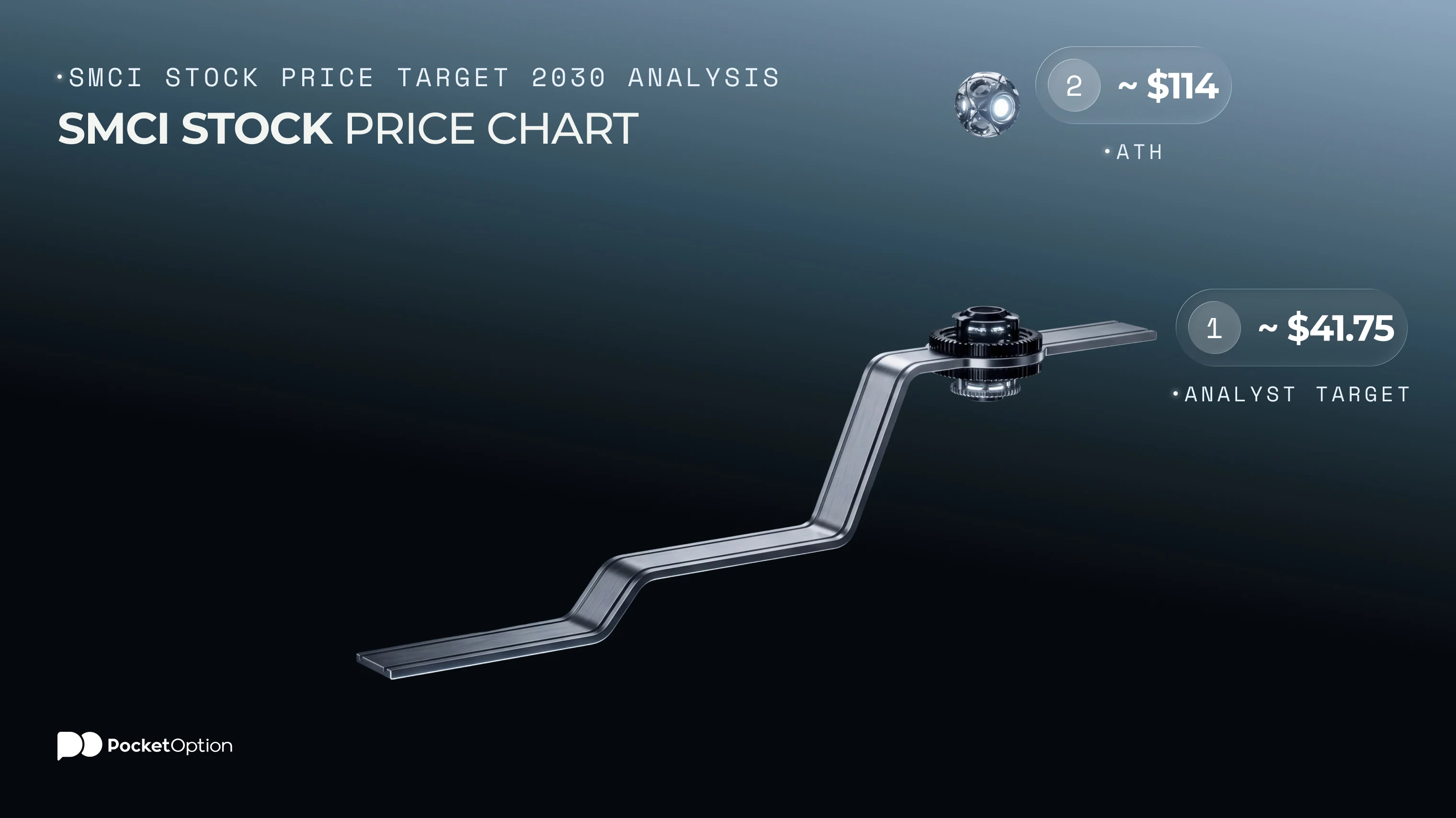
SMCI stock closed at ~$31.46 on August 10, 2026, but then surged 10-14% in the next two days because of the Q4 2026 results they reported. They beat the estimates handily, and those extremely good SMCI news have pushed the stock into the $38-$41 range by August 13.
However, this is still substantially lower than the peak in March 2024, which was around $114. There are still ways to go, to reach an ATH.
Current Metric | Value (as of Aug 2026) |
|---|---|
Share price | ~$38 - $41 |
Market cap | ~ $27 billion |
52-week range | $19.48 - $58.78 |
Average analyst target | ~ $41.75 (average from 19 analysts) |
Consensus rating | Hold (not Buy) |
So far, the SMCI stock price target analysts have set sits close to where the stock is actually at. Therefore, a Hold consensus remains. A 12-month price target is just above the current price, which to many analysts is a signal in itself: the obvious room to run doesn’t seem to be very large.
SMCI's Accounting and Compliance History: Why It Still Matters
In August 2024, a report by short seller Hindenburg Research was released, alleging some manipulation and undisclosed transactions at SMCI. By October 2024 the auditor of the company, Ernst & Young, resigned, saying the management might be misrepresenting its figures. A Special Committee investigation was launched, and found no evidence of misconduct by the board or management.
This conclusion stands so far, and the immediate crisis was resolved, but the story didn’t end. In the 2025 annual report, SMCI themselves said that there are some weaknesses in internal control over financial reporting. This whole ordeal was part of the reason the SMCI stock price target was slashed by multiple analysts, despite strong revenue growth.
Current Litigation and Investor Risk
What followed a 2024-2025 fiasco was, by some estimates, an even more serious matter. On March 19, 2026, the U.S. Department of Justice unsealed an indictment versus three people from SMCI, including its co-founder. DOJ alleged a scheme to divert servers containing restricted Nvidia cards worth ~$2.5 billion to China, in violation of export controls from the US. On those rough SMCI news, shares of the company fell around 33 percent in just one session.
This is still a risk, it’s active, and it’s pushing the price of the SMCI stock down. At the same time, some analysts imply that this might present some buying opportunities, as the price is relatively depressed, and push their SMCI stock price prediction 2030 up, as when the matters are fully settled, this might imply some rebound.
Bullish Drivers: AI Server Demand, Liquid Cooling, Speed to Market
The bull case here sits on three things:
Insatiable AI server demand. In fiscal 2027, company guides to $65-$72 billion in revenue. Continued Nvidia GPU platform demand points to a buildout that is still not slowing down.
Leadership in liquid cooling. SMCI has better production scale in this, than most rivals. As liquid cooling becomes more sought after, the SMCI stock price target increases.
Speed to market. SMCI's modular approach allows deployment of the new Nvidia platforms faster than most competitors. If the new GPU generations are highly sought after, time after time, SMCI benefits.
Most of this isn’t unique to SMCI, however. In this case, Super Micro stock is one of many AI-adjacent hardware plays. They benefit from the buildout as a whole, as part of the broader basket.
Bearish Risks: Competition, Customer Concentration, Margin Pressure
The same August 2026 earnings report that produced the rally also shows the potential risks for the stock:
Competition. In particular, Dell and HPE both want similar hyperscaler and AI deals. Lenovo and Taiwanese companies add further pricing pressure.
Customer concentration. A small number of AI hyperscalers are a large share of SMCI's profits. If some of them stop their own AI buildout, the company's revenue changes drastically.
Margin pressures. At present, SMCI has 17.6 percent gross margin, but even that, analysts predict, may not be sustainable long-term, given the competition.
SMCI Stock Price Scenarios for 2030
There’s more than a single SMCI stock price prediction 2030. Rather, there are scenarios that can form a realistic range of what can be expected.
In a bear scenario, AI buildout stalls. Margins compress due to competitions. Major customers stop their massive capital spending. Under such a path, SMCI stock price target 2030 could sit back in the $20-$30 range, not increasing much beyond breakout prices seen in 2026.
In a base scenario, SMCI stock 2030 lands in the $45-$75 range, which is an extension of the current re-rating. No new dramatic catalyst happens, and the company continues to perform as expected.
In a bull scenario, direct liquid cooling, a tech developed by the company, becomes the go-to for the industry. SMCI retains its share, overcomes its legal challenges, and slowly gains leadership in the key areas. FY2027 revenue guidance actually proves conservative, and not aggressive. Under this scenario, a SMCI stock price target above $100, or even $150 by 2030 becomes somewhat plausible. But it would probably have to mean that competitors can’t catch up to the SMCI edge. So far, this seems like a less realistic scenario than the base case.
Long-Term Investing vs Short-Term Trading This Stock
SMCI's history argues for trading it differently depending on the time horizon. A long-term holder, waiting for SMCI stock 2030 to be at new highs, is trusting the AI thesis. They should be comfortable to sit through 10-30% moves around earnings, news, and legal developments. The 52-week range of the stock of ~$19 to $59 shows how unpredictable and drastic the changes to its price can be.
A shorter-term trader, however, is likely excited about SMCI stock volatility. There are specific catalysts that tend to move the price quite a bit, and those can be capitalized on. A proper stop-loss, set in advance, can matter more for a stock like this, than for steadier, low-beta names.
Is SMCI Available to Trade on Pocket Option
So far, SMCI is not on Pocket Option's tradable stock assets list, but there are a lot of other AI and hyperscaler plays available. This includes Apple, Microsoft, Intel, Nvidia, AMD, Palantir, Coinbase, alongside various indices like S&P500 and US100, with significant technology and AI weight.
With plenty of AI stocks on Pocket Option
Open Free DemoHow to Trade AI-Sector Volatility on Pocket Option
You can position around AI-sector sentiment. Whenever hyperscalers are under pressure because of increased CAPEX, shorting Microsoft or Google becomes a possibility. If the spending goes to chip companies, going long or buying (in QT mode) Intel, AMD, or Nvidia can be profitable. There is also a specific ‘Shares’ mode, specifically built for trading equity prices.
If you’re involved with a stock like SMCI, with a history of 30% moves in a day or a week, you need to have a plan set in advance. Learning to manage emotional response before a catalyst hits, such as an earnings date, and practicing on a demo account before using real funds, is also one of the possibilities that Pocket Option opens.
Practice first, trade smarter.
Try Free DemoConclusion
SMCI in 2026 was an interesting stock to watch: accounting crisis,export-control indictment from DOJ, lawsuit, but then a blowout earnings beat, which put the stock at the crossroads. Any SMCI stock forecast 2030 now needs to hold two realities in mind at once. The AI server demand is real, but so are the legal and margin risks creating the bear case for the company, which might not allow the target of $100 or above to materialize in this timeframe.
Disclaimer: This article is made for educational purposes only. It does not constitute financial advice. Do independent research, and, where appropriate, consult professionals before committing to any investing or trading decisions.