Cryptocurrency Options Trading
Cryptocurrency options are trading instruments that let a trader define risk before it is taken, using puts, calls, strike prices, or timed exits. We explain the mechanics of cryptocurrency options trading and how Quick Trading on Pocket Option works.

What Are Cryptocurrency Options
So what is cryptocurrency? It's a digital asset secured by cryptography and recorded on a decentralized ledger (‘blockchain’). Any cryptocurrency trading covers selling or buying such assets. And a cryptocurrency option is a contract to buy or sell such assets later. This contract is layered on top of basic trading activity. The contract gives the right, but not an obligation, to sell or buy a token or a coin later on. For that right, the buyer usually pays a premium. That premium is the highest amount that buyer can lose on that position, no matter what happens to the market.
When crypto trading Pocket Option in the QT mode, the underlying principles are similar: a contract, a fixed time horizon, and you are buying/selling not the asset itself, but an instrument for it, a layer on top of it. This is the core appeal of cryptocurrency options trading compared to buying tokens on a blockchain. There’s no need to own a large amount of the asset, and be exposed to its price decreases over time.
You also can’t add to losing positions, or push stop-losses far enough so that it puts your whole account at risk (even if the position was small beforehand). Instead, a trader gets defined ceiling on loss, but participates in all of the volatility. If you know what is Bitcoin and how volatile other cryptos can be, the potential to cap losses and have a stable platform to trade on are 2 of the reasons to try crypto trading Pocket Option. Some people consider this significantly less risky than trying to trade on a CEX or on a DEX directly on the blockchain.
Call Options vs Put Options
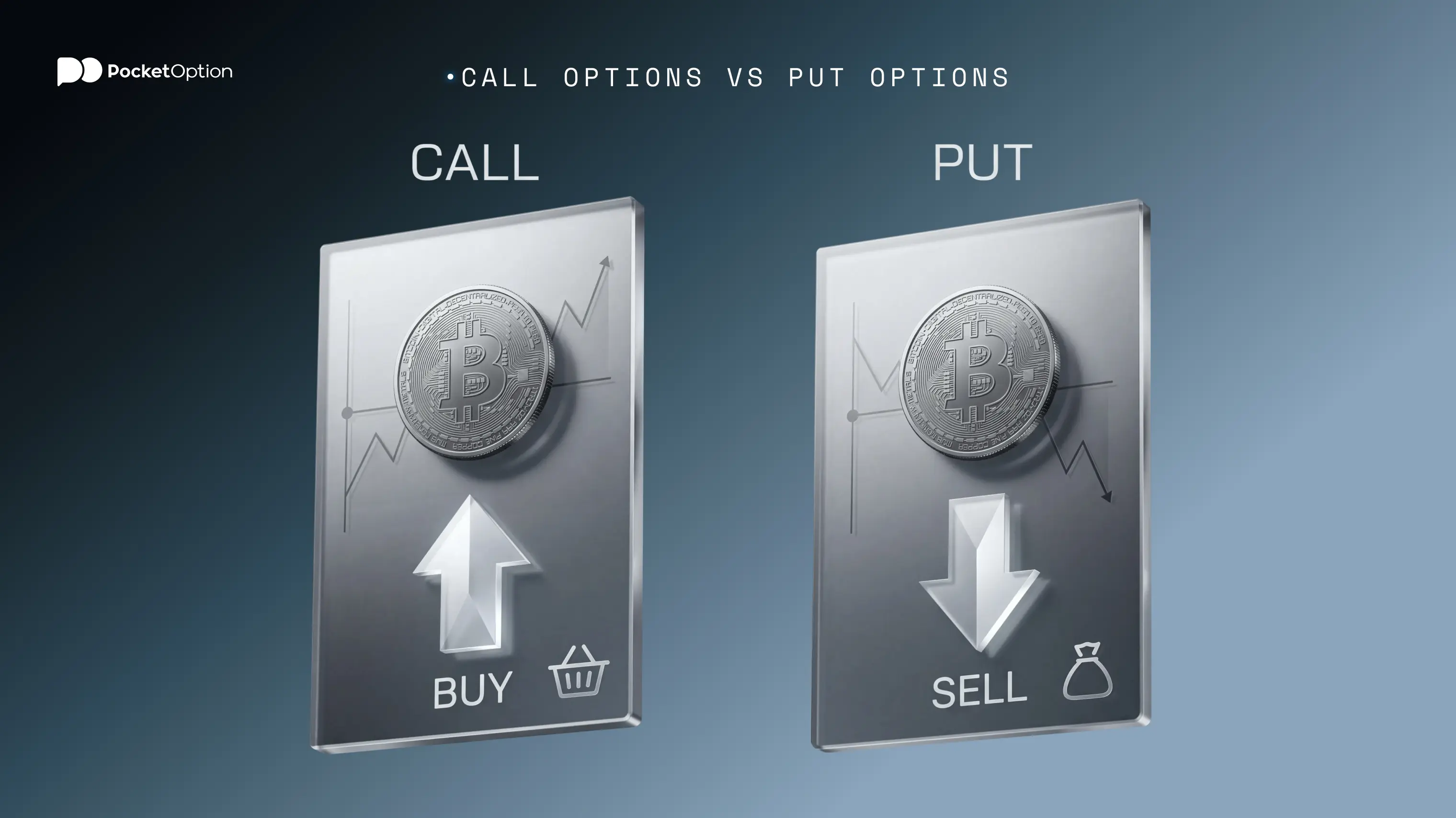
If you have a call option, it means you have the right to buy the underlying coin at the price specified in that option (before it expires). You buy it hoping the prices will rise, and then a call will become more valuable. A put option is an inverse of that: it gives the owner the right to sell the coin, at the specified price, before expiry. It is bought with the expectation of a price decline in the underlying asset. Put gains value if market prices are lower than the strike prices specified within it.
Each side of a trade, regardless if you bought call or put, has a counterparty. If a brokerage, an exchange, or anyone sold you a call, this means they must deliver a coin, if you exercise the right for a call you bought. If someone sold you a put, it means they are obligated to buy the coin, if you exercise your right to that put.
Options vs Spot Trading vs Futures: Key Differences
Spot trading in crypto implies selling/buying the coin itself. The transaction settles immediately, and you are now the owner of the coin (even if you have a custodian, such as an exchange).
In comparison, a crypto futures contract is an agreement to buy or sell that coin at a set price at some future date. Buying futures, therefore, is buying those contracts, not the tokens themselves. This can be done using leverage, and both upside (if the transaction will be profitable) and downside are scaled by that leverage.
Options sit apart from both of those. Here, buyer's downside is fixed at the premium. If a trader in spots or futures can lose more of the capital committed to it, then in cryptocurrency options trading the downside is known.
Feature | Spot | Futures | Options |
|---|---|---|---|
Ownership | Direct | Contract, so no ownership | Contract, no ownership |
Max loss for buyer | Full value of the position (if asset goes to 0) | Can exceed initial margin | Just the premium paid |
Leverage | Typically none | Is common | Pre-built into the premium |
Obligation | None after purchase | Must settle or close | Right, instead of obligation |
In regular options the downside is that you pay a premium, or that they can expire worthless if the market doesn’t move as expected. In comparison, a spot position never expires, and you don’t pay anything for holding it, but there’s no in-built leverage, and so the upside might not be as drastic as well. As for the tradeoff for cryptocurrency binary options trading, it's that the win or loss there is just that, binary. You can get a payout if your trade was successful, or you get nothing at all, if it wasn’t. There are no partial profits or trailing stops along the way.
How Crypto Options Trading Works Step by Step
The ‘strike price’ is the fixed price at which the option can be exercised. A call that has a strike below current markets price already has some value (‘intrinsic value’). But if a call has strike above current market prices, then it’s purely a bet on future movement.
‘Expiry’ is the time the contract stops existing. If the date is close (so expiry is short), such options contracts are cheaper. But there is less time for the move to happen, and so the chances for price to reach the intended target are lower. Options with longer expiries cost more premium, but they also have more room to actually play out.
The ‘premium’ is the price an options buyer is paying to open the position. It’s shaped by how far the strike is from the current price, and how much time is there till expiry, as well as how volatile the asset has been. Higher volatility means there are more chances for asset price to reach the intended target, and so the options for that asset can cost more as well (as they can be seen as more likely to be in the profit).
What to Look For When Evaluating Any Options Platform
Not every options platform is worth using. Conducting a short review before committing any real funds is often times considered mandatory. Especially if a platform has a demo account, or provides opportunities for paper trading. For example, you can test crypto trading Pocket Option with unlimited free funds, for however long you like, and see if conditions suit you.
What you should check in any options platform are:
Its regulatory standing.
How long did the platform operate for.
Fee schedule, built-in spread, premiums, payouts.
Strikes and expiries which are available (if its regular options, not binary).
Additional trade systems. The more options a platform has, the greater the flexibility to match a specific view, or find trading opportunities.
Demo account access, to test your strategy with no real capital risks.
Risk Management Basics for Options Traders
On a regular option, maximum loss is the premium, and therefore the first risk-management decision is simply how much premium you should commit to a position. Here, a common starting rule with cryptocurrency trading in general is to risk a small, fixed percentage of total trading capital. Even a string of losses should not meaningfully damage the account. Position sizing matters in options just as much as in spot, futures, and CFDs, even if the loss on any one trade is capped.
The second risk-management decision is time. A regular (not binary) option that is not working well can be closed before expiry, to try to recover some remaining value. If held to the end in hopes of a reversal, value may decay faster as expiry time approaches.
However, in time-bound binary mode, even this risk-management tactic doesn't exist. A trade cannot be closed before its time expiry. This is why cryptocurrency binary options trading is also considered quite risky, despite not having the ability to double down on losses. The contracts there are set from the start, from the moment of an opened trade, and can’t be changed later on, under the normal circumstances.
Simple Strategies for First-Time Traders
Long Call
Simply buying a call option, when you expect a rise in price. Maximum loss in normal options is the premium you paid, meanwhile potential gain is not capped. If you know what is cryptocurrency, you know that a coin's price can experience a drastic rise in price, sometimes hundreds of percentages in a short period. All of this can be a potential gain for a call. This is why buying calls is often considered less risky and more profitable for beginners than buying puts.
Protective Put
Buying puts is often seen as more risky, but a ‘protective put’ can be worthwhile in times of turmoil. It means holding the coin directly (on spot), and buying a put option against it. So if the market drops, this put's gain offsets some of the losses from holding a coin (or a stock), and if the market rises, owning a coin offsets the losses on this protective put. This is essentially having an insurance on a long-term position, that would otherwise be fully exposed.
Straddle
A straddle means buying both a call, and a put, at the same strike and expiry date. This can be worthwhile if you expect a large move, such as from a news event or some announcement, but the direction of the move is not yet clear. Either leg up, or leg down, can sometimes be profitable enough to offset the premium cost for buying both.
Common Mistakes Beginners Make
Most of the losses early on can be attributed to a few errors, such as:
Buying options that have too short of expiries, and so the expected move doesn't have time to actually develop, even if the thesis is correct.
Ignoring the option chain analysis (put-call ratio, open interest).
Trading illiquid strikes that have too wide of a spread, that has an effect on entry and exit prices, making trading as a whole not quite as profitable.
Treating premium as some disposable, small money, and therefore opening more positions than is right for the risk budget. Maintaining lower risk on the whole should often have a priority, if the cryptocurrency trading is a long-term commitment, and not just a few ‘lottery-style’ bets.
Holding a losing option position all the way to expiry date, out of pure hope. Remember that if it’s not a binary option, there’s a possibility to close it early and preserve the remaining value, which can be exercised.
Getting Similar Risk-Limited Exposure Through Quick Trading on Pocket Option
In traditional options, traders have to learn strike selection, correct premium pricing, working around expiry mechanics and premium decay, and understanding how the price can react when the contracts are due. This has to be learned before even the first trade can be placed with some degree of confidence. It’s not an easy task.
In comparison, crypto trading Pocket Option accounts can simplify this logic, and make the learning process far easier. That same directional, limited-risk logic exists in the Quick Trading mode, for many assets, including stocks, metals, and crypto. You pick an asset, and a direction in which you expect its price to trend. The risk amount is fixed (to the size of your total position). You can’t add to that position without opening another trade. You know the risks before a trade is placed, similar to knowing a premium of an option contract in advance. What’s more, you have the ability to test every strategy on a demo account thoroughly, without the need to risk any real money.
This doesn’t exactly replicate one-to-one every mechanic of the regular options contracts. For example, there are no ongoing premium decays or expiry mechanics to manage. You can’t close the trade and sell the contract beforehand, at an opportune time. You have to wait till the exact specified time, pre-determined at the moment of entry. It’s also relatively simpler as there are no strike selections or ongoing premium decays to manage. What carries over, however, are the core ideas of cryptocurrency options trading, which people find valuable in the first place: a decision can be made once, with a capped and pre-determined amount of risk, and there’s no need to actively manage a position after an entry.
Only on Pocket Option!
Start NowConclusion
Cryptocurrency trading through options gives people a way to express their view on likely price direction without uncapped losses, and with pre-determined entries and exits. A loss is usually capped at the premium paid, and that is significantly different from spot or futures trading, let alone CFDs. To some beginners, this seems simpler to manage. However, unless you are trading binary options, understanding things like strikes, expiries, and premiums, is still very important. The other way is to use paper trading to get the hang of it, or trade in a simplified equivalent like Quick Trading with Pocket Option, to understand the base mechanics and key market behaviour.
Disclaimer: Trading options and cryptocurrencies involves risks of capital loss, and thus may not be suitable for all investors. This article is made for educational purposes and does not constitute concrete financial advice. Do independent research and, where appropriate, consult with professionals, before making any trading decision.
See more:Knowledge baseMarkets