Pocket Option Explores: How Did People Buy Bitcoin in 2010
Bitcoin in 2010 wasn't something you could buy with a tap in the app. There was no exchange, no price chart, no simple conversion rate. Instead there was mining, faucets, forum deals based on trust, and that is the environment in which the first Bitcoin billionaires had been born.

Bitcoin in 2010: What the Market Looked Like
At the start of 2010, Bitcoin did not even have a formal price. You didn’t know what you were holding. The only reference was one late-2009 Bitcointalk peer to peer forum trade, where 5,050 BTC were exchanged for $5.02 to PayPal, just for fun. This implied a BTC price roughly $0.01. However, since there was no exchange and no liquidity, trading even a few BTC was a difficult task. You would need to do it within your community, directly, 1 on 1.
The ‘BTC crowd’ was composed mostly of cryptographers, programmers, and hobbyists who'd found the blockchain idea fascinating through Satoshi Nakamoto's original forum posts. Barely anyone else knew about the blockchain, or could understand mining or hashrate.
That, however, changed gradually throughout the year, as Bitcoin in 2010 underwent a graduation ceremony: the first few pieces of an actual market (an exchange, real trading volume, and outside attention) started to show up around this time.
Main Ways People Acquired Bitcoin in 2010
Mining Bitcoin at Home with a Regular PC
People didn’t know how to buy Bitcoin in 2010, this was a foreign concept to them. That is why most of BTC was acquired by CPU mining at home. There was no need for GPU mining even: a simple processor could cough out around 70-100 BTC per day, due to very low mining difficulty. Each block reward was 50 BTC at the time, and getting 1 or 2 blocks discovered per day was relatively easy.
However, that changed partway through the year. On May 10, 2010, Laszlo Hanyecz (later known for his famous 2 pizzas purchased for 10,000 BTC) developed and posted his mining software to popular Bitcointalk forum. That software could now use GPUs instead of CPUs. This significantly sped up the mining process, and ramped up the competition for coins. GPUs were capable of performing the task 50-100 times faster, and by July 2010, there were already dedicated GPU mining farms that were mining hundreds of Bitcoin a day. They were starting to sell coins for profit, and the secondary market was beginning to form, where people were asking how did you buy Bitcoin in 2010, and how to sell acquired BTC. At Bitcointalk transactions hit a record peak, and the first mining pool, Slush's Pool, launched in September 2010.
By the end of the year, first basic BTC exchanges were running, and total network mining power had increased by 130,000% since the start of the year. CPU mining at home, still fully viable and even profitable in January, was obsolete by December.
Free Bitcoin Faucets and Small Giveaways
Every early enthusiast had a lot of Bitcoin, and the priority to most of them was onboarding. They didn’t mind giving away free BTC, if it meant encouraging more people to use the network.
That is why, in June 2010, Bitcoin Core developer Gavin Andresen launched a simple, but by now historical website called ‘The Bitcoin Faucet’. It was giving away 5 BTC automatically to anyone who solved a captcha, directly to their wallet. At the time Bitcoin was still worth fractions of a cent, so giving away 5 BTC cost almost nothing, but new users had to download the software, and create a wallet, to receive the payment. At the peak in 2025, those 5 BTC, earned for free, would be equal to more than $625 000.
The faucet drained quickly and went offline before long, but it was many people's first exposure to holding any BTC at all. So if a question is, how did people buy Bitcoin in 2010, the answer is: some people didn’t. They literally were given it for free, they didn’t even have to mine for it. After the first one launched, Bitcoin faucets and giveaways became a somewhat common occurrence in 2010 and even 2011.
Peer-to-Peer Deals on Forums and Chat Rooms
Before any exchanges, the main marketplace was the Bitcointalk forum, where most developers and enthusiasts congregated. Users talked to each other directly, and negotiated trades with each other in threads, direct messages, and IRC chat rooms. Often thousands of Bitcoins were exchanged for a few dollars directly to someone’s PayPal. The amounts were small enough that people just trusted each other.
The most famous transaction of all time happened with Bitcoin in 2010: Laszlo Hanyecz's pizza purchase. On May 22, 2010, Hanyecz posted a topic "Pizza for bitcoins?" on Bitcointalk, and offered 10,000 BTC for two pizzas. Someone else took the trade, and received his BTC. Since there was no exchange rate, that transaction actually marked the price of Bitcoin for a while. Since each pizza was worth around $12 at the time, that put Bitcoin’s price at roughly $0.24 (~ a quarter of a cent). This was considered not a great deal for the pizza seller (BTC receiver), as he could’ve easily negotiated a cheaper price with other peer to peer forum trades. That said, it was treated more as proof of concept, for both parties involved.
The transaction is now commemorated annually as ‘Bitcoin Pizza Day’, celebrated on May 22 each year. With Laszlo, a person buying the pizzas (who later became a multi-millionaire of his BTC mining anyway), mocked for how silly his decisions seemingly were.
First Experimental Exchanges and Bank Transfers
Real price discovery for BTC started on March 17, 2010, with the launch of BitcoinMarket.com, the first dedicated Bitcoin exchange. It was proposed on Bitcointalk forum by a user ‘dwdollar’, and launched two months later. A few early trades there priced BTC at around $0.003.
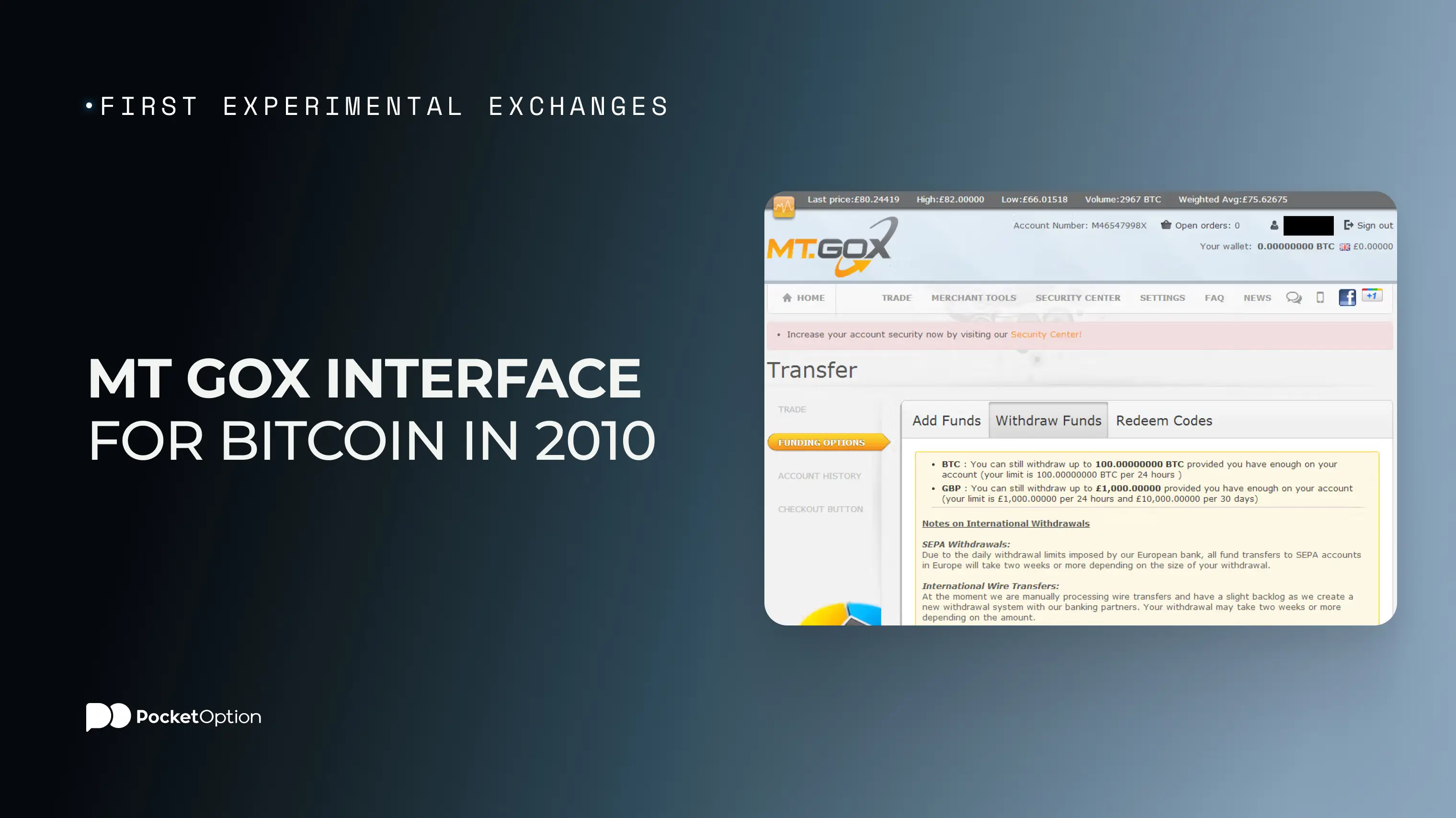
Infamous Mt. Gox exchange followed in July 2010. Originally built as a trading site for Magic: The Gathering cards, it was remade into BTC selling ground. The first trade there was completed on July 17, 2010: twenty BTC were traded for $1. This marked the price for $0.04951 each, accounting for exchange fees.
Both exchanges had practically no UI to speak of. To trade for BTC, you had to first send a bank wire to small exchanges, and a person at Mt. Gox or BitcoinMarket had to manually receive it, approve it, and link it to your account. Despite such complexity, that is how did people buy Bitcoin in 2010. It was nothing like the instant card purchases, BTC ATMs and e-walets available today.
How Prices Moved in 2010, from Almost Zero to Cents
Period | BTC Price (USD) | What Happened |
|---|---|---|
Early 2010 | ~$0.003 | BitcoinMarket.com launches, first real price established |
May 22, 2010 | ~$0.0024 (implied) | The pizza purchase |
July 2010 | ~$0.05-$0.08 | Mt. Gox launches; a few articles about it drive outside attention, increasing price |
Oct-Nov 2010 | ~$0.10-$0.25 | Trading volume and GPU mining ramp up |
December 2010 | ~$0.30 | Year closes 100 times above the January starting point |
Even if a 100x move sounds dramatic, in actuality it happened in a market with only a few thousand participants and almost no infrastructure. This is a very different situation from the same 100x move in a developed market with millions of users and real exchanges, not just Bitcoin faucets, giveaways, and peer to peer forum trades.
Where and How Early Buyers Stored Their Bitcoin
Storage for Bitcoin in 2010 was extremely primitive and limited by today's standards. It consisted of:
The Bitcoin Core client (called Bitcoin-Qt back then), which stored a wallet file locally, along with an entire full copy of the blockchain, which was rather impractical.
Text file backups (private keys copied into a plain text file), a common, if risky, backup method.
Paper wallets, with keys printed and kept offline; these existed but weren't standard practice yet.
There were no hardware wallets at the time, no 2FA, and no established security norms. A lot of wallets and hard drives were lost, a lot of keys were forgotten. One corrupted file could mean permanently lost coins, all of them. This is what happened to a meaningful number of early holders.
What if I Bought $10,000 BTC in 2010?
Initial BTC price: ~$0.04
Bitcoins bought: 250,000
Peak value of BTC in 2025: ~$125,000
Potential net worth: $31,25 billion
How Buying Bitcoin in 2010 Differs from Today
Difference | 2010 | Today |
|---|---|---|
Access point | Forums, IRC chats, a couple of very experimental exchanges | Established, regulated exchanges, proper ways to trade BTC with safety and guard rails |
Liquidity | A few thousand active users, one transaction can take days to happen | Millions of investors and traders, deep order books that work instantly |
Funding | Manual bank wire to small exchanges, PayPal | Instant card, e-wallet, direct crypto deposits |
Price discovery | Set informally, one forum trade at a time | Continuous, real-time, broad |
Security | Local files on PC, no standard practices | Hardware wallets, 2FA, custodial insurances |
Buyer protection | None; just a trust in someone from your forum | Exchange-level dispute processes |
Lessons Modern Traders Can Take from the 2010 Era
The lesson from Bitcoin in 2010 isn't "buy early and hold". It's that new technology is always risky. A lot of early adopters became rich, but some were left with nothing due to hacks, lost wallets, or simply selling all their BTC for $0.0003 a pop. Modern BTC investments and trading offer a lot more protection, and thus reflect a fundamentally different set of market dynamics, where a price growth of 100x in one year is unlikely.
What does carry over from 2010 is the underlying discipline. Those who retained their profits kept their coins in a few baskets, and were treating custody and security seriously. They were trading infrequently, waited for a long time to sell, and recognized that volatility can cut in both directions. Some exited the crypto market in 2017, when BTC ran to $20,000, some in 2021, when price reached $69,140, some are still holding today. The most successful early adopters were patient and kept their keys to themselves, rather than giving all of their BTC to the exchange.
If you're exploring crypto markets today, our Bitcoin trading guide covers how crypto trading actually works today, and why a demo account is the most reasonable way to get familiar with the current trading environment.
on Pocket Option Demo Account
Open Demo AccountDisclaimer: This content is provided for informational and educational purposes only. It does not constitute financial, investment, or trading advice. It is not a recommendation to buy or sell any instrument. Do your own research before acting.
See more:Knowledge baseLearning