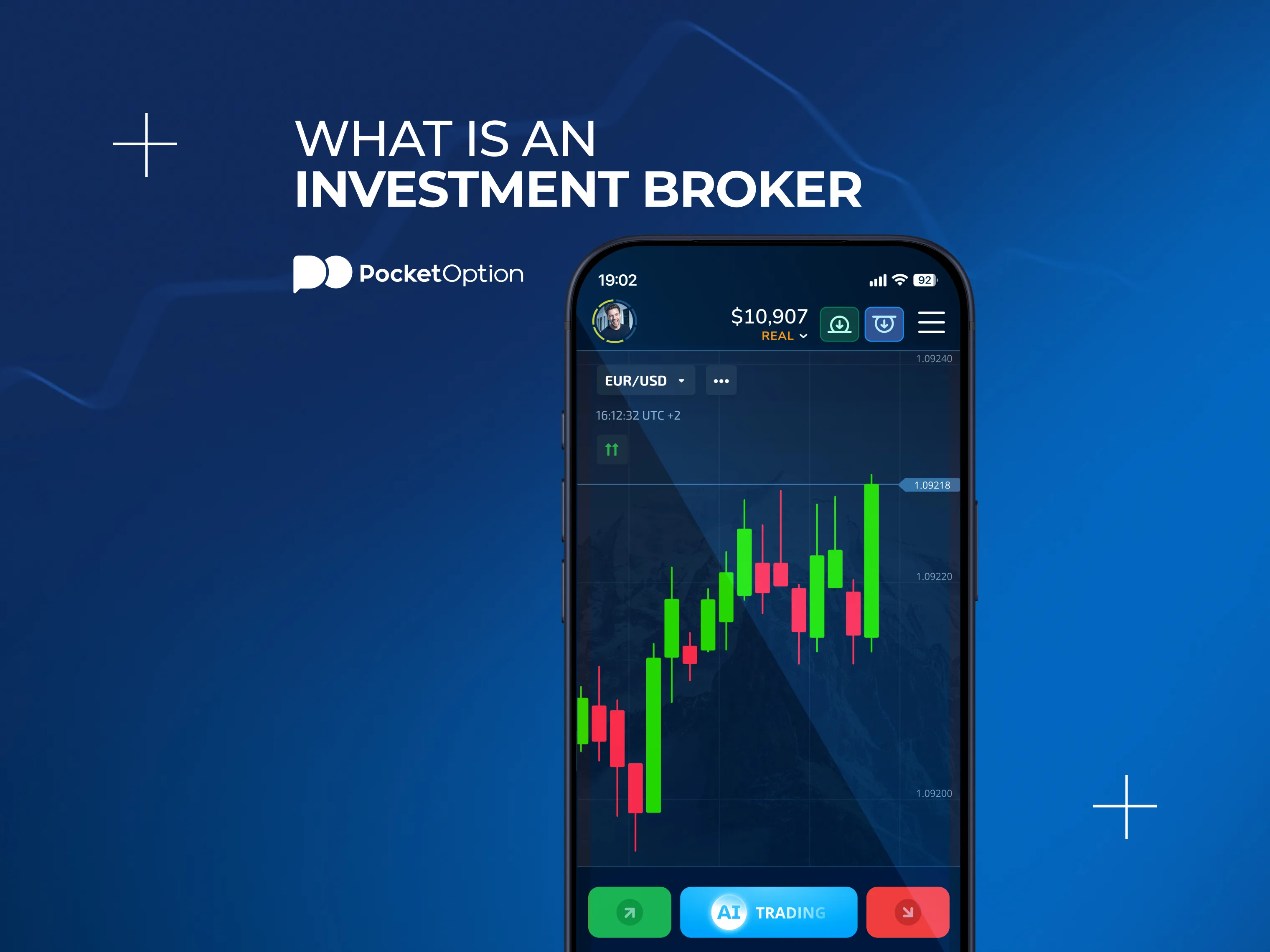
Investment Broker: How Pocket Option Fits into Your Choice of Trading Platforms
The wide expansion in the context in which the word “broker” is used means that it no longer has a precise definition. A wealth management firm, an execution venue, and even a mobile application for buying fractional shares are all classified as “broker”, even if these serve widely different purposes and are regulated differently. Below we will look closer at what an investment broker is, see the difference between the categories, understand the criteria for choosing a trading platform, and then assess how Pocket Option fits into this picture, what it provides, what it doesn't, and whether you need it.

What Is an Investment Broker
Investment broker is an intermediary who helps clients purchase and sell financial products. Brokers stand between the trader and the stock market (or other exchange), execute the client's orders, and, sometimes, store the purchased financial instruments.
The income of the brokers is usually made up of commissions or spread (or both). They can charge for each transaction or have zero commissions but make a higher spread. It's important to understand the fee structure of the brokers since it might be quite different, and this point should be considered while making a choice.
The term "broker" includes a wide range of financial institutions that include institutional brokers for hedge funds and individual brokers for retail clients. The services and responsibilities vary greatly in these categories.
Broker-Dealer vs Investment Advisor: Key Difference
Understanding the differences between a broker dealers and an investment advisors is considered to be one of the most important differences, but also one of the least known, among average investors.
A broker dealer can be either a company or an individual who buys and sells investments either for clients (brokerage business) or for themselves (dealing business). This kind of relationship involves a transactional process because the broker-dealer simply carries out the order of his client and gives him advice about products.
An investment advisor is more focused on providing long-term financial advice to clients. Investment advisors are usually paid via fees that depend on the amount of managed assets rather than commissions for each transaction.
The difference between an investment advisor vs broker dealer is significant and important for the quality of service.
Fiduciary Standard vs Best-Interest Standard
It is here where the difference between the broker vs financial advisor really matters. Financial advisors who are registered under the Investment Advisers Act have fiduciary responsibilities. What this entails is that the advisor has to put the interests of his clients before anything else and he has to reveal any conflict of interest.
Broker dealers in the US work to a different standard. Under Regulation Best Interest, in force since June 2020, a broker dealer making a recommendation to a retail customer must act in that customer's best interest and must not place its own financial interest ahead of theirs. That obligation covers disclosure, care, conflicts of interest and internal compliance. It is stricter than the older suitability standard, which only asked whether a recommendation fit the client's profile, and it stops short of the ongoing fiduciary duty an investment adviser owes under the Advisers Act.
Understanding the difference between broker dealer vs investment advisor can help an investor figure out whether the party he is working with has his best interest at heart or not.
What to Look for When Choosing a Trading Platform
The specifics of each type of investing require some unique features from the trading platform, but there is a common list of key aspects:
regulation and licensing;
types of assets available on the platform;
fee structure;
execution speed;
availability of trading tools and analysis options;
the ability to use demo account.
Asset Access and Instrument Variety
The types of platforms differ in their specialization and the types of assets which can be traded there. Thus, some platforms are specialized in stocks only; others are limited in forex trading only. This aspect is significant since it determines whether one platform will be enough for all kinds of trades or whether several accounts will be necessary.
One of the features which should be considered is the kind of assets which the platform provides. If one decides to engage in the stock market, it is necessary to know whether the platform allows having stocks directly (that means having dividends and voting rights) or providing the contracts for difference with the prices close to the real stocks' ones.
Fees, Spreads, and Execution Speed
One of the hidden expenses is trading fees. It is obvious that the commission is one of them. But there are some additional costs which can decrease the trading income: spreads, overnight financing, withdrawal, inactivity fees. If the platform promotes "zero commission" trades, they can increase the spreads that have to be paid on every trade.
The execution speed is an important feature especially for short-term trading. One second delay in executing the order may influence its result considerably. For long-term investing, the speed is not important but the reliability of the platform is.
Tools That Matter: Charting, Indicators, and Demo Accounts
The range of analytical capabilities available on the platform directly correlates with the amount of external software required from the trader. Integrated charting and analysis, together with drawing tools and economic calendars, significantly minimize the need for external charting services. On the contrary, limited analytical capabilities of a platform drive a trader to the use of external charting services, complicating the process even further.
The demo account is not a nice-to-have, but a necessary testing ground. Platforms which do not provide such an opportunity raise doubts and require additional caution because they restrict their potential customers from a proper testing of all features, executions, and trading experience without risking any funds.
Where Pocket Option Fits as a Trading Platform
Pocket Option is a trading platform which provides access to various financial instruments: forex pairs, commodities, indices, stocks, and crypto. Trading formats include Quick Trading, which runs on a fixed expiry, and MT-format trading, where positions stay open until closed manually or by a stop-loss or take-profit order.
Pocket Option is not a wealth management platform, robo-advisor or retirement savings service. The platform is designed with active traders in mind.
What Pocket Option Offers: Assets, Demo, and Indicators
Range of assets: currency pairs, metals like gold and silver, indices like the S&P 500 and DAX, stocks and cryptocurrencies.
Demo trading account: filled with virtual money, to replicate the real market, and is available upon signing up without requiring any deposit.
Charts and indicators: a set of indicators included in the platform, including RSI, MACD, moving averages, Bollinger bands, and trendlines for key support and resistance areas.
Economic calendar: a schedule of economic events, which can affect your assets.
Quick Trading: an instant execution trading option, helpful for honing your timing skills.
Trade platform with 4.6⭐ on Google Play
Get StartedWhat Pocket Option Is Not: Setting Realistic Expectations
In the range between broker vs investment advisor, Pocket Option doesn’t fall into either. There is no personal financial advisory service provided. The company is not an investment adviser, nor it manages any portfolio or makes any recommendations about asset allocation and retirement plan.
Pocket Option is a trading platform, with brokerage services provided by Infinite Trade LLC. It is not a registered US broker dealer and not an investment adviser, and it does not provide personalized investment advisory services. You get the tools and market access. The analysis, the decisions and the risk management stay with you.
That is why if you are counting on getting some advisory services, you are going to be disappointed. But, on the other hand, if you want to have a lot of freedom to make your own decisions and get a set of analytical instruments, this is your platform.
How to Decide What You Actually Need From a Broker
There are three important questions one has to ask in order to choose the right platform:
Do you need an advisor or execution? If you expect a person to give you an advice and tell you what to buy and when to do it, then you will need a financial advisor and not a platform for trading. On the other hand, if you prefer taking decisions by yourself and having the means to act on them, then a platform such as Pocket Option is what you need.
What assets do you wish to trade? The platform has to offer the assets you plan to trade, including competitive spreads and good execution.
How experienced are you? If you are a beginner, you will need a demo account to test your skills in trading. Experienced people can use a demo account as well, just as the testing time to evaluate the platform.
Therefore, the financial advisor vs broker question is not a matter of one being better than the other. It depends on what a person needs in his specific case.
Unlimited funds, available for any strategies
Try Demo AccountConclusion
As mentioned above, the concept of investment broker implies a large range of entities from the full-service financial advisors to execution only platforms. It is important to understand in which place on the spectrum a platform you consider belongs to.
Pocket Option is a trading platform for self-directed traders. It includes a demo account, several financial instruments and the analytical toolkit. The company does not provide any personalized advice or advisory services. This is exactly what traders, who want to make decisions themselves and execute them, need. However, if a person looks for trading advice and small but steady capital gains - another provider can be chosen.
Test the demo. Evaluate the tools. Make the right choice.
Disclaimer: Trading comes with high risks of losing money. The information on this website is provided purely for educational purposes and is not intended as financial advice. You should always conduct your own research and determine your level of risk before starting to trade.
See more:InterestingTrading platforms