HFX Trading Platforms: What Is HFX Trading & How to Get Started
A trade that opens and closes inside a minute leaves no room for sluggish platforms or slow decisions. That is the essence of HFX trading when positions are opened and closed within the range of 5 seconds to several minutes, and only the speed of execution really matters in such a case. This guide reveals what HFX trading is all about, which features are typical for a real HFX platform in comparison to a regular one, how top HFX trading brokers of 2026 differ, and gives step-by-step instructions on making your first fast deal as well as the rule of risk management for short term traders.

What Is HFX Trading?
HFX means high-frequency forex trading. It is a specific approach based on numerous short-term trades lasting for several seconds or minutes, mostly on currency pairs. The key difference from conventional trading lies in the period during which the asset's movement in this direction or that is predicted and acted upon.
A short note on the meaning of HFX. It often gets mixed up with HFT - high-frequency trading. High-frequency trading (HFT) refers to institutional firms using algorithms to send thousands of orders in one second from servers located near exchanges. HFX is also a kind of high-frequency but much simpler trading style that is used by retail investors.
Characteristics of HFX trading style:
Positions last for several seconds or minutes instead of days
The specific outcome time window for each trade: you know your profit/loss prior to opening
Liquid markets are used, forex trading pairs being the main one
Many decisions instead of fewer large ones
The need to act quickly shrinks the time for everything. The entire work on analysis, decision-making, and execution takes less time than it takes your cup of coffee to cool down. Some traders enjoy this kind of dynamic while others get tired of it easily.
How HFX Trading Platforms Work
High-speed trading needs fast trading infrastructure. If a trade is made within thirty seconds, any delay of two seconds in clicking and executing can change the final outcome of the trade. This issue has been solved by high-frequency trading (HFT) platforms through the following technical stack:
Low-latency order routing: Orders will be executed within fractions of seconds, based on current market prices.
Real-time market data feed: Price changes are seen by each tick on the charts. Outdated quotes will make short-term trades impossible.
Short-term contract engine: The platform needs to be capable of dealing with contracts with expiration from seconds and instant settlement.
Fast interface: One-click trading, countdown timers, and real-time charts. For HFT platforms, the interface is a part of the execution flow.
This means that such systems require large-scale server infrastructure and high uptime requirements. A system which does not work properly during newswires is failing its customers right when they need it the most. This is why infrastructure is the most important thing to consider about a platform, rather than its marketing.
Key Features to Look for in an HFX Trading Platform
Having one consistent checklist will make it easier to compare different HFX trading platforms. The following are six elements that play an important role in the process:
Speed of execution. This is the period between clicking and the transaction being executed. Some brokers provide information about their average speed of execution; it’s better if they do.
Variety of expiration times. Having many options for the duration of trades – from a couple of seconds up to a number of hours – gives you flexibility.
Trading tools. Technical analysis tools should be built into the platform. Switching between windows will cost you valuable seconds.
Clear payout conditions. You should have all the information regarding your potential earnings and risks before you execute any trade.
Demo account. Fast trading requires certain skills and experience. You can try using virtual money first.
Low minimums. This will allow you to test the waters without risking much.
Best HFX Trading Platforms & Brokers in 2026
There are four names that always get mentioned when it comes to the best HFX trading platforms. Here is a brief overview followed by a detailed discussion of the last one.
Nadex
The CFTC-regulated US exchange offering contracts with fixed risk per trade. Nadex would be a good choice for traders in the United States who prefer the model of the exchange and complete regulation. The only drawback is a rather complicated interface and logic of the contracts, which makes Nadex more attractive for experienced traders.
IQ Option
The broker that is famous for its well-designed proprietary platform for web and mobile devices, short duration of trades and great charting. The design reduces the entry barriers. However, availability may vary according to regions and there are fewer assets available compared to other brokers.
Binary.com
A classic name that has been working since the early 2000s and is known for its custom contracts and synthetic indices for volatility traded 24/7. The brand has moved its operations to Deriv, but the products remain the same. It attracts intermediate traders due to unique instruments.
Pocket Option
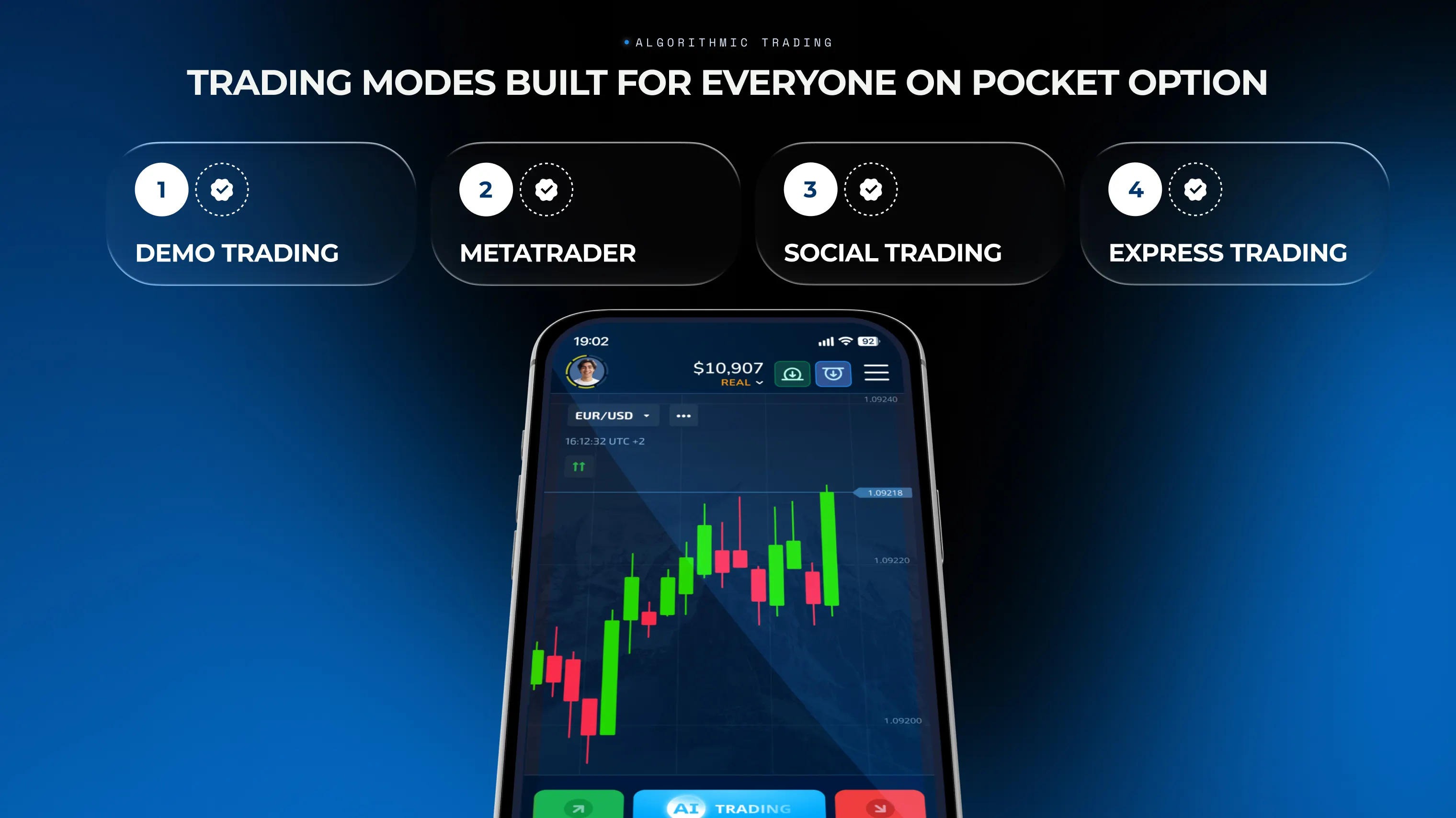
A platform built around fast execution, with the minimal trade duration of 5 seconds, the minimal trade of $1 and the minimal deposit of $5. Apart from its Quick Trading mode, the platform offers social trading, access to MetaTrader and analytics in the same account.
Before going further, a quick note for every comparison, including this one: the conditions, features and availability of the brokers may change, so make sure you check them on the official websites.
Why Pocket Option Stands Out for HFX Trading
There are three features which make a HFX strategy possible to implement on this platform:
Quick Trading Mode
Quick Trading is the basic tool of HFX strategy offered by Pocket Option. You select an asset, specify the amount and a term ranging from 5 seconds, and choose direction. There is one unique feature of Pocket Option which attracts the attention of all traders: a payout of major forex pairs equals 92% of the trade amount, and it is known as one of the most advantageous payouts in the industry. The mechanics of Quick Trading are quite simple and transparent - if you predicted correctly, you will receive your initial amount along with the payout. If not, your amount will be deducted from your balance. Both numbers will be known before the transaction.
MetaTrader Integration
Pocket Option connects to the MetaTrader platform, which is considered the standard platform for forex trading and CFDs, as well as the most popular environment for algorithmic trading. This feature is important due to the nature of HFX strategy, as in real trading most high-frequency traders have automated their systems and use Expert Advisors on MetaTrader.
Social Trading & Analytics Tools
In the Social Trading tab, one can see other traders' profiles and copy their trades in his own account with a desired account size. It is a great lesson for beginners on how experienced traders perform their short-term trades. One should keep in mind the common restriction about copying both profitable and unprofitable streaks, as past success does not guarantee future results.
All analytics are available right below the chart: there is a trader sentiment indicator showing how other users think about the asset, there are technical indicators like RSI, Bollinger Bands and MACD, and one can also analyze his trading history.
How to Start HFX Trading on Pocket Option: Step-by-Step
From zero to your first lightning-fast trade:
Register an account. Registration is available straight in your browser via web interface, and there's also an app version of the platform for iOS and Android.
Go through demo practice. Start trading on a free demo account, which is set up automatically in your personal area. Speed affects the trading experience, and with a demo account you will figure out if it fits you, without risking real money.
Pick a liquid asset. High-frequency trading takes place on major forex pairs such as EUR/USD since prices never stop moving on them and spreads are low.
Do your analysis. Open one or two indicators on the chart, take a look at the sentiment tool and make your prediction regarding the price movement in the upcoming window. A trade without analysis is like betting on heads or tails just with more steps involved.
Choose the amount and expiration time. Start trading with $1 minimum while you learn to trade and pick an expiration time that corresponds with your analysis, starting from 5 seconds.
Select direction and execute the trade. Choose UP if you think that the price will increase by the expiration, and choose DOWN if you think it'll decrease.
Keep an eye on your track record. All your positions get recorded in your trading history, and analysing your performance and your trades teaches you more than any article.
on Pocket Option Quick Trading mode
Best HFX tradingRisks and Tips for HFX Trading
Speed amplifies results, and it applies in both directions. A large number of trades per session leads to faster profit accumulation in case your analysis was right, while, in the other case, the same occurs with losses. And such openness is always the starting point of any honest discussion on HFX trading.
It is risk management that defines who survives. Those traders who are able to withstand the periods of loss make it to the top in high-frequency trading because, in this approach to trading, periods of loss are not just a possibility but inevitability. Reliable rules are:
Fix and stick to your trade size. Make it consistent and equal to some fraction of your balance. Do not change it in order to recoup a loss.
Make a stop loss per day. Plan ahead what amount of loss you are ready to take per day and stick to it. The market opens tomorrow.
Limit the number of trades. Fatigue degrades decision-making ability. It is unlikely that fifty rushed trades outperform fifteen well thought out.
Review your trading results once a week. It will show you which assets, periods and hours bring you profit and which do not. Trade more from the profitable period and less from the unprofitable one.
Trading is a skill developed through time, and speed cannot substitute this process.
Disclaimer: Remember that financial markets are volatile and prices can move against you quickly. Past performance is not indicative of future results. Only trade with funds you can afford to lose.
See more:InterestingTrading platforms