What Is Take Profit and How Do Take-Profit Orders Lock In Gains?
Deciding when to exit a winning trade can be harder than deciding when to enter. A take profit settles that question in advance: it is an exit price set before the trade moves, so the gain is closed automatically once the market gets there.

What Is Take Profit
Take profit is an instruction to close a position automatically when the price reaches a chosen level in the trader's favor. That price is the take profit level. The order sits on the platform's servers, so it works even when the trader is not watching, and it closes the whole position, or part of it on platforms that allow partial exits. Its purpose is to turn an unrealized gain into a realized one at a price decided in calm conditions.
How a Take-Profit Order Works
A take profit order follows a simple sequence:
The trader opens a position and sets a price for the exit.
For a long (buy) position, the level sits above the entry; for a short (sell) position, below it.
The order stays inactive while the price moves elsewhere.
When the market reaches the level, the platform closes the position automatically.
Most platforms handle a take profit as a limit order, so it fills at the set price or better. It can be added when the trade is opened or later, and changed or cancelled while the position is open.
A Simple Example
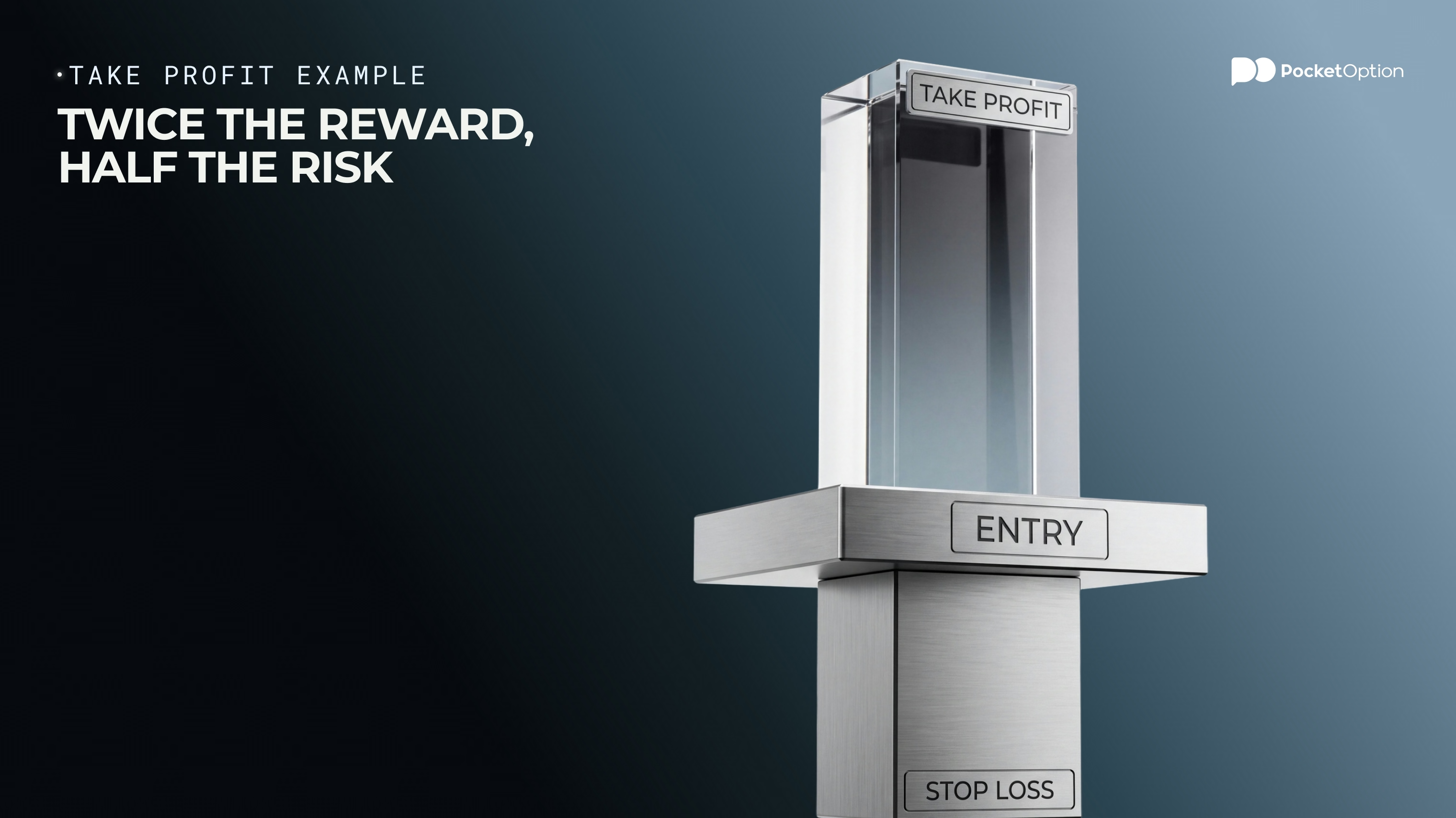
A trader buys a stock at $100, sets a take profit level at $110 and a stop-loss at $95. If the price rises to $110, the position closes with a gain of $10 per share; if it falls to $95, the stop-loss closes it with a loss of $5 per share. If neither level is reached, the position stays open.
The setup risks $5 to make $10, a 1:2 risk-reward ratio, and both outcomes are known before the trade starts. Planning exits this way is a core part of day trading risk management. For a short position opened at $100, the same take profit would sit at $90.
Take Profit vs Stop Loss
Feature | Take profit | Stop loss |
|---|---|---|
Purpose | Locks in a gain | Limits a loss |
Level for a long position | Above entry | Below entry |
Level for a short position | Below entry | Above entry |
Typical order type | Limit order | Stop (market) order |
Traders often set TP and SL together. On many platforms the two are linked, so when one is filled the other is cancelled automatically, an arrangement known as one-cancels-the-other (OCO).
The Role of Take Profit When Closing a Position
When the take profit is triggered, three things happen at once: the gain is locked in, the trade ends, and any linked stop-loss is cancelled. The trader no longer needs to watch the chart or decide under pressure whether to hold for more. That removes a common source of error, since greed and fear tend to grow as a position moves, a pattern discussed in trading psychology for beginners. A preset exit also keeps results in line with the plan used to judge the strategy.
Limits of Take-Profit Orders
A take profit does not guarantee a profit. Its main limits are:
Opportunity cost: if the price keeps rising after the exit, the extra move is missed.
Execution: if the price only touches the level briefly, a limit order may fill partly or not at all, and platforms that close at market can fill at a different price in fast markets or after a gap.
Distance: a level set too far away may never be reached, and the trade can turn into a loss.
Some traders combine a take profit with trailing stops or partial exits, options covered in this guide to trading exit strategies.
Conclusion
Take profit is a preset exit that closes a position automatically once the price reaches a chosen level, locking in the gain and ending the trade. Set it before entering, place it where the market can realistically reach, pair it with a stop-loss, and accept that it may cap a larger move or fill differently in fast markets.
Test your exits with virtual funds.
Try DemoDisclaimer: Trading involves significant risk of capital loss and may not be suitable for all investors. Past performance does not guarantee future results.
See more:Glossary