
What Is Maintenance Margin and How Is It Calculated?
One deposit gets a position open. A smaller, moving one keeps it open. Confusing the two is how traders end up surprised by a call they were sure they had room to avoid.

What Is Maintenance Margin?
The maintenance margin definition is short enough. It is the least equity that has to stay in the account for a leveraged position to keep running.
Note the word stay. This is not what was paid at the start. It is a floor, checked continuously for as long as the position is open, and because the floor is set as a percentage of what the position is currently worth, it moves whenever the price does.
Fall through it and the broker acts. What follows is a margin call, or a liquidation, or both in quick succession. Those are consequences rather than part of the definition, and margin calls and forced liquidation are worth reading on separately.
Maintenance Margin vs Initial Margin
Initial margin vs maintenance margin is a distinction of timing more than of anything else.
Initial margin | Maintenance margin | |
When it applies | At the moment of opening | Every moment afterwards |
What it measures | Deposit needed to take the position | Equity needed to keep it |
Typical level | The higher of the two | Lower, often around half |
Does it move? | Fixed once the trade is placed | Moves with position value |
Initial is a gate. Pass it once and the trade opens. Maintenance is a floor and it never stops being checked, which is the whole reason a position can be comfortably funded on Monday and in trouble by Thursday without anyone having touched it.
Leverage and maintenance margin pull against each other as well. Higher leverage means a thinner starting cushion between equity and the floor, so a smaller move is enough to reach it. Same floor percentage, a lot less room above it.
How Is Maintenance Margin Calculated?
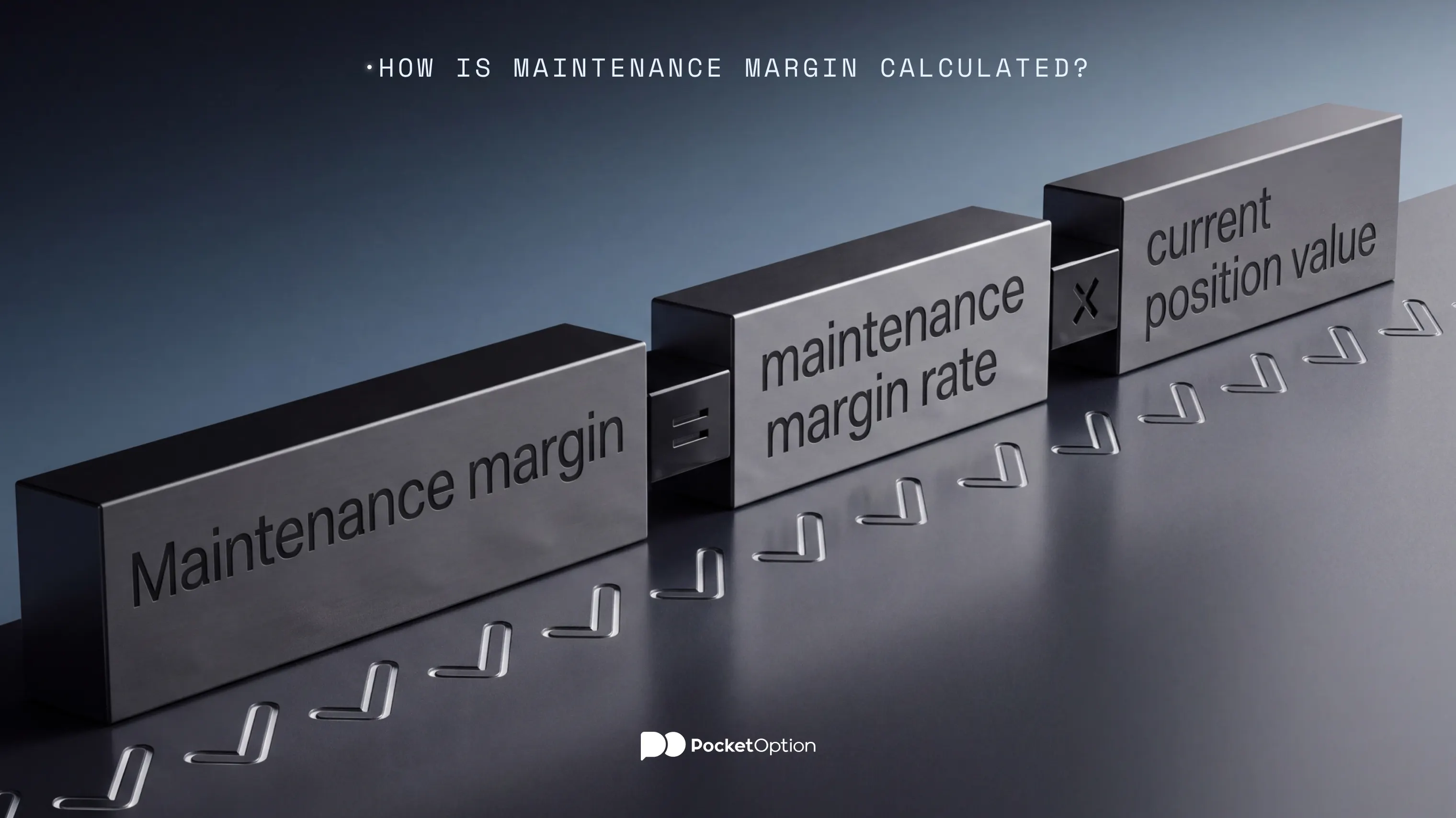
The maintenance margin formula is a percentage of what the position is worth right now:
Maintenance margin = maintenance margin rate × current position value
Against that sits margin account equity, which is the position value less whatever was borrowed to build it:
Equity = current position value minus the borrowed amount
Then the two get compared. Equity above the requirement, position runs. Equity below it, the shortfall has to be covered. Margin requirement calculation is really just those two numbers being worked out again every time the price ticks.
The rate itself is not fixed by anything universal. Regulators set minimums in some markets, brokers routinely set their own higher, and the number can be raised on a particular instrument when volatility picks up. Position value and margin are linked in both directions, which is the awkward part, since a losing position shrinks the requirement too, just never as fast as it shrinks the equity. Anyone new to margin trading in practice tends to find that asymmetry out the expensive way.
Maintenance Margin Calculation Example
Numbers make this quicker. Say 100 shares get bought at $50, on 50% initial margin, with a 25% maintenance rate.
Position value at the start: $5,000.
Deposited: $2,500. Borrowed: $2,500.
Starting equity: $2,500.
Now the price slides to $40.
Position value: $4,000.
Equity: $4,000 less the $2,500 loan, so $1,500.
Requirement: 25% of $4,000, which is $1,000.
Cushion still there: $500.
Fine so far. Slide it further, down to $35:
Position value: $3,500. Equity: $1,000. Requirement: $875.
Cushion: $125. Getting thin.
The level where equity and requirement finally meet is $33.33 a share. Below that the account is short, and the broker can ask for a deposit or close the position out. Note that the loan never moved. The $2,500 borrowed stayed $2,500 whole way through, which is why a fall of a third in the share price took roughly two thirds of the equity with it. Margin in forex trading runs on the same arithmetic with different labels on it.
See the maths before you fund it.
Open Demo AccountConclusion
The $2,500 loan in that example never changed once. Price fell, position value fell, equity fell along with it, and the borrowed half just sat there being the same number it had always been. That asymmetry is the whole of maintenance margin. Knowing the rate on an instrument before opening is less useful than knowing the price at which it starts to bite.
Disclaimer: Trading on margin carries a high risk of losing money rapidly, and losses can exceed the initial deposit. Consider whether you understand how leveraged products work before trading.
See more:Glossary