What Is a Limit Order and How Do Limit Orders Work in Trading?
A limit order is an instruction to buy or sell an asset at a set price or better. It gives control over the price paid or received, but it does not promise that a trade will happen. This entry explains how buy and sell limits work, with simple numbers, and how they compare with market orders.

What Is a Limit Order?
A limit order is an order to buy or sell at a specified price or better. The trader names the worst price that is acceptable, and the order can only be filled at that level or at a more favorable one. The chosen level is called the limit price.
Two terms are worth defining here. Order execution is the moment an order is matched with a counterparty and the trade takes place. The execution price is the price at which that match happens. With a limit order, the execution price can never be worse than the limit.
Limit orders are placed in an order book, which is the list of all waiting buy and sell orders for an asset. Buy orders are known as bids, and sell orders as asks. The best bid and ask prices sit at the top of the book, and the gap between them, the bid-ask spread, is a trading cost in its own right.
How Do Limit Orders Work?
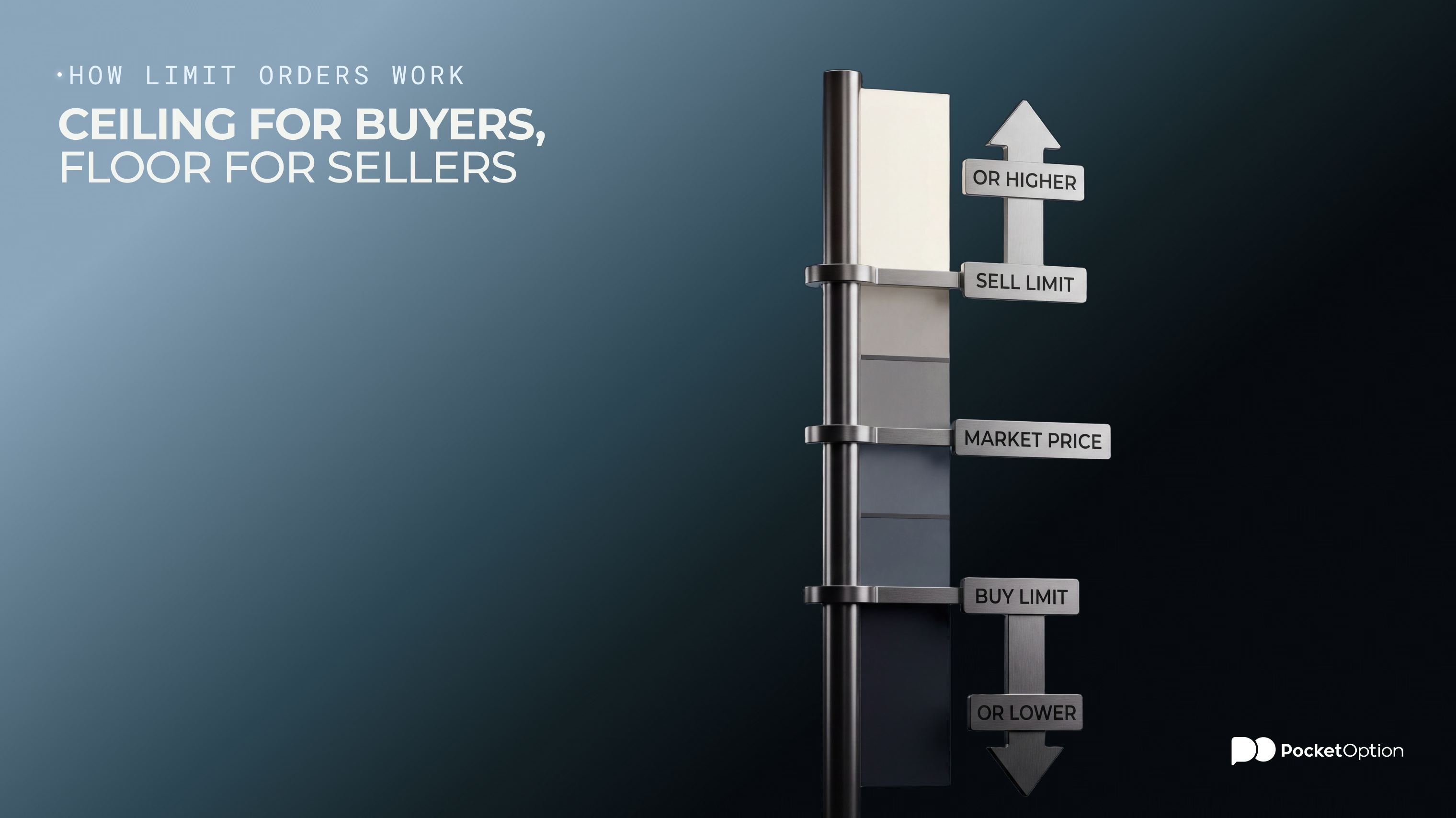
Each limit order sets a boundary on price. The direction of that boundary depends on whether the trader is buying or selling.
Buy Limit Orders
A buy limit order is usually placed at or below the current market price. It executes at the limit price or lower. A trader who wants to buy a share trading at $50, but sees $48 as a fair entry, can place a buy limit at $48. If no seller accepts $48, the order stays open and no shares are bought.
Sell Limit Orders
A sell limit order is usually placed at or above the current market price. It executes at the limit price or higher. An investor holding shares at $50 who wants to sell at $55 can set a sell limit at $55. The order waits until a buyer is willing to pay at least that amount.
Execution at the Limit Price or Better
The words "or better" matter. If a buy limit is set at $48 and a seller offers shares at $47.90, the order is filled at $47.90. This is known as price improvement: the trade is completed at a more favorable price than the one requested.
Reaching the limit price does not guarantee a fill, however. Orders at the same price are generally queued, and those placed earlier tend to be filled first. If the price touches $48 only briefly, the shares offered there may be taken by orders ahead in the queue. Market liquidity also plays a part, since thinly traded assets have fewer orders at each level. The way exchanges match these orders is covered in this overview of how the stock market works.
An order can also be partially filled. A buy limit for 500 shares at $48 might receive only 200 shares if that is all that is offered at $48 or less. The remaining 300 shares stay open until they are filled, cancelled or the order expires.
Buy and Sell Limit Order Examples
The examples below use one hypothetical stock with a best bid of $99.95 and a best ask of $100.05.
Buy limit at $98. The order rests in the book and is filled only if sellers offer shares at $98 or lower. If the price never falls that far, nothing is bought.
Buy limit at $101. The limit is above the current ask, so the order can execute at once. It would typically fill at $100.05, which is better than the $101 limit.
Sell limit at $103. The order waits until buyers bid $103 or more. A fill at $103.20 is possible if a buyer pays above the limit.
Sell limit at $99. The limit is below the current bid, so the order can be filled straight away, typically at $99.95.
In each case, the limit acts as a ceiling for the buyer and a floor for the seller.
Limit Order vs Market Order
A market order is an instruction to buy or sell immediately at the best price available. It puts speed and the likelihood of a fill first. A limit order puts price first.
Feature | Limit order | Market order |
|---|---|---|
Price control | Fills only at the limit price or better | No price set; fills at the best available price |
Execution speed | May wait, or never fill | Usually immediate in liquid markets |
Risk of no fill | Yes, if the price is not reached or volume runs out | Low in liquid markets |
Main risk | Missing the trade | Slippage: a worse price than expected |
Partial fills | Possible | Possible in thin markets |
Market orders can be costly in assets where the gap between bid and ask is wide, because a large order may move through several price levels before it is complete. That is one reason limit orders are often used for small, thinly traded shares, a theme explored in this article on penny stock risks. The trade-off runs the other way as well: with a limit, the price may move away and the trade may never take place.
Conclusion
A limit order sets the worst price a trader is prepared to accept. A buy limit caps the purchase price, and a sell limit sets a minimum sale price.
Test ideas before real money is involved.
Get StartedWhat it cannot do is force the market to that level. A limit order exchanges certainty of price for uncertainty of execution, and the queue at the limit decides whether it fills.
Disclaimer: Trading involves significant risk of capital loss and may not be suitable for all investors. Past performance does not guarantee future results.
See more:Glossary