What Does Depreciation Mean and How Is It Used in Accounting?
When a company buys a machine that will last for years, the cost is not charged against profit in a single year. Depreciation in accounting spreads that cost over the asset's useful life, so each year's profit carries its share of the expense.

What Is Depreciation in Accounting
Depreciation is the systematic allocation of the cost of a tangible fixed asset, such as equipment, vehicles or buildings, over the years it is expected to be used. It follows the matching principle: an expense is recorded in the same period as the revenue it helps produce. A delivery van used for eight years earns revenue in each of them, so its cost is spread across all eight.
Which Assets Depreciate
Depreciation applies to physical, long-lived assets that wear out or become outdated: machinery, computers, vehicles, furniture and buildings. Land is not depreciated, because it has no limited useful life. Intangible assets such as patents or software licences are handled through amortization, which applies the same idea to assets without physical form.
Cost, Useful Life and Salvage Value
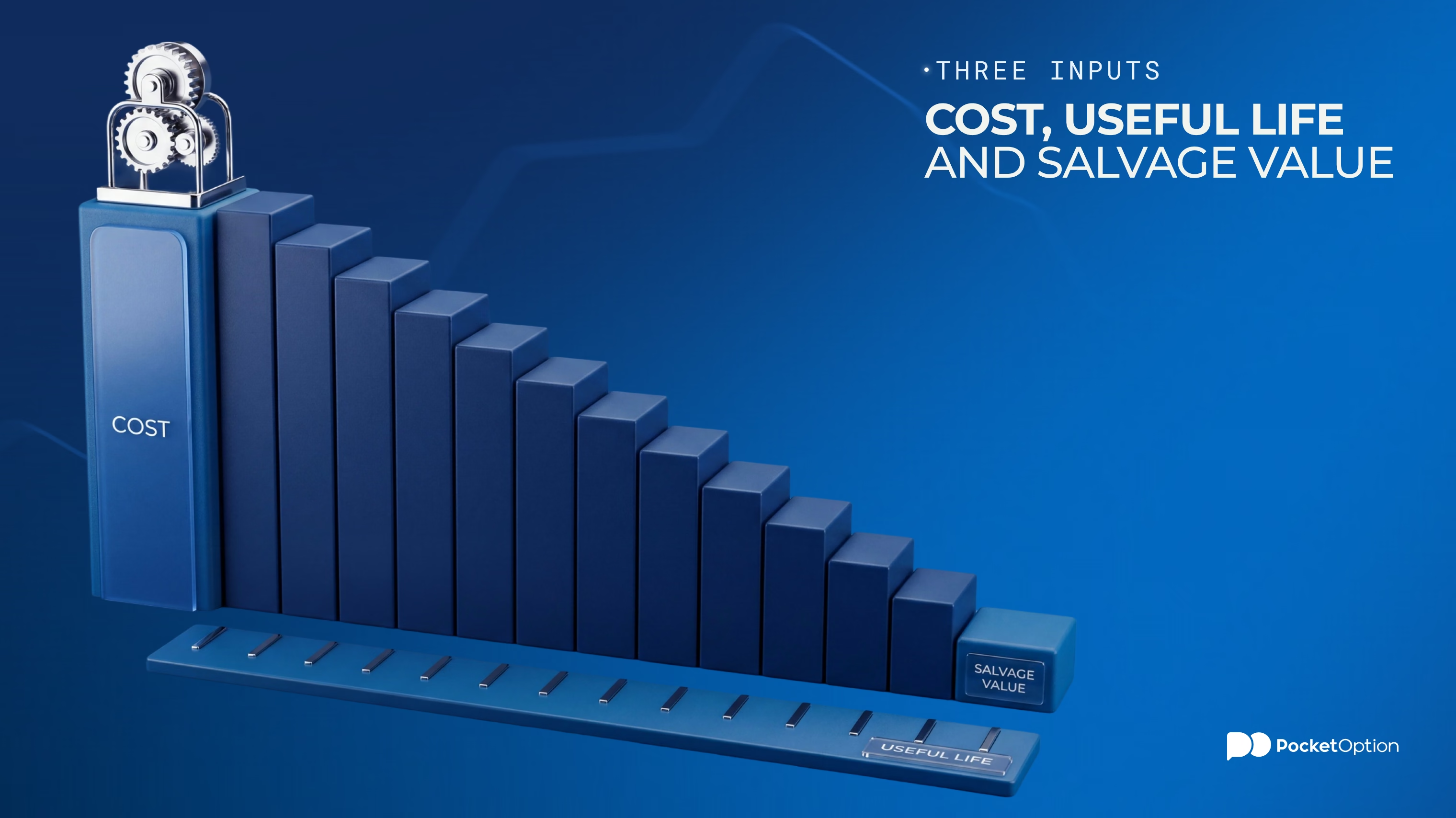
Every depreciation schedule rests on three inputs. Cost is the purchase price plus delivery and installation. Useful life is the period, or number of units, over which the asset will be used. Salvage value is what the asset is expected to fetch at the end of that life.
Cost minus salvage value gives the depreciable base, the total to be expensed. Useful life and salvage value are management estimates and can be revised.
Main Depreciation Methods
Four methods are in common use:
Straight line depreciation: (cost - salvage value) ÷ useful life, the same charge every year.
Declining balance method: a fixed rate applied to the remaining book value; the double version uses twice the straight line rate, so charges start high.
Sum-of-years' digits: the depreciable base multiplied by a falling fraction, remaining life ÷ sum of the years' digits.
Units of production: (cost - salvage value) ÷ total expected units × units produced in the year.
The straight line approach is the most widely used because it is simple to apply.
Worked Example: One Asset, Three Methods
A company buys a machine for $10,000 with a salvage value of $1,000 and a useful life of five years, so the depreciable base is $9,000.
Method | Year 1 calculation | Year 1 depreciation expense |
|---|---|---|
Straight line | 9,000 ÷ 5 | $1,800 |
Double declining balance | 10,000 × 40% | $4,000 |
Sum-of-years' digits | 9,000 × 5 ÷ 15 | $3,000 |
Over five years each method expenses the same $9,000; only the timing differs. That timing changes first-year profit, and with it measures such as the P/E ratio, so analysts check which method a company uses.
How Depreciation Appears in Financial Statements
Each year's charge is recorded as depreciation expense on the income statement, reducing operating profit. On the balance sheet the asset stays at cost, and the running total of charges is shown as accumulated depreciation. Cost minus accumulated depreciation is book value: after year one under straight line, $10,000 - $1,800 = $8,200.
Depreciation is a non-cash expense, since the cash left when the asset was bought, so the cash flow statement adds it back to net income. Anyone following listed companies, a core part of how the stock market works, meets this gap between profit and cash flow.
Book Depreciation vs Tax Depreciation
Companies often keep two schedules. Book depreciation follows accounting standards; tax depreciation follows tax law, which may allow faster write-offs, as the MACRS system and bonus depreciation do in the US. The difference shifts taxable income between years and is recorded as deferred tax. Reported earnings, the figures any stock earnings analysis starts from, use book depreciation. Neither schedule estimates market value: a fully depreciated machine may still be worth a lot.
Conclusion
Depreciation in accounting spreads the cost of a long-lived tangible asset over its useful life, so profit carries the expense in the years the asset is used. When reading accounts, check which method and useful life a company applies, remember that depreciation expense uses no cash, treat book value with care because it is not market value, and keep tax depreciation separate from reported profit.
Read the market on a demo first.
Start NowDisclaimer: This article is for informational purposes only and does not constitute financial advice. Trading involves risk, and losses can exceed initial deposits.
See more:Glossary