What Is a Fiat Wallet? How Fiat and Crypto Wallets Differ and Where to Store Cash
You have probably already used it, though maybe without noticing it. It is your account balance on an exchange, cash balance in a payment app, and even a trading platform's cash wallet. This article explains what is a fiat wallet, how it differs from the regular bank account and cryptocurrency wallets, and what to look for before using it.

What Is a Fiat Wallet
A fiat wallet is a digital wallet storing traditional government-issued currency. Dollars, euros, pounds, yen. In short, fiat is the official term for government-backed currency, rather than commodity-based or cryptocurrency ones. So fiat wallet stores regular cash in digital form. This account is also known as an exchange wallet on the trading venues.
The fiat wallet meaning becomes clear when looking at where it is located between. On the one hand, there is your bank. On the other, there is crypto market. So fiat wallet is the place for keeping cash after you have moved it from the bank and before using it anywhere.
Stripped down, the what is a fiat wallet question remains unchanged. But what is fiat wallet in practice, and what is a fiat account in the same sense? It is the balance on a trading platform denominated in normal currency, which you may fund from outside of the platform, use for transactions within the platform, and then withdraw back. No conversion occurs while keeping money in the wallet. For example, a hundred dollars deposited remain a hundred dollars after a month, minus fees the platform charges.
Most likely people asking whats a fiat wallet expect something more complicated from it. However, this is not the case. The interesting part is not technology itself but its function, because the same features that make fiat wallets easy to use make them worth examining more carefully.
Fiat Wallet vs Traditional Bank Account
They store regular currency. The difference is who is holding it for you and what protections come attached to that. Other things also differ:
Regulation. The banks are licensed and supervised institutions. The platforms issuing wallet balances may have licenses of payment or e-money provider, or may not have them, depending on their location.
Deposit protection. There is a government-backed deposit insurance in the majority of developed countries. Wallet balances have no such protection. Money may be stored in segregated accounts, which is another thing from being insured.
Interest. The bank account usually pays some interest on your balance. The balance in the wallet does not, and the platform retains whatever the funds earn.
Speed inside the system. Transfers of money between users on the same platform are instant and free of charge. Transfers in the banking system are slower and costly.
Scope. The bank account performs a range of financial operations, such as salary or direct debits. The wallet performs only one operation, which is funding transactions within the platform.
Choosing the way of transferring money between the two affects both the speed and costs, which are examined in detail in the payment methods overview. The conclusion is not that one method is better. It is just that they perform different tasks, and the balance in the wallet is working capital for a specific activity, rather than deposit.
Fiat Wallet vs Crypto Wallet: Key Differences
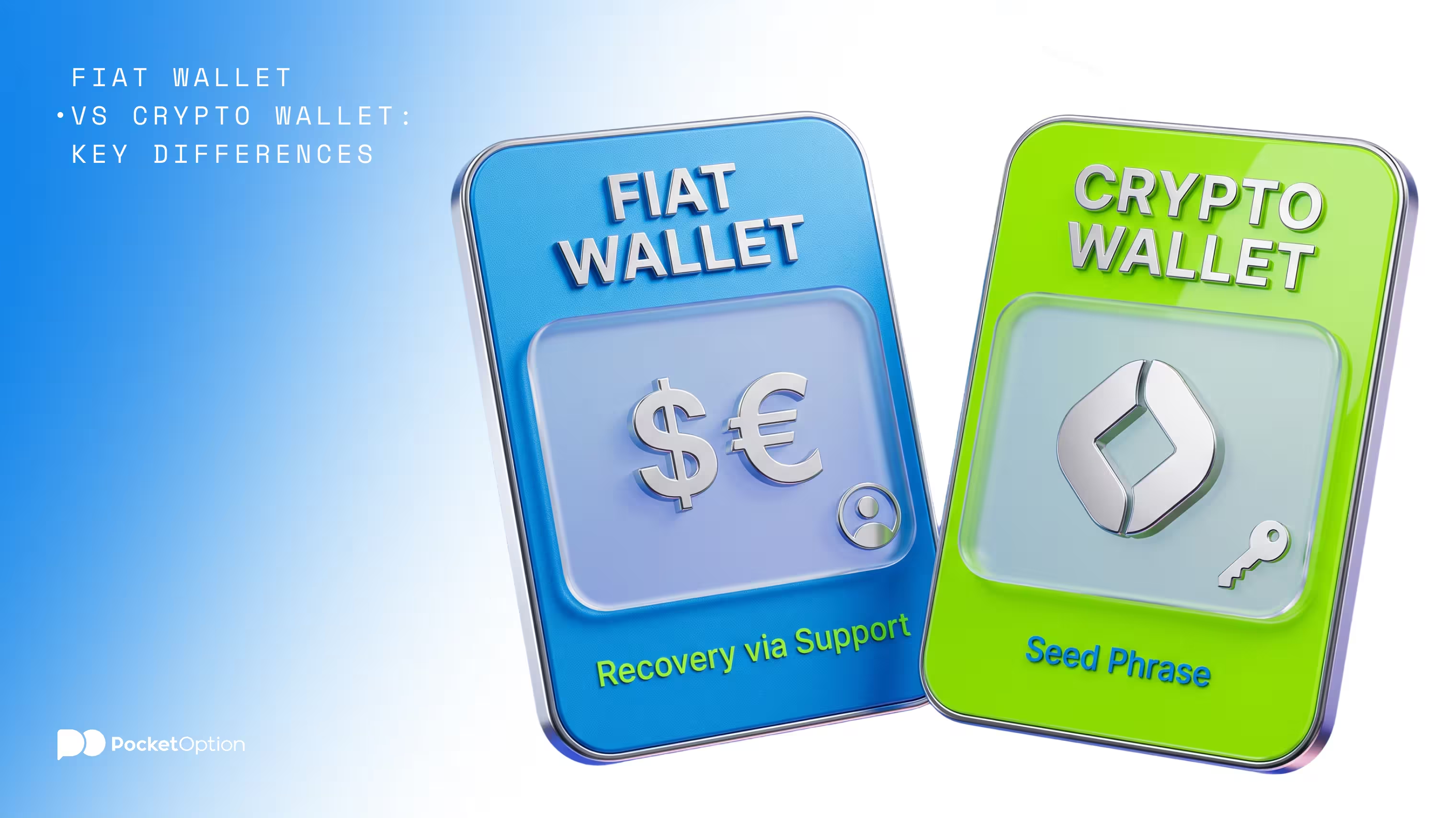
The most important thing to understand is what is a fiat wallet in contrast to what is a crypto wallet. The differences between them are numerous, but there is one critical row in this comparison table.
Fiat wallet | Crypto wallet | |
|---|---|---|
What it holds | Government-issued currency | Cryptocurrency or private keys |
Who holds it | Platform, on behalf of the user | User, in case of self-custody; platform otherwise |
Value stability | Stable in its currency | Varies according to market, sometimes sharply |
Access control | Login and password | Private keys or seed phrase |
If you lose access | Recovery through support | Permanent loss in case of self-custody |
Transfers | Through banking or payment rails | Over the blockchain network |
The row about losing access is the key factor. Losing the login and password to the fiat wallet is not a problem, because support will help you to restore the access. However, losing the seed phrase in self-custody crypto wallet is permanent and irreversible loss, because nobody can do anything to recover the access. It changes the approach to these wallets drastically.
The fiat wallet crypto relation is complementary rather than competitive. The majority of people use both: fiat wallet to fund and withdraw money, and cryptocurrency wallet to keep long-term assets. If you are considering the custody of assets, there is an article on choosing a crypto wallet for deposits and withdrawals with a full explanation of trade-offs.
One more important difference to mention separately. A fiat wallet does not expose you to price movements. Whatever cryptocurrency you keep in the wallet, it is exposed to price movements, no matter whether the wallet is your personal or the platform's one.
How to Buy Fiat Currency and Use a Fiat Wallet Step by Step
It is the same almost everywhere, and knowing how to buy fiat currency and store it in a wallet is mostly about understanding the steps and when the certain checks occur.
Step | What you do | What to check first |
|---|---|---|
1. Open and verify | Register, then complete identity verification | Whether verification is required before deposit or before withdrawal |
2. Choose a funding method | Card, bank transfer, or e-wallet | Fees and processing time for this method |
3. Deposit | Send the money from your bank account or card | Minimal deposit and whether the currency converts upon the deposit |
4. Use the balance | Trade, or convert to crypto | Spread or conversion fee upon the conversion |
5. Convert back | Sell the assets and turn them back to fiat balance | Whether the return leg has an additional fee |
6. Withdraw | Send the funds to your bank account or card | Minimal withdrawal and that the method corresponds to the deposit method |
Step six catches people out more than others combined. Most platforms require withdrawing money via the same method the deposit was done via, and this is not a restriction but a standard procedure of preventing money laundering. Deposited with card, withdrawn to the card.
Performing the whole cycle of deposit, usage and withdrawal with a small amount is the best way to understand the platform behavior. Deposit a little, use it, withdraw it. You will learn more from that one loop than from an hour of reading reviews.
Start small and see how it works.
Get StartedBenefits of Using a Fiat Wallet
The benefits are quite clear and deserve being mentioned separately, as vague statements of convenience do not help anyone to make a decision.
The speed is the most obvious benefit. Sending money already present on the platform into the position takes a second. Waiting for transfers through the banking system to complete may mean missing the opportunity, because you are restricted to the working hours of the banking system.
The costs of the transactions are often cheaper on the platform than in the banking system. Transfers between users are usually free, and platform's conversion rate for major currencies is usually better than bank's rate. However, not always, and it is good to check it rather than to assume.
The separation of the capital helps more than people think. It is easier to estimate your actual trading capital if you separate it from your other money, and much harder to add extra to the position from other money.
The access is also quite helpful feature. The balance is available whenever you want, even during weekend or holiday when bank transfers are processed next working day.
Drawbacks and Risks: Is a Fiat Wallet Safe
Anyone asking is fiat wallet safe must get the honest answer, and the honest answer comes with conditions.
The critical issue is that it is not your money but the platform's money in the wallet. So failure of the platform, freezing withdrawals, loss of access to its banking partners, etc., means that the wallet is impacted regardless of any measures you took. It is the platform risk and it cannot be mitigated by any measures taken by you.
The regulation may be quite different. Some providers have the licences of the payment institution or the e-money provider and have the corresponding rules for client funds. Others have lesser regulation. The difference becomes obvious only in the case when the problems arise, which is already too late for investigation.
The deposit insurance is also unavailable for the wallets. It is the one that people assume incorrectly the most often. Segregated client accounts are an actual protection of the funds, but they are not deposit insurance, and the distinction matters exactly in the situation where you would need it.
Withdrawal limitations is the practical risk of the wallet that you are most likely to encounter. Verification requests, method limitations, processing times, none of these are the signs of the problem, although these are the reasons to check the way of withdrawing money before you need it. In case the crypto withdrawals are involved, network confirmation time is another one, which is explained in this article on BTC transfers and withdrawals.
So the answer is conditional. A regulated platform with the history of payouts is quite safe for the working capital. No platform is a safe place for the savings, and the amount of balance left there must reflect it.
How to Choose a Trustworthy Fiat Wallet Provider
Follow these steps before depositing rather than afterwards. It takes about twenty minutes.
Start with the license. Get the name and registration number of the company, and check it on the site of the regulatory authority, not on the website of the platform. The license number that does not resolve to the registered company is the end of the conversation.
Check how the client funds are kept. Look for the detailed information about the segregated accounts at the certain institutions, not the general promises about the security. Encryption is protecting your login. It does not protect the place where the money is.
Check the full fee schedule, not the marketing one. Fees for deposit, withdrawal, conversion margins, and any possible inactivity fees. The conversion margin is the fee that hides the best of all, because it is hidden in the conversion rate.
Then test the withdrawal of a small amount of money before scaling it up. The platform returning a modest sum without any difficulties proves something that no reviews may prove. The platform demanding unusual documentation at this point gives you the signal about what is expected later, when the stakes become higher.
Finally, read negative reviews of the platform specifically, and filter them by the subject. Slow bank processing is a bank-related issue. Frequent denial of the documents is related to the verification process. The refusal of the verified account withdrawal is a completely different category, and this is the one to consider.
Registration takes under a minute.
RegisterDepositing and Withdrawing Funds on Pocket Option
The account balance on Pocket Option operates on the same principles as described above in this article. You deposit money, the balance is stored in ordinary currency, and you withdraw it when you want.
The funding methods include usual ones: bank cards, bank transfers, e-wallets, and a wide range of cryptocurrencies. The specific funding methods depend on the country where your account is registered. That is why the list, offered to you on the registration page, is the list of funding methods for your account.
The withdrawal procedure is the same as described in this article: money withdrawal goes the same way money was deposited. The verification is mandatory, and these are the standard procedures, rather than platform obstacles.
The processing times are different for the various methods. E-wallets and cryptocurrencies are usually fastest; cards are in the middle; bank transfers are the slowest ones, as most of the time is spent in the banking system. Knowing which stage a delay sits in tells you whether to chase it with support or simply wait it out.
Demo account is mentioned here for a different reason. You may familiarize yourself with the platform interface before depositing any money to it, thus removing one variable from the first deposit.
Conclusion
Run one small deposit and withdrawal before you trust the platform with significant amount.
It is the only thing that answers the question, which this article circles around. It is whether the money deposited can be withdrawn. All other things, from license checks to fee schedules and reviews, are the inferences. The completed withdrawal to your account is the proof. It costs you several pounds and a couple of days, but most people skip it and find out the expensive way once the balance becomes significant.
Disclaimer: Trading involves a high risk of capital loss and may not be suitable for all investors. Wallet balances held with a platform are generally not covered by government deposit protection schemes, and availability of payment methods and regulatory protections varies by jurisdiction.
See more:Education