Bitcoin Transaction: How BTC Transfers Work and What It Means for Trading and Withdrawals on Pocket Option
Every BTC transfer you make is a Bitcoin transaction moving through the same public network (blockchain) that Bitcoin has run on since 2009. Understanding how that network processes data is important if you want to trade or invest into BTC, or do any crypto payments in general.

How Do Bitcoin Transactions Work
A BTC transaction doesn't move a "balance" in the way a bank or card transfer does. The amount of Bitcoins is constant, and it cannot change. The only thing that changes is who’s wallets that specific Bitcoin (with tracked history ever since the moment it was mined) does belong to.
To do that, the network references specific pieces of previously received Bitcoin, called unspent transaction outputs (UTXOs), as inputs, and creates new UTXOs as output, for the recipient. It’s not like adjusting a number, and more like paying with a physical bill. You spend a whole bill (a UTXO) and receive ‘change’ as a new UTXO, a smaller one.
Here's the sequence:
Your wallet says a transaction is needed, signs it with your private key to confirm.
The request is broadcast to the entire Bitcoin network. It lands in mempool (a pool of yet unconfirmed BTC transactions that are waiting to be picked up).
Miners, wanting to receive some fees for the transfer, get transactions from the mempool, and process them, assigning where each one goes. Transactions with higher fee rate (higher ‘gas cost’) are prioritized first. They are bundled into a candidate block, which will now be waiting to be mined.
Once a miner successfully mines that block, it gets its first confirmation. But information needs to be verified by other miners in the entire network, to make sure the math is sound, and everything is in order. Then, that entire block transactions, and you see that the BTC has arrived to where you sent it to.
As each new block gets added on top of that one, it adds more confirmations that everything was right. This makes the transaction harder to reverse or disprove.
Anatomy of a Bitcoin Transaction Example
Let’s look at concrete Bitcoin transaction example, where you're sending 0.01 BTC to some other wallet:
Component | Example Value | What It Represents |
|---|---|---|
Input | 0.015 BTC (from a prior UTXO you own) | The "bill" that’s being spent |
Output 1 | 0.01 BTC | Gets sent to the recipient address |
Output 2 (change) | 0.0049 BTC | Is sent back to a new address you control |
Fee | 0.0001 BTC | The difference between input and outputs, claimed by the miner who found your block first |
Notice that the gas fee here isn't a separate thing you send. It's simply whatever is left over once your transaction gets processed. Wallets calculate this fee automatically based on the rate you select. The lower the rate, the less miners care about getting your specific BTC transaction ahead of everyone else, to get that fee, and so the longer the transfer takes for you. The average time of Bitcoin transactions can be anywhere from 10 to 40 minutes, on average. For newer chains, like Solana and Ethereum L2s, crypto transactions can take under a millisecond.
What Confirmations Mean and Why They Take Time
A ‘confirmation’ means that a block containing your transaction has been added to the chain. On average, one new block gets added to the chain every 10 minutes (although this is probabilistic, since miners finding the hashrates for new blocks happens at random).
The first time your block, with all the block transactions stored inside it, is found, it doesn’t get added to the network right away. Meaning, the payment doesn’t show up in the wallets. First, new confirmations must be made, by other miners, and only after they agree that the block is sound and safe, and contains the right information, does the BTC transaction get fully processed.
Each additional confirmation makes a transaction more secure, as there’s less chance that a mistake has occured. That's why platforms handling real funds, including Pocket Option, wait for a set number of confirmations (usually 3-6) before treating a deposit as final, and crediting it to the account number mentioned in the block.
Understanding Bitcoin Transaction Fees and Fee Rate
Bitcoin fees aren't based on exactly how much BTC you're sending. They're based on transaction size (in bytes) and the fee rate you set. This is measured in satoshis per virtual byte (sat/vByte). A transaction with more inputs or outputs takes up more block space and costs more, regardless of whether it's moving $10 or $10,000 worth of BTC. This is how you get legendary stories of people sending billions of Bitcoin, and paying just $9 for it.
Fee = fee rate × transaction size. That's the entire formula. A special wallet offering "priority" in transactions or "economical" fees is really just letting you choose a higher or lower sat/vByte rate, or choosing that rate for you, in order for your payment to arrive at the appropriate time.
Why Fees Can Vary Depending on Network Activity
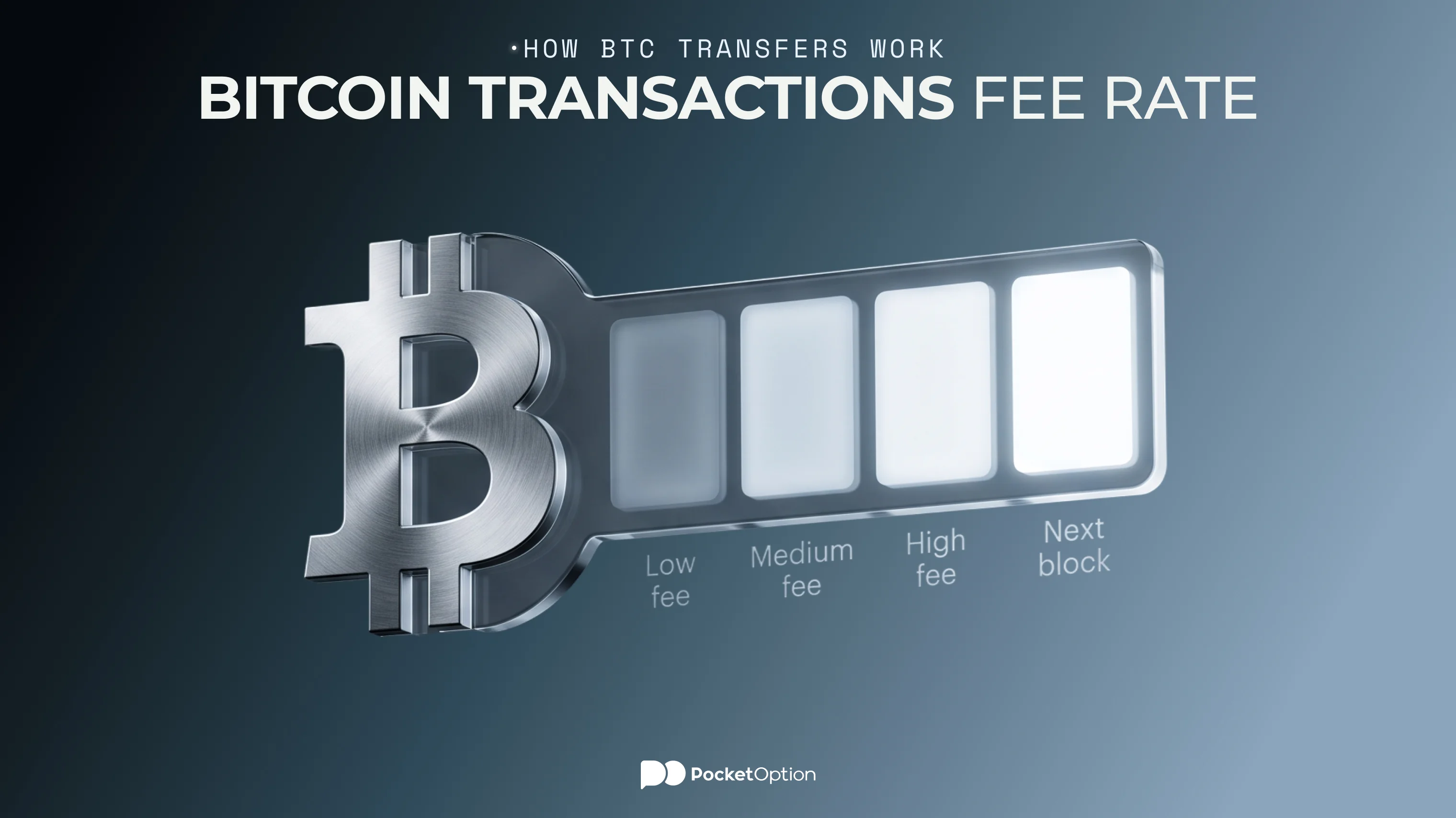
Block space is limited. Blocks are mined at a roughly fixed schedule. But demand for that space isn't constant. Sometimes there’s a rush, and millions of payments might need processing. How do bitcoin transactions work in that case? Each payment competes for a limited number of slots for confirmation that it happened. To choose which one goes into the next block first, a fee rate set for a transaction is checked. Miner software automatically picks the ones with the highest rate, to collect that fee. Others get deprioritized. Their payment will go through during a quieter period, in one of the next blocks.
Depending on the time of day, or even an hour, the same transaction can confirm for tenth of the cost. This is why the fee is always shown when you initiate a crypto transaction. It is there so you can make a conscious choice: would you pay such a fee, to be in the ‘middle of a pack’, would you lower it to save some sats, or would you hike it so that your coins go through first.
Crypto Transactions Beyond Bitcoin: What's Different
Many cryptocurrency transactions work in a different way from Bitcoin. Newer chains enable much faster confirmations, and on some, the fee rate is in the millionth of a cent. Some key differences are:
Account-based vs. UTXO-based. Ethereum and many others now use an account-based model, more similar to bank balance, instead of the input/output structure of BTC. Fees on ETH there are denominated in gas and gwei, not sat/vByte.
Block time. Bitcoin's ~10-minute average for a confirmation is somewhat obsolete, as many crypto transactions now take seconds to fill. This is why most stablecoins, like USDT, USDC, and so on, are working on faster chains. However, Bitcoin is still considered the most secure, as it’s the oldest one, and still works in exactly the same way. It’s just that it is no longer used for fast payments: BTC blockchain is notoriously slow.
Fee rates. Most networks have more predictable, lower fees, although others can spike even harder than BTC during peak demand.
The core idea behind almost every crypto transaction is the same, though: broadcast the need for payment, wait for the network to include that request, confirm it from multiple sources and add it to the immutable blockchain forever.
How Transaction Speed and Fees Affect BTC Deposits on Pocket Option
When you send BTC to your account with us, that deposit follows the process above: sits in the mempool with other payments, gets picked up by a miner, processed, and then confirmed multiple times. In practice, this means that:
Network congestion affects you. If the network was busy at the time you sent your deposit, it may take longer to confirm, sometimes up to an hour, or more.
The fee rate you (or your wallet, automatically) set will affect how fast your deposit gets to your account. Each breakpoint reached (to add your payment to the previous block) lowers the full processing time by around 10 minutes.
Crediting happens after confirmation, not after broadcast. Seeing a Bitcoin transaction as "sent" doesn’t mean it has been received. Check the transaction's confirmation count if a deposit seems delayed. Just 1 or 2 confirmations is generally too low.
Don't resend a deposit that appears delayed without confirming without a doubt that it actually failed (either by asking support, or through seeing the failed status in the Pocket Option transaction window). A transaction sitting in the mempool for an extra hour is still considered valid, and will eventually confirm. Sending a 2nd transaction will just deduct extra money from your wallet unnecessarily.
Best way to learn the basics
View the Quick Start GuideHow Transaction Speed and Fees Affect BTC Withdrawals on Pocket Option
Withdrawals work the same way, but in reverse. Once you request one, Pocket Option broadcasts a BTC transaction to the address you provided. It goes through a mempool, to miners, to a confirmation stage. A few practical suggestions for BTC withdrawals from Pocket Option:
Processing time depends on our internal review and actual network confirmation time. These are two separate steps, and network business affects the 2nd step no matter what.
Absolutely double-check the withdrawal address, before confirming. Bitcoin transactions aren't reversible once confirmed by the blockchain.
A "pending" status usually means that the crypto transaction has been broadcast and is now waiting on enough confirmations. This means that payment is not stuck.
If you have any questions, you can message our support with the transaction ID ready (this is the number that identifies your transaction, visible right next to it). This will help resolve any possible question quicker.
Register and start trading
Create Your AccountConclusion
A Bitcoin transaction is a public, verifiable transfer, broadcast to a network, and confirmed through blocks added roughly 10 minutes. A process works the same way whether you're moving BTC between personal wallets or funding a trading account at Pocket Option. Fee rate and confirmation mechanism makes deposit and withdrawal timings vary quite widely, and what's worth checking network congestion or talking to support before assuming something's gone wrong.
Disclaimer: Cryptocurrencies can be volatile and unpredictable. This article is for educational purposes only and does not constitute financial advice. Always verify wallet addresses carefully before sending any crypto transaction, since blockchain transfers cannot be reversed once confirmed.
See more:Crypto