What Is RENDER/RNDR Crypto? Render Network, Token Utility and Why High-Tech Tokens Attract Traders
Two tickers, one project, and no end of old pages nobody ever went back and put right. That is the bulk of the muddle behind what is RNDR crypto. RENDER is the project running the show presently, over on Solana network. RNDR is the Ethereum one it came out of.

What Is the Render Network
Render Network is a place to buy and sell graphics card time, and at bottom there is scarce more to it than that. One side has artists, studios and little outfits with weighty jobs to get through, the sort that would tie a single machine up for days on end. Other side has folk whose cards sit idle the better part of the day. Network brings the two lots together and pays out in tokens.
A great many readers run into the project backwards, off a ticker on some exchange page, and only thereafter go hunting for what is Render crypto. Nothing wrong with that as a way in. Thing under the ticker sells computing, and it was shifting frames about long before the token you see today came along. You will find it called the Render protocol, the Render Network, or plain Render. One and the same, three labels.
Engine underneath is OctaneRender, OTOY's own bit of software, which was already sat in studios a good while before any of the crypto parts got bolted on. That matters rather more than it sounds like it should. Plumbing was there first, token came after and got wrapped round it, and the settling up is done on Solana nowadays, a chain most folk know off the price screen rather than the compute side, which is why how to trade Solana gets typed into search far oftener than whatever is actually built atop it.
What Problem Render Solves
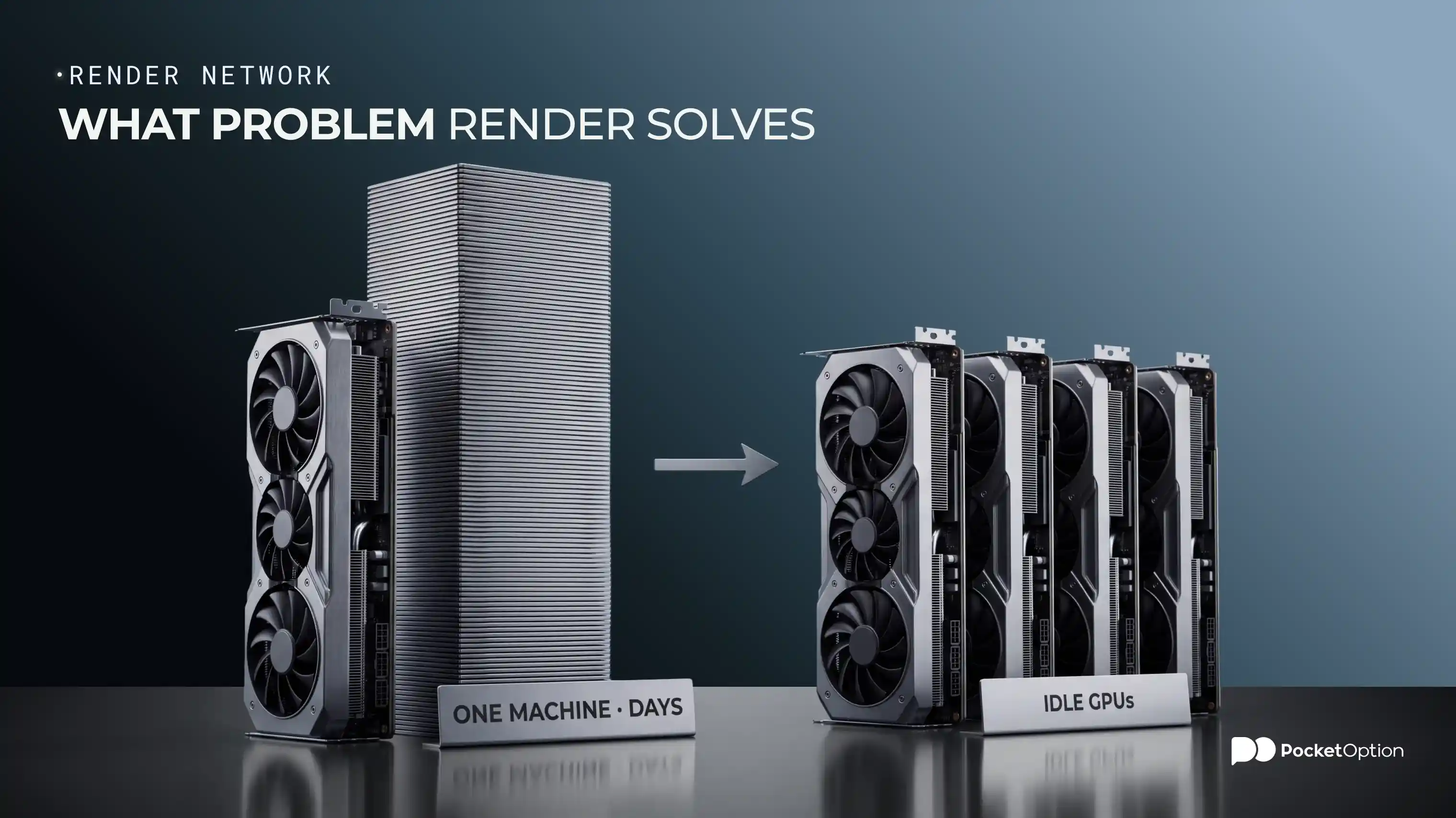
Rendering is slow and it chews through hardware something awful. One frame of film-grade 3D can sit on a card for hours, and a sequence has thousands of frames stacked up in it. Big studios get round that by buying racks of machines, which is dear and then sits doing nothing between projects. Everybody else waits their turn, or rents time off a cloud provider at prices written for firms with a budget line set aside for it.
Meanwhile there are graphics cards the world over doing next to nothing at all. Gaming rigs of an evening, old mining kit left stranded after Ethereum did away with proof of work, small studios between jobs. Render crypto pays those owners to pick the work up instead, and the pitch amounts to this:
Artists come by more cards than they could ever buy, for exactly as long as the job runs. Then they stop paying.
Card owners make something off hardware that was otherwise merely warming a room.
Prices are quoted up front in dollars, not in a token amount that wanders about while the job is still going.
Why should any of this want a chain? Because the payments are small, constant, and between strangers with no cause whatever to trust one another.
How the Render Network Works
The flow is plain enough once you scrape the vocabulary off it.
A creator puts a scene up and asks for the work done. Network quotes a price back in dollars.
Job is parcelled out in bits to node operators, who are merely people running the node software on their own cards.
Work comes back, the creator gives it the once over, and the money only lets go once the result is signed off.
Node operators pick up tokens for whatever they finished, and their standing on the network rises or falls with how well they did it.
Operators are sorted into tiers, and a poor run costs them something, so there is skin in the game rather than pure good manners. Search logs are stuffed with phrases on the order of RNDcoin block chain, which is a mangled way of asking one perfectly sensible question: which chain is this thing settling on? Answer is Solana, and has been since November 2023. Before that, Ethereum. The RENDER coin folk trade today is the Solana one.
The RENDER Token: Utility and Use Cases
So what is RENDER token doing in all of this? Four jobs, near enough, and they lean on one another:
Paying for work. Jobs are priced in dollars, then settled in RENDER, and the tokens handed over for that payment are destroyed outright rather than passed on to anybody.
Earning for work. Node operators are paid out of freshly minted tokens, on a timetable the voting side settles.
Voting. Holders vote on Render Network Proposals, the RNPs. That is how the Solana move and the minting timetable both got decided, not by some company memo handed down.
Staking and standing, the quiet one of the four. Operators put tokens up to show they mean it, and poor delivery can cost them part of that.
One practical word about wallets, since it catches folk out. An old RNDR wallet on Ethereum will still show the legacy balance sat there, but it cannot pay for a job as matters stand. RENDER lives as an SPL token on Solana, so it wants a Solana wallet, and the two do not swap over merely because the names look alike. If the vocabulary here is new, this basic guide to cryptocurrency covers the groundwork sat underneath the lot of it.
Burn-and-Mint Equilibrium (BME) Explained
BME is the part worth slowing right down over, for it is the bit that decides supply. Jobs are priced in fiat first. When a creator pays up, the matching amount of RENDER is burned off, gone for good. Separate from that, the network mints fresh tokens on a timetable and hands them out to whoever did the labour.
Two flows, running contrary ways. Burn comes out of folk actually using the thing. Mint comes off a fixed timetable that shrinks as the years wear on. Heavy usage burns off more than the timetable mints and supply drops, thin usage and supply grows instead. That is the equilibrium bit, and it is an arrangement rather than a promise.
Numbers behind it are out in the open. Year one, under RNP-006, put 9,126,804 RENDER into emissions. Year two came in lower under RNP-018, at 5,905,580. Maximum supply sits at 644,168,762 tokens, up from the old fixed cap of 536,870,912 that RNDR started out with, and the extra was bolted on expressly to pay for those emissions across roughly ten years.
The bit that gets passed over: Render pricing is set in dollars first and swapped after. A creator who puts 400 dollars by for a job pays 400 dollars of RENDER, whatever the token happens to be doing that week. Which is why the token price and the cost of rendering are two separate conversations wearing the one coat. Supply design of this sort is a tokenomics question at heart, and how supply and demand shape crypto prices goes through the general case properly.
RNDR vs RENDER: Legacy Ticker and the Migration to Solana
Here is where nearly the whole of the confusion sits. What is RNDR, in one line: the original ERC-20 token off the 2017 sale, issued on Ethereum. What is RNDR token doing nowadays, in another: sat for the most part in old wallets and older articles still.
Two proposals went through in 2023 and settled the matter. RNP-002 picked Solana as the chain to build upon. RNP-001 brought in the burn and mint model. On 2 November 2023 the new SPL token went live and the ticker swapped over from RNDR to RENDER, with holders upgrading at 1:1 through the official portal the Render Network Foundation runs. Portal has no closing date upon it, though the early-upgrade sweeteners ran dry back in October 2024. Exchanges moved across at their own pace through 2024, Kraken amongst them, which set its migration going on 29 July 2024 and dropped the old ticker thereafter.
RNDR (legacy) | RENDER (current) | |
|---|---|---|
Chain and standard | Ethereum, ERC-20 | Solana, SPL |
Status | Still about, no longer the one they back | The token the network actually runs on |
Pays for rendering jobs | No | Yes |
Upgrade route | 1:1 into RENDER through the official portal | Not applicable |
Emissions | None | On the BME timetable |
Support for either ticker differs by venue and is apt to shift, so check where you hold rather than trusting a list you saw last year.
Render's Origin and Team
Render did not begin life as a crypto project, which explains a fair deal about the way it behaves. Jules Urbach, who set OTOY up and runs it still, first had the idea down on paper in 2009. OTOY is a Los Angeles graphics concern, OctaneRender is its product, and that renderer has been put to work on film and television for years.
First public token sale ran in October 2017, with a private phase behind it from January to May 2018. Early users poked at a beta network a good while, and the public launch landed on 27 April 2020. Then in 2023 the Render Network Foundation was spun out as a Cayman-based non-profit, so the governance side now sits with the Foundation and the token holders rather than with the firm that built the engine.
The advisory side has pulled in names off film and digital art down the years, and write-ups about the Render protocol mention them without fail. Worth keeping in proportion, that. Advisors are not the network, and they do not render frames.
Practice first, fund later.
Open Free DemoWhy High-Tech Utility Tokens Like RENDER Attract Traders
Tokens of this sort pull attention for reasons that have precious little to do with rendering. There is a story attached, and stories get about a good deal quicker than balance sheets do. Graphics card scarcity, AI compute demand, a chain folk already watch: it all lines up into something easy to repeat at speed.
Jumpiness follows the attention around. A chart of the RNDR price off 2023 and one from a couple of years after look like two separate assets, and in a fair sense they were. Then there is the pairing to think on. Some venues quote a Render BTC pair in place of a dollar one, which quietly alters what the number on the screen means, for you are then measuring one crypto against another rather than against money you actually spend.
Risk side is the same as any small-cap token, and then some. Thin books, gaps over the weekend, moves that come off a single headline, and a supply timetable that keeps issuing whether the demand turns up or not. Moves can be quick upward and every bit as quick the other way, and position sizing is the only part of it a trader has any grip on. Anyone treating Render crypto as a clean stand in for AI hardware demand is making a wager with several extra links in the chain, every one of which can snap on its own.
Conclusion
Clearest way to hold the whole of this in your head: somewhere, a frame is rendered on a stranger's card, and a small pile of tokens vanishes for good the moment it is. That burn is the whole of the idea. Everything else, the ticker swap, the chain move, the emissions table with its shrinking rows, is scaffolding built round that one event. And if you are eyeing the RENDER token as something to trade rather than something to spend on frames, check the asset list on the venue you actually use first, for availability shifts about and no article is a substitute for the list sat in front of you.
Disclaimer: Trading involves significant risk of capital loss and may not be suitable for all investors. Past performance does not guarantee future results.
See more:Crypto