What Is a Fork in Crypto? How Fork Events Can Impact Your Trading
Splits of blockchain into two are called forks, and they are the most violent and misunderstood events in the entire space. There are still debates around Ethereum forks, which block they should happen at, which chain is the ‘main’ one, etc. This guide explains what is a fork in crypto, why forks happen, how they tend to affect price, and what traders on Pocket Option should know when a fork is about to happen.

What Is a Fork in Crypto
Crypto emulates traditional finance. In TradFi, there are disputes between shareholders that are settled in meetings or courts. In cryptocurrencies, however, everything needs to be settled on the chain. The most violent disputes between developers usually result in a fork. This happened multiple times with both Bitcoin and Ethereum.
A cryptocurrency fork occurs when the rules governing a blockchain are changed. Usually this results in two chains: one with the original rules, and a second one with new, changed rules. Any such change requires users of the chain to update their software, which can be functionally no different from a ‘vote’. If a user switches chain, and starts using updated software, he has voted for the fork, and is supporting it.
There almost never was the case where a network continued as one, with only exceptions being scheduled updates of popular chains. For example, Ethereum hard forks number over 15 over its history, but the blockchain still works as one, with barely any user loss. The only fork with any sustained legs is Ethereum Classic, but it still has just $1.05 billion in market cap, over 200 times lower than the main chain of Ethereum.
So what is a fork in crypto? It's a split of the road: after a certain block one road continues to go straight, following the old rules, but there is a second way, following the new ones. The metaphor is quite literal. Both paths share the exact same history (= exact same chain) to the point of divergence, but from that moment their history of transactions (the blockchain) updates differently, and is no longer having any contact with its brother.
Hard Fork vs Soft Fork: What's the Difference
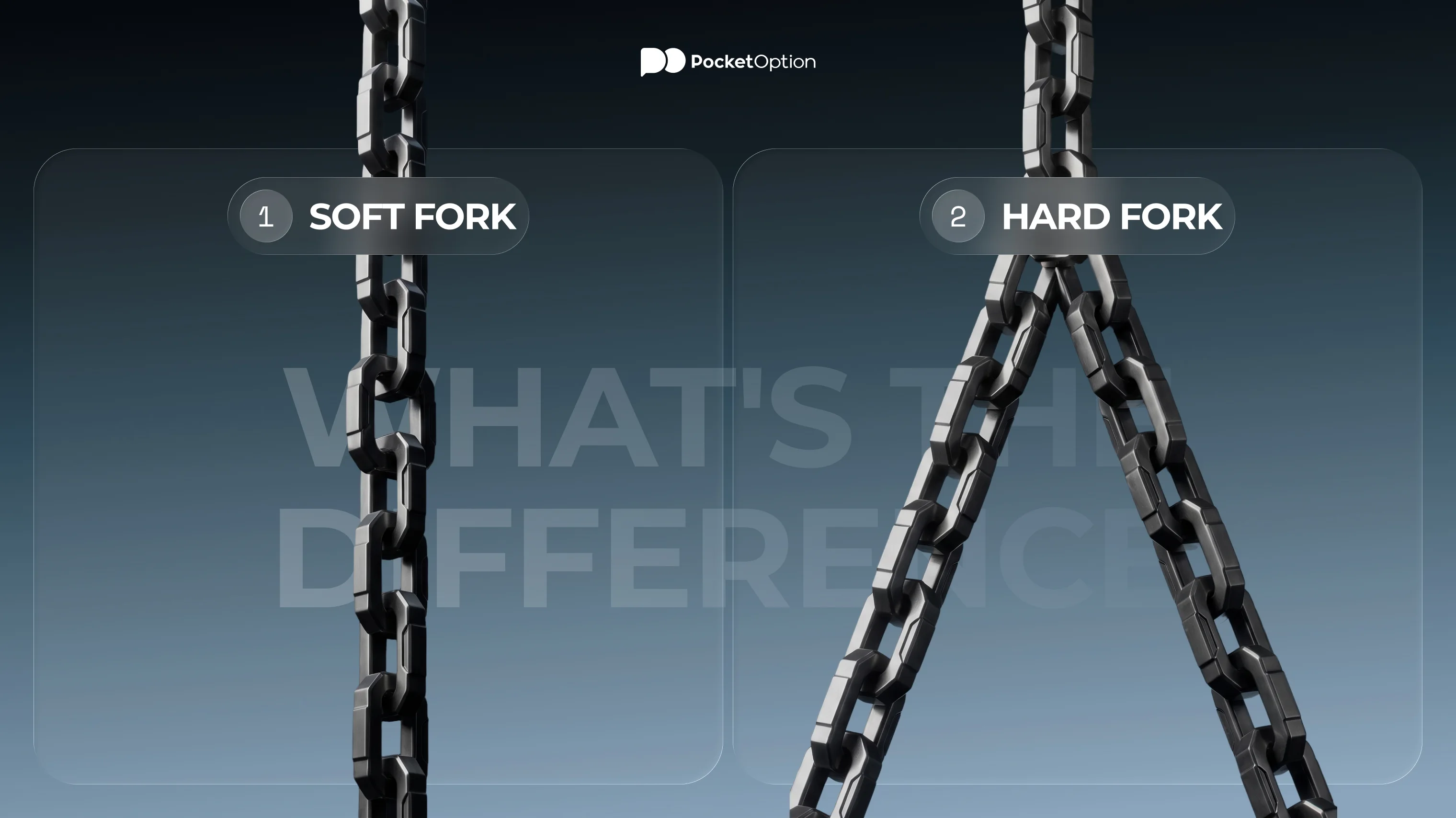
There is quite a large distinction between the two, including for investors and traders. Ethereum hard forks and Bitcoin hard forks tend to produce a lot more volatility than soft forks. A hard fork often results in a new token being issued (like BTC Cash, Ethereum Classic, BTG, BSV, and so on). It is usually automatically distributed to previous token holders (who stood on the main road before the event). This creates speculative interest and huge amount of new selling pressure in the days surrounding the event. Many people who were not supporting of the hard fork may choose to sell. Meanwhile, soft forks never end up creating a different token.
Feature | Hard Fork | Soft Fork |
|---|---|---|
Compatibility | Not backward compatible. Old nodes can’t validate new blocks | Backward compatible. Old nodes still accept new blocks |
Chain split | Always creates two chains (but one may fade, or become irrelevant) | Usually no permanent split: absolute majority adopts new chain |
Upgrade requirement | All nodes must upgrade, or be left on old chain | Upgrade is often optional, and non-upgraded nodes can still function |
New token created | Yes, if both chains survive (like BTC and BCH) | No, the existing token continues as usual |
Disruption level | High; can divide the community, create a lot of sell pressure | Low; this is typically a routine upgrade with no drama |
Examples | Bitcoin Cash (2017), Ethereum Classic (2016) | Bitcoin SegWit (2017), various chain and protocol patches |
Why Forks Happen
Forks can be employed for a variety of reasons, and the motivation behind a fork determines their market impact. Most Ethereum hard forks are scheduled and planned, with all of the community behind them, so the price can move a few percentage points, and that’s it. Meanwhile seemingly ‘smaller’ soft forks like SegWit catalyzed the 2017 Bitcoin bull run to its peak near $20 000 and ended the infamous crypto ‘Civil War’. What is Ethereum hard forks in comparison to this soft fork? Why was its impact so large? It largely hinges on the reasoning behind the fork.
We can count 4 main reasons for a blockchain fork to happen:
Security patches: a vulnerability is discovered and has to be fixed through a fork. Happens a lot on Layer 2 and Layer 3 chains, and with individual dApps. These are often soft forks, and result in the increase of the token price, if only temporarily. Implemented quickly and with consensus.
Scalability upgrades: network needs to handle more transactions per second (TPS). A fork simply increases block size, or optimizes the code. No meaningful price impact.
Feature additions: new functionality is added to the protocol. For example, new smart contract capabilities, or improved privacy features. Usually a small upside in the price.
Community disagreements: a portion of the developers or miners want entirely different direction for the project. This is a drama-filled fork that can create an entirely new cryptocurrency. Market swings are often violent in both directions, but the tumultuous time before the fork is often biased to the downside.
The Bitcoin block size debate of 2017, which resulted in the creation of Bitcoin Cash, is the best known example of the last category. New BCH token was created, and Bitcoin was quite never the same since: a passionate early crowd of developers had left, and started paving its own path. What is forking in crypto at its most consequential? It is what happens when a community can’t reach consensus, and so the only resolution is a split.
Notable Fork Examples: Bitcoin Cash, Ethereum Classic, and More
Bitcoin Cash (BCH) was launched in August 2017, when some developers and miners who wanted larger block sizes forked the Bitcoin blockchain. A new Bitcoin was created, with different properties, more suited to smart contracts. The original Bitcoin, meanwhile, remained with the store of value as the main narrative.
Holders of BTC at the time of the fork received an equivalent amount of BCH on the new chain. But the original Bitcoin went upwards of $125,000, and BCH hardly broke above $1,500, beyond its initial hype. It remained in a downtrend ever since. The store of value narrative won over smart contracts narrative, in this case, because Ethereum had already proven itself as ‘the’ smart contract platform at the time.
Ethereum Classic (ETC) was born in 2016 after the DAO hack. Large part of the tokens was stolen, and the community didn’t want to leave those tokens in the hands of a hacker, forever. The Ethereum community voted to reverse the hack through a hard fork, and initiated the process. Essentially a new Ethereum blockchain was created, where the stolen tokens were never in the hands of a hacker. Those who opposed this transfer (saying that the blockchain should be immutable) continued mining the original chain, which became Ethereum Classic. Currently, the price of the new Ethereum is around $1900, while the Ethereum Classic tokens are worth $6.60.
In both cases, the larger community won. The old chain remained superior in the Bitcoin case, and the new chain prevailed in the Ethereum case. Whoever had the most network effects, had claimed hard victory, at least in terms of the price.
The situations can become much more complicated than that, same as with the stock mergers and splits, where even people working at the company are not quite sure what to call the event. For example, the famous Ethereum Merge in 2022, often discussed under the heading "what is fork ethereum," was technically not even a traditional fork. It was instead a consensus mechanism change from Proof of Work to Proof of Stake. No new chain was created. A software update was all that happened. But traders treated it as a fork event in terms of its impact on markets, and so it is now considered as such. But what is ethereum hard fork history in reality? It is a history of a large community that has been making structural changes to its product multiple times a year, every year, each time the majority considered those changes necessary. It is one of the largest and most successful libertarian projects in history.
Accidental Forks vs Planned Forks
Not all forks are a choice. Accidental forks are a thing. Sometimes two miners solve a block at the same time, and this creates a small split in the Bitcoin chain: two versions that are slightly different. However, this is resolved in minutes when the network converges on the longer chain, as per Satoshi code. These are typical blockchain operations and rarely carry any trading significance, except for altcoins with barely any users.
Planned forks, by contrast, are announced in advance, debated publicly, and executed on a specific block number, so that nobody could misinterpret the fact on whether the event happened or not. Planned hard forks are the tradable events, and the announcement itself can often trigger a significant rally or a downfall.
What Happens to Your Crypto During a Fork
If you hold any cryptocurrency at the time the chain forks, whether it’s in your custom wallet or on the exchange, a hard fork should result in you receiving tokens on both chains (if the exchange supported the fork, as they usually do). The original tokens remain, and you get an equal quantity of the new token.
This might seem great, as you get two for the price of one. However, it’s not always a good thing, as both tokens can be slightly lower in price than your sole token before the fork happened. That is why it’s important to check what is forking in crypto, and decide if you are willing to stomach the volatility. If you are not sure about the event, selling the token before it forks was often previously a sensible choice.
If you are trading crypto on Pocket Option, the situation is different, because you don’t technically hold the underlying tokens. You are simply trading their price, both in QT mode, and in the CFD mode. You don’t own the underlying asset, so you won’t receive new tokens. What you will experience is the price volatility which offers trading opportunities during the event.
How to Approach Trading Around a Fork on Pocket Option
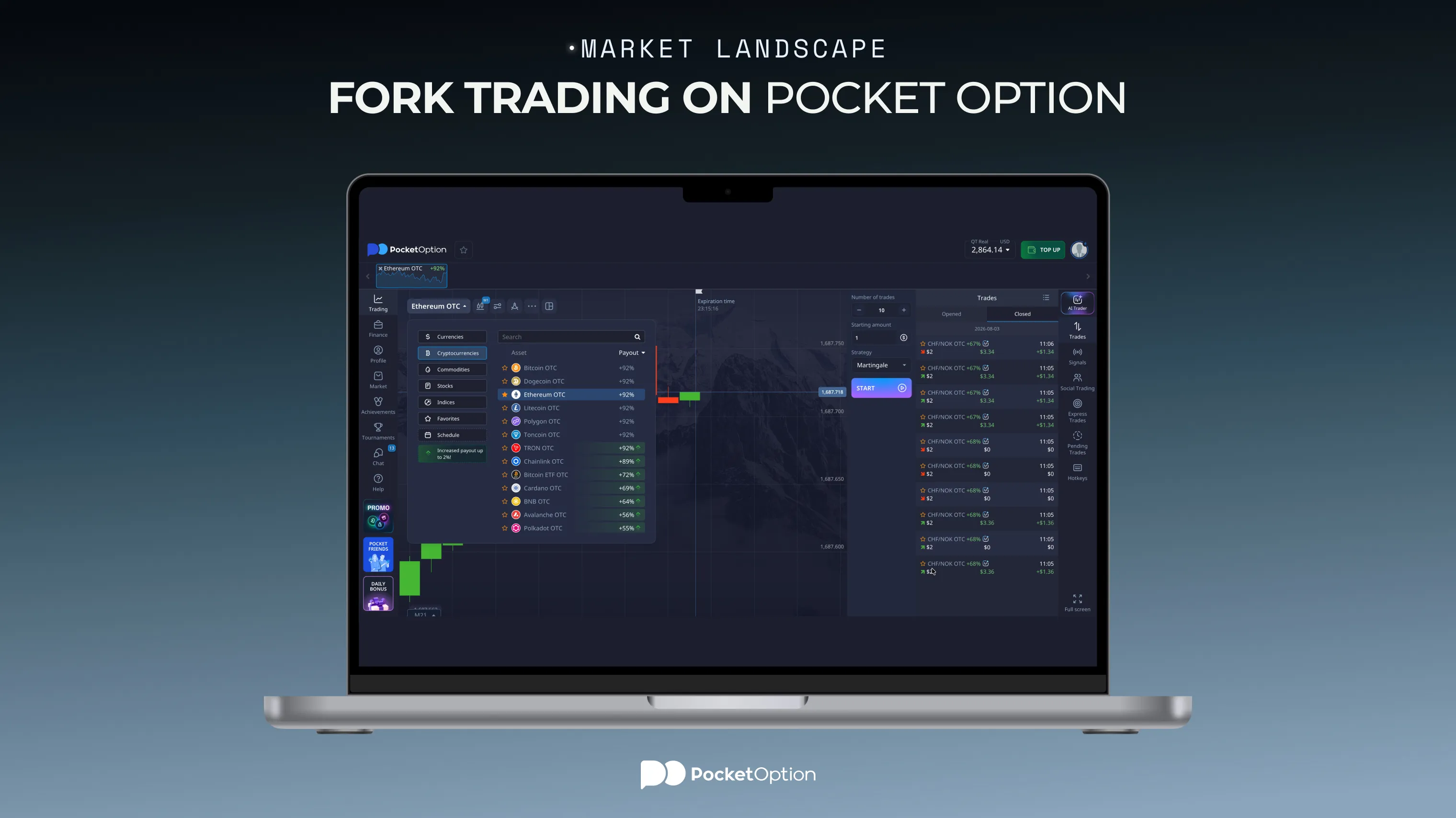
If you know that Ethereum forks on a certain day, certainly mark it on your calendar. This can be an excellent volatility event.
Monitor the fork date and the specific block number at which the fork will activate.
Reduce position size in the days surrounding a fork, as the volatility in cryptocurrency is likely to be elevated.
Widen your stop loss in the CFD mode (but never beyond a level that violates your overall risk rules).
Consider not opening any positions during the actual fork execution, if you are not comfortable with increased risk.
If you open positions, make them short-term ones, for example in the Quick Trading mode, because the daily direction of the price is often impossible to predict in advance, even if you are the chain's developer.
After the fork, wait for the volatility to settle before re-entering a trade. The first 24 to 48 hours post fork are often the most unpredictable and erratic.
ADA, SOL, ETH, BNB, Tron, and more
Get StartedConclusion
Forks are a feature of cryptocurrency markets, and not an anomaly. They should be expected, and can be traded around. These events can create strong volatility, which can be used, with careful discipline, reduced size, and attention to the timeline.
Risk Disclaimer: None of this information constitutes financial advice. Cryptocurrency trading involves substantial risk. Past performance does not guarantee future results. Before trading with real funds, use a demo account and seek independent advice if necessary.
See more:Crypto