Revenge Trading Explained
You take a loss. It stings. So instead of stepping back, you slam into another trade to claw it back, bigger this time. That impulse has a name, and it has blown up more accounts than almost any strategy error ever will. Here is the upside though: spot the pattern and you can kill it. Below is how it starts, what it drains, and how to shut it down.

What Is Revenge Trading?
At its simplest, revenge trading is trying to win back a loss the moment it happens, driven by emotion rather than a plan. You lose on a trade, feel frustrated or angry, and immediately open another one to get even with the market. The problem is that this new trade is rarely thought through. It is bigger, faster, and detached from your strategy. A loss you could have shrugged off turns into a chase, and the market feels nothing about how badly you want the money back.
Want to build discipline before real money is on the line? Open a free demo account and trade 100+ assets with virtual funds.
Want to build discipline before real money is on the line? Open a free demo account and trade 100+ assets with virtual funds.
Open DemoThe urge to chase a loss is hardest to resist when real money is bleeding. That is exactly why practicing the response ahead of time matters. If you can take a loss, feel the pull to hit back, and train yourself to walk away instead, all without a cent at stake, that habit sticks far better than any advice you read after the damage is done.
A demo trading account gives you a no-stakes room to train that reflex, so you can see how you handle a loss on live prices while every dollar in play is virtual.
Why Do Traders Fall Into Revenge Trading?
So what is revenge trading really about, deep down? Emotion, almost entirely. A loss bruises the ego, and the brain scrambles to patch that feeling right away. Frustration insists the market owes you. Pride will not let you close the day in the red. And a nagging voice says recover it now, before the chance slips. Stack those up and logic quietly leaves the room. It is the exact tilt that ruins poker players, only the chips are your trading balance.
If you are still learning the mechanics of placing and managing trades, the pocket option tutorial covers the basics so emotion is the only thing you have to master, not the buttons.
How Revenge Trading Works
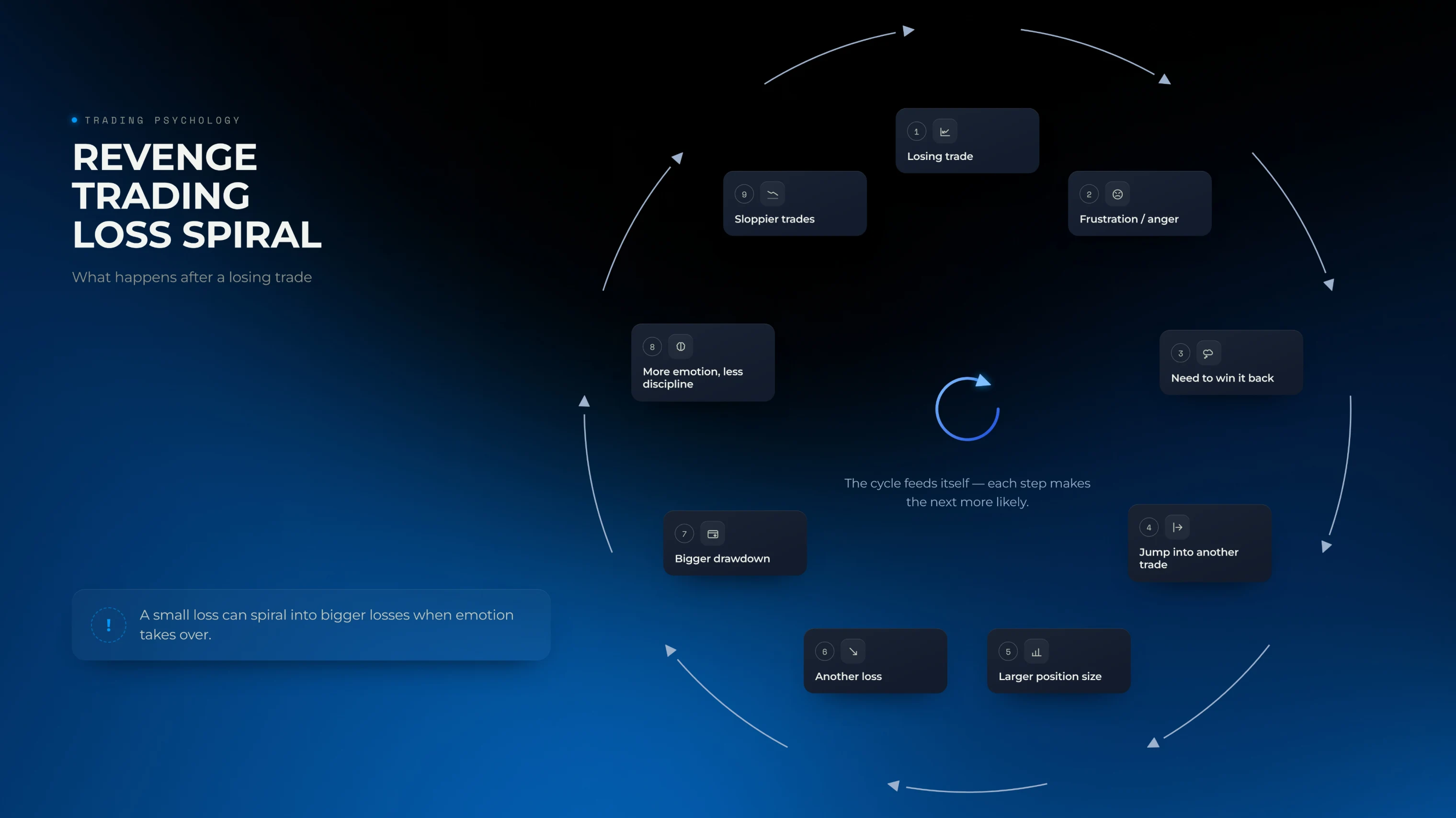
Revenge trading is just one branch of emotional trading, and the script barely changes. Watch it play out. You drop 100 dollars on a trade that looked clean. Annoyed, you slap on a new position at twice the size, desperate to win it back quick. That loses too. Now you are down 300. The anger jumps, the size climbs again, and every trade lands louder and sloppier than the one before. A single small loss has swollen into a real hole, and the clock has barely moved an hour.
Revenge Trading vs Emotional Trading
These two get lumped together, yet they are not the same thing. Emotional trading is the wide umbrella, any call made on feeling rather than a plan. Revenge trading is one narrow, loss-triggered spoke of that umbrella. That is where revenge trading psychology stands apart: it is powered by the urge to get even, not just by general fear or greed.
Aspect | Revenge Trading | Emotional Trading (broad) |
|---|---|---|
Trigger | A recent loss you want to win back | Any strong feeling: fear, greed, FOMO |
Motive | Getting even with the market | Reacting to emotion instead of a plan |
Typical action | Bigger, faster, unplanned trades | Impulsive entries or exits of many kinds |
Core fix | Step away and cool off after a loss | Build overall emotional discipline |
Think of revenge trading as the sharpest, most destructive point of a much wider problem. Fix the broad habit and the specific one tends to fade with it.
Consequences of Revenge Trading
The damage goes well past one rough session. On the money side, it empties accounts fast, because position sizes swell at the precise moment your judgment is at its worst. The quieter cost lands on your discipline. Each time you ditch the plan, whether you dodge the bullet or take it square, the habit sinks deeper. Confidence frays. Stress builds. Some traders never win back the trust they had in themselves. Grasping all of this is the first real step in learning how to stop revenge trading, because you cannot fix a habit you have talked yourself into ignoring.
Common Emotional Trading Mistakes
The revenge trading meaning shows up most clearly in the actions it drives. These are the usual ones:
Increasing position size to win back a loss faster.
Pulling or ignoring stop losses so the trade has room to recover.
Overtrading, taking far more positions than your plan allows.
Jumping in with no real setup, just to be back in the market.
Notice the theme. Every one of these trades size or frequency for feelings, swapping a calm plan for a frantic one.
How to Stop Revenge Trading
One revenge trade rarely stays alone, so the whole game is breaking the chain before it forms. These steps do exactly that:
Walk away from the screen the moment you feel the urge to hit back.
Set a daily loss limit and stop trading the instant you reach it.
Fix your position size in advance so emotion cannot inflate it.
Follow your trading plan, entering only on your defined setups.
Keep a trading journal to catch emotional patterns before they cost you.
Accept that losses are a normal cost of trading, not a personal insult.
Building Emotional Discipline in Trading
Nearly all emotional trading mistakes trace back to one gap: no structure. Discipline is not feeling nothing. It is having rules that hold up when the feelings get loud. A written plan decides your move before emotion ever shows up. A journal lays your patterns out in black and white. Tight risk rules cap what any single trade can cost you. And realistic expectations, simply accepting that losing is part of the work, pull the sting out of the moment that would otherwise kick off a chase.
Risks and Important Considerations
Make no mistake, this habit can empty an account in a single afternoon and do lasting harm to your discipline. The honest answer to how to avoid revenge trading is a blend of hard rules and self-awareness: know your triggers, cap your losses, and step away when emotion takes the wheel. No indicator or strategy can save a trader who keeps chasing. The edge here is entirely psychological, and it is one every trader has to build for themselves over time.
Risk Disclaimer: Trading involves significant risk of capital loss. This article is for educational purposes only and does not constitute financial advice. Always conduct independent research and consider your risk tolerance before making any trading decisions.
See more:Psychology