How Can the House Money Effect Change Risk-Taking After a Gain?
The house money effect describes how a recent trading gain can change how acceptable further risk feels, rooted in mental accounting and shifting reference points. This guide covers where it comes from, how it differs from other biases, and how to notice it in your own decisions.

House Money Effect: Why a Recent Gain Can Change the Next Decision
A cash gift from a relative tends to get spent differently than a paycheck. Even though both amounts sit in the same bank account, spendable exactly the same way, the gift often feels a little more disposable, a little easier to part with on something impulsive. Losing part of it stings less than losing the same amount pulled from a paycheck would. The house money effect describes something close to this same pattern showing up after a trading gain.
The name traces back to a simple idea: money won recently can feel like it belongs to someone else, at least psychologically, easier to risk than money that was always yours. Studying the house money effect this way, through where the term originated, matters more here than any specific behavior tied to gambling itself. It's a behavioral tendency, not a rule every trader follows automatically.
A classic study by Thaler and Johnson found exactly this connection experimentally: prior gains were linked to increased willingness to seek out further risk afterward. That's one of the foundational pieces of research behind the house money effect as it's understood today, though the house money effect itself shows up with varying strength depending on the specific situation.
Open a free demo account and get a feel for real trading decisions, using virtual funds.
Try Demo AccountReading about the concept only goes so far. Watching how your own risk appetite actually shifts after a win, in real time, tends to make the pattern easier to spot than any description can.
Open a demo trading account and get a feel for how these decisions actually play out, with virtual funds and nothing real on the line.
Why Profit Can Start to Feel Like Different Money
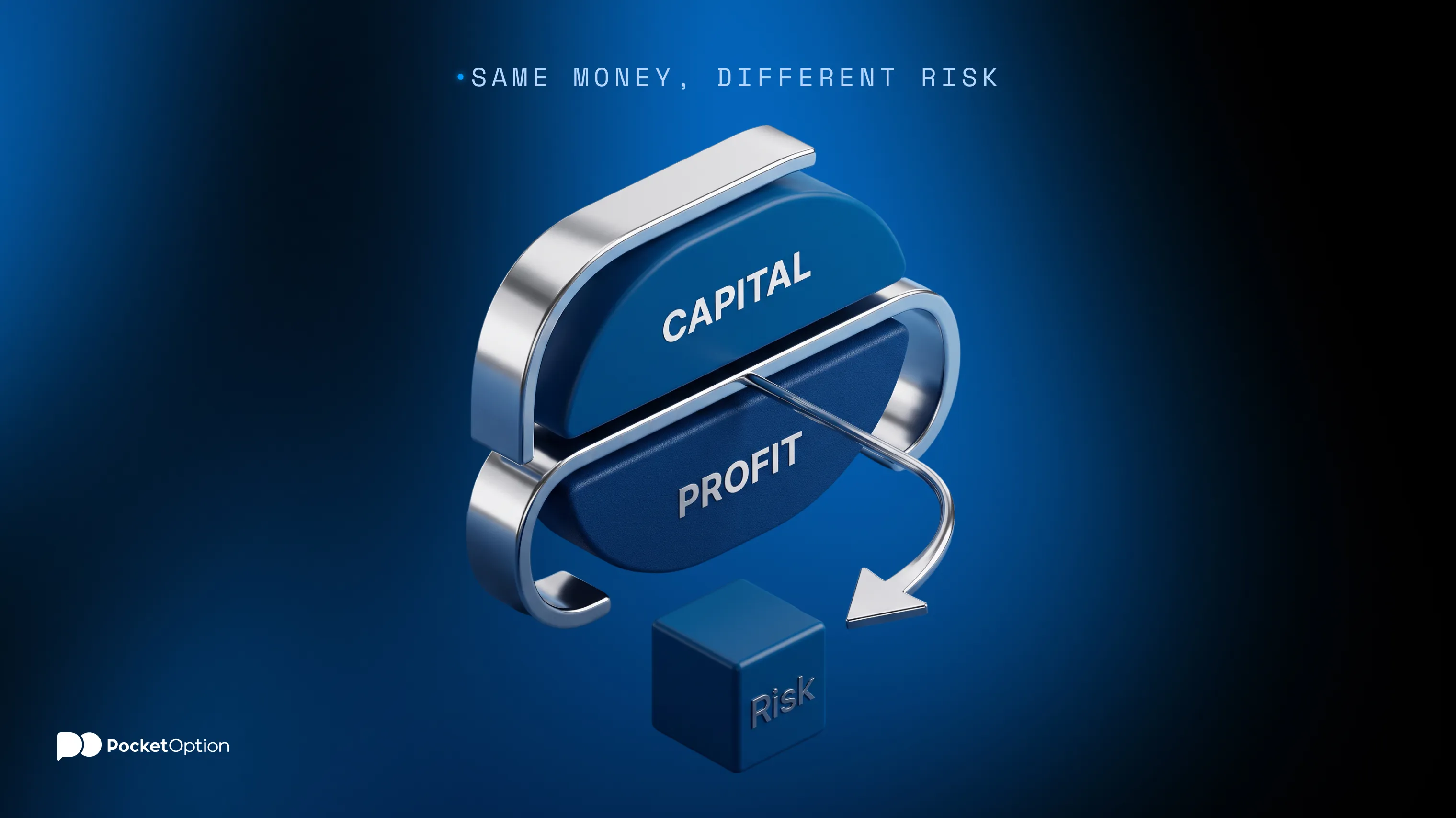
Looking at the house money effect behavioral finance angle means looking at mental accounting, the tendency to sort money into separate psychological categories depending on where it came from or what it's meant for. Before a gain, a trader treats a given sum as their own capital and handles potential loss of it with real caution. After a recent gain, part of that total sum can get mentally filed under a different heading: profit, separate from the original stake.
Economically, none of this separation actually exists. Money stays interchangeable regardless of which mental category a person puts it in. The house money effect behavioral finance research doesn't dispute that; it's specifically about the gap between that economic reality and how the money actually gets treated in someone's head. Checking your own account directly through your Pocket Option login, and noticing which balance you'd call "profit" versus "capital," can make that gap concrete rather than abstract.
How the Reference Point Can Shift After a Gain
A reference point works as a kind of internal baseline for what counts as a gain or a loss going forward. Right after a gain, that new, higher total doesn't always get absorbed into the baseline immediately, so losing part of it can feel different from losing the same dollar amount out of the original capital. Reference points do shift over time, though. Research on individual investors in Taiwan found that the tendency toward increased risk-taking after gains actually decreased the longer the time that had passed since that gain. Reading the house money effect psychology through that lens, reference points aren't fixed forever; they adjust.
What the House Money Effect Can Look Like in Trading
A handful of purely illustrative scenarios show what this can look like in practice. A trader risks a larger amount on the next position after a profitable trade or a short winning streak. A setup gets taken that would have been passed over entirely before the recent gain. Previously set risk limits quietly loosen. Losing back part of that recent profit gets treated as somehow less costly than losing an equivalent amount of the original capital would be.
None of this means every instance of increased risk after a gain traces back to this specific effect. Exposure can change for entirely rational reasons too, a genuinely stronger setup, new information, a shift in market conditions. Research following real individual investors found a connection between prior gains and subsequent purchases of more volatile stocks, though that finding doesn't automatically generalize to every trader or every market.
How the House Money Effect Differs From Other Trading Biases
This effect can look similar to other trading psychology patterns on the surface, since more than one bias can push someone toward taking on more risk after a win. The real difference sits in the reason behind the shift, not just in the behavior itself. Two comparisons below make that distinction concrete: overconfidence, and the Gambler's Fallacy.
Bias | What Changes | Typical Trigger |
|---|---|---|
House money effect | How acceptable a given risk size feels | A recent gain makes losing it feel less costly |
Overconfidence | Belief in one's own skill or control | A winning streak strengthens confidence in judgment |
Gambler's Fallacy | Expectation about the next outcome | Independent outcomes get treated as connected |
Why It Can Look Like Overconfidence
Picture one purely illustrative trader after a winning streak. If the added risk comes from the recent gain feeling like a less painful thing to lose, that's this effect at work. If it comes from a growing belief in their own skill, their read on the market, their ability to control the outcome, that's overconfidence instead. In actual practice, both mechanisms can show up in the same moment, which means a single instance of increased risk-taking doesn't pin down which one is actually driving it.
Why This Is Not the Gambler's Fallacy
The difference here comes down to the type of mistaken reasoning involved. This effect shifts how acceptable a certain size of risk feels after a prior gain. The Gambler's Fallacy involves expecting that a string of independent outcomes somehow makes the next one more or less likely, red coming up because black just hit several times in a row, say. One trader risking more simply because a recent trade paid off illustrates the first pattern. A trader expecting a losing streak to end simply because it's "due" illustrates the second.
How to Notice When Recent Gains Are Changing Your Risk Decisions
A practical self-check, without any promise of eliminating the pattern entirely, starts with a few direct questions:
Did the acceptable size of this risk change only because the previous trade happened to be profitable?
Would this same trade have looked acceptable before that gain showed up?
Does a potential loss here feel like losing profit, rather than losing capital that's actually on the line right now?
A trading journal helps make this comparison concrete rather than theoretical, recording the reasoning behind a decision before the outcome is known, then reviewing it against what actually happened. Pocket Option already covers journaling as a way to track reasoning, emotions, and recurring behavior patterns over time, which applies directly here without needing a separate walkthrough.
Keeping Risk Rules Consistent After Recent Gains
A handful of approaches help keep recent results from quietly reshaping risk decisions: setting risk limits in advance, applying the same evaluation process to every trade regardless of what happened on the last one, reviewing any changes in position or risk size after the fact, and actually writing down the reasoning whenever a decision departs from the original plan.
None of this means keeping the exact same risk size in every single circumstance forever. The actual goal is different: any change in risk should trace back to a reason decided on ahead of time, not just the feeling that this is profit, so losing it wouldn't really hurt.
Risk Disclaimer: Trading involves significant risk of capital loss. This article is for educational purposes only and does not constitute financial advice. Always conduct independent research and consider your risk tolerance before making any trading decisions.
See more:Psychology