Disposition Effect in Trading: Why Traders Sell Winners Too Early and Hold Losers Too Long
The disposition effect is the habit of closing winners too early and holding losers too long. Here is why it happens, how loss aversion and reference points feed it, how to recognize it in your own trades, and which habits can reduce it.

Picture your screen on a normal Tuesday. Position A is green. Position B is red. Your hand drifts toward A. Cash it, feel good. B? Let it breathe. Almost everyone has done this. Researchers noticed the pattern long before retail trading apps existed.
What Is the Disposition Effect in Trading?
The disposition effect is a habit. Gains and losses get judged by different rules. Winners get cashed fast. Losers get tolerated, sometimes for months. Finance professors Hersh Shefrin and Meir Statman named it in 1985. Later, Terrance Odean dug through thousands of brokerage accounts. Investors sold winning stocks more eagerly than losing ones.
The telling part is the lopsidedness. Realized profits meet one standard. Realized losses meet another. That lopsidedness is the disposition effect in a nutshell. A single early exit proves nothing, though. Your plan may have asked for it. News may have changed the picture. Plenty of exits are rational. It's the repeated pattern that gives the game away.
Open a demo account and practice exits with virtual funds.
Try Demo AccountNothing exposes a habit like a quiet experiment.
Try this. Open a demo account. Place a handful of trades with virtual funds. Don't change how you'd normally trade. Watch what your hand does with a green position. Then with a red one. Jot it down. The disposition effect is easier to spot when nothing real is at stake. Fear isn't shouting over the evidence.
Give demo trading a week and record every exit, good or bad.
Why Traders Sell Winners Too Early and Hold Losers Too Long
No single cause explains it. The disposition effect behavioral finance literature blames several forces working together. Start with loss aversion. A loss stings more than an equal gain pleases. Roughly twice as much, in classic lab experiments.
Need a place to track each trade? The pocket option tutorial points you to trade history.
Next, the anchor. Most of us measure a trade against the price we paid. Above that number you feel right. Below it you feel wrong. Every decision gets filtered through one figure the market doesn't care about.
Then comes the sting of making a loss real. While the trade is open, the loss lives on paper. It might still heal. Close it and the story ends. Mental accounting adds fuel. Each trade sits in its own little notebook. Nobody wants a notebook that closes in red.
Cashing a winner feels like a receipt for good judgment. Closing a loser feels like a confession. Prospect theory, from Kahneman and Tversky, is a leading framework. It isn't the only one. Across the disposition effect behavioral finance studies, no single explanation wins.
What the Disposition Effect Looks Like in Practice
Still asking what is disposition effect, really? Look at two open trades, A and B. No tickers. No signals. A is in profit. B is in the red. You close A because you'd like to bank the win. B stays open because it'll get back to entry. Yet B's original reason to exist has faded. Nothing in the market promises a recovery. Only your hope does.
Situation | Disposition-Driven Reaction | More Objective Question to Ask |
|---|---|---|
Winning position | Sell fast and enjoy the relief | Does my plan call for an exit here, or am I scratching an itch? |
Losing position | Wait for a return to the entry price | With no position, would I enter at this price today? |
Changed market thesis | Pretend nothing changed | Is the reason I opened this trade still true? |
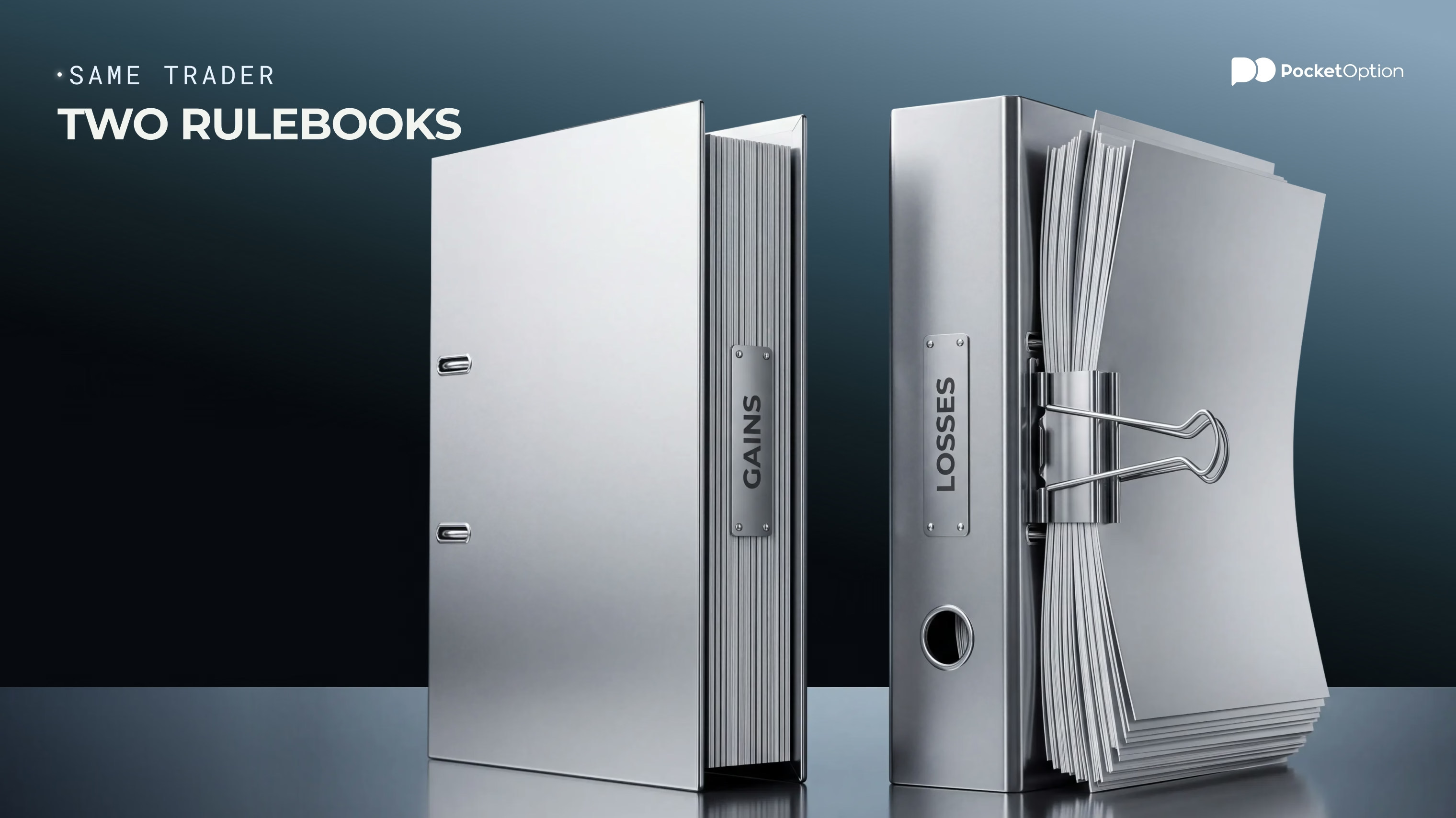
Same trader. Two rulebooks. Look at row three. The story changed. The behavior stayed.
How to Recognize the Disposition Effect
One trade proves nothing. Look for repetition. Signs of the bias:
Profits get banked on instinct instead of on a plan
Losses stay open mostly because closing them hurts
The entry price keeps popping up as the number that matters
Gains and losses are handled by different rules
After a trade goes bad, the original reasoning quietly drops out of the picture
Pull your last twenty closed trades. Compare how long the winners lasted with how long the losers lasted. A big gap deserves a closer look. It isn't a verdict.
Why the Disposition Effect Can Distort Trading Decisions
The damage lands on decision-making. You rate a position against what you paid. Not against what the market says today. You loosen your risk rules once a loss shows up. Imagine a stop that slides away the moment a trade turns red. The rule bent. The market didn't. Winners and losers get filed under different laws, every time.
Does that doom every trader who shows the pattern? No. Researchers have seen it among professionals too. Some studies tie it to weaker results. Others find little. The process problem is the same: rules that shift with mood.
How Traders Can Reduce the Disposition Effect
These are behavioral controls, not a strategy. Habits worth building:
Write down your exit conditions before you enter
Run gains and losses through the same checklist
Revisit the original trade idea on a schedule
Log every entry and exit with a one-line reason
Ask: would I open this position today, at this price?
Judge the trade on its merits, not on the urge to get back to even
A journal beats memory. Memory edits itself into a flattering version. These habits make choices more consistent. They don't make outcomes certain.
Risk Disclaimer: Trading involves significant risk of capital loss. This article is for educational purposes only and does not constitute financial advice. Always conduct independent research and consider your risk tolerance before making any trading decisions.
See more:Psychology