
Cross Currency Pairs Guide
Pull up almost any forex chart and one name dominates: the US dollar. EUR/USD, USD/JPY, GBP/USD, it anchors nearly every headline quote. So how do you trade the euro straight against the pound, dollar excluded? A separate breed of instrument does exactly that, opening setups the dollar pairs cannot.

What Are Cross Currency Pairs?
So what are they? Cross currency pairs are forex pairs that contain no US dollar at all. Rather than measuring a currency against the dollar, they quote two non-dollar currencies directly, euro versus pound, or pound versus yen. Before electronic dealing, converting euros to yen took two hops through the dollar, not one clean quote.
Brand new to forex? Set up an account and make your first trade along a guided, step-by-step path across 100+ assets.
Get StartedThat gap matters. Every major pair rides on the dollar, the currency ruling global reserves and daily turnover. Crosses drop it, and that one change reshapes their liquidity, spreads, and movement. Traders who read how cross currency pairs behave catch chances dollar-only chartists miss.
Just starting out? A short hands-on walkthrough teaches the mechanics faster than any wall of text.
Our pocket option tutorial walks you through opening a position, reading a live quote, and sizing the trade before any real money goes in.
Once those basics stick, trading cross currency pairs feels routine, no harder than the majors you already know.
Cross Currency Pairs List
Not every pairing earns a place on your watchlist. A useful cross currency pairs list keeps to the combinations with solid liquidity and spreads slim enough that entry costs stay modest. Here are the crosses with the most real activity:
| Cross Pair | What Makes It Notable |
|---|---|
| EUR/GBP | Closely linked economies, narrow ranges, among the gentlest crosses for beginners. |
| EUR/JPY | Middling volatility with readable trends in busy hours, a dependable all-rounder. |
| GBP/JPY | Notorious for huge daily swings. High reward, high danger, no place for newcomers. |
| EUR/CHF | Muted moves, driven largely by Swiss central bank policy shifts. |
| AUD/JPY | A favored risk-appetite gauge, swayed by world growth and commodity moves. |
| GBP/CHF | Liquid but jumpy, quick to spike on UK or Swiss headlines. |
Reading about a pair is nothing like watching it move live. A pocket option demo account lets you open EUR/GBP or GBP/JPY and watch the spread, pace, and daily swing on virtual funds before real capital is at risk.
Risk Disclaimer: Trading involves significant risk of capital loss. This article is for educational purposes only and does not constitute financial advice. Always conduct independent research and consider your risk tolerance before making any trading decisions.
How Do They Work?
This is where beginners stall. If your broker mostly prices currencies against the dollar, how does an EUR/GBP quote exist? Those rates are worked out, not posted directly. To see what are cross currency pairs in forex mechanically, stack two dollar pairs side by side. EUR/USD tells you a euro's worth in dollars; GBP/USD tells you a pound's worth in dollars. Split the first by the second and EUR/GBP emerges. Feed in EUR/USD at 1.0800 and GBP/USD at 1.2700, and the result sits near 0.8504. Platforms handle this on the fly, so you get one tidy price while the dollar legs run underneath. It also explains how a sudden dollar move spills into a cross when neither currency looks responsible.
Best Cross Currency Pairs to Trade
Popularity here rests on liquidity and predictable behavior. The minor cross currency pairs forex traders favor share one trait, enough turnover to keep spreads tame plus clean reactions to economic data. Three names lead, each suiting a different temperament.
EUR/GBP
EUR/GBP is the quiet one. Britain and the eurozone do enormous trade with one another, so the euro and pound tend to track together and the pair holds tighter ranges than most. That calm makes it a natural first step into cross currency pairs trading. Range tactics fit well, and low volatility leaves room to learn. Stay alert around Bank of England and ECB rate calls, when the quiet can vanish fast.
GBP/JPY
Traders call GBP/JPY "the dragon," and it fits. The GBP (British Pound, also called Pound Sterling) against the Japanese yen delivers some of the widest daily ranges in forex. The pound injects risk-driven momentum, the yen mirrors global fear and rate gaps, and side by side they heave violently. Veterans chase the payoff; newcomers get steamrolled. Trade it only with smaller size and wider stops.
EUR/JPY
EUR/JPY sits between the two, livelier than EUR/GBP, far calmer than GBP/JPY. It mixes the euro's heft with the yen's read on risk moods, often carving clean, trackable trends in busy sessions. Volatility is moderate, enough to matter but tame enough for a sensible stop. Many traders use it as the step up once EUR/GBP feels too sleepy.
Cross Pairs vs Major Pairs
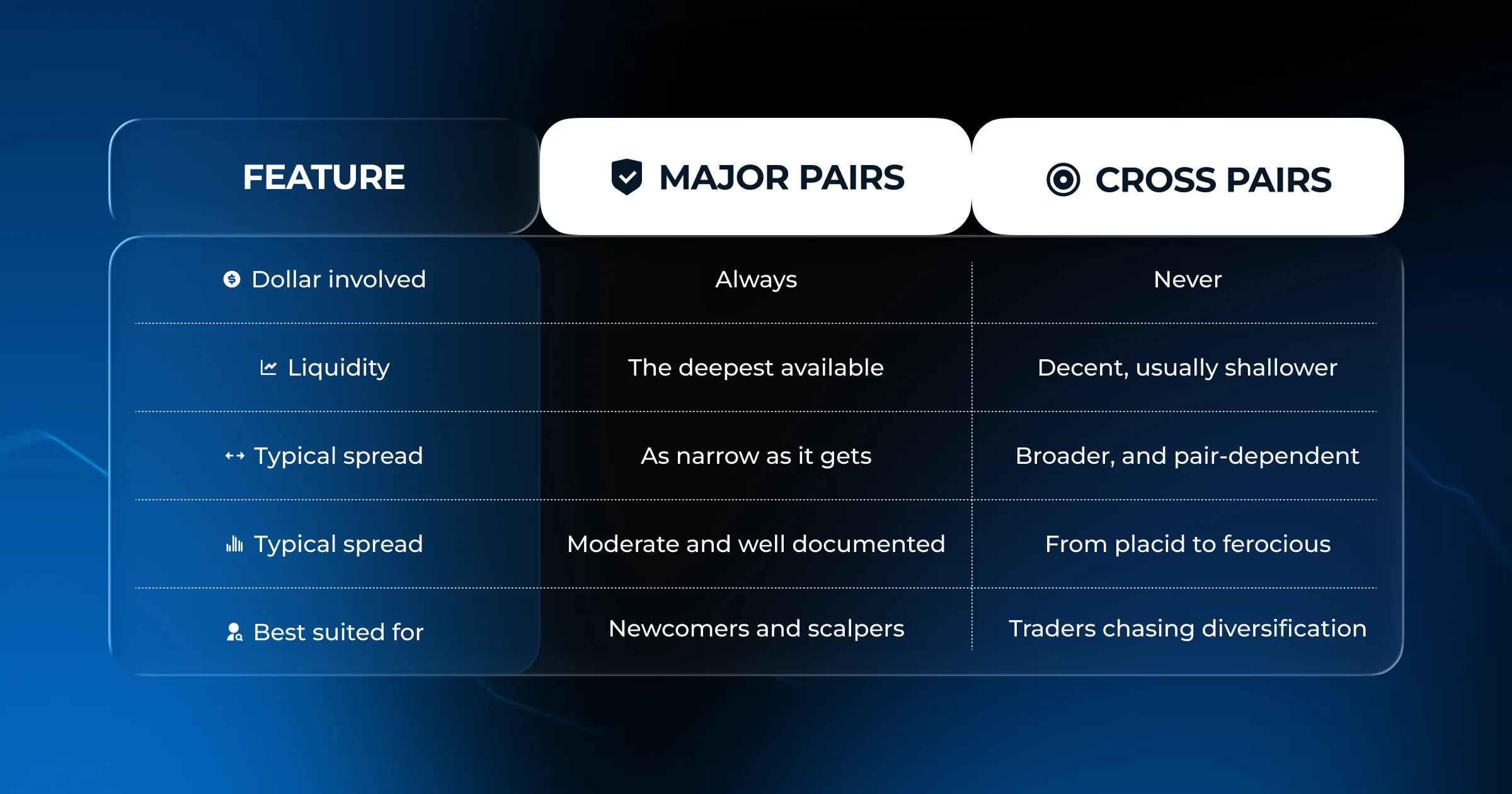
So how do crosses compare with the dollar majors you started on? The contrasts are practical, showing up in cost, timing, and risk.
| Feature | Major Pairs | Cross Pairs |
|---|---|---|
| Dollar involved | Always | Never |
| Liquidity | The deepest available | Decent, usually shallower |
| Typical spread | As narrow as it gets | Broader, and pair-dependent |
| Volatility | Moderate and well documented | From placid to ferocious |
| Best suited for | Newcomers and scalpers | Traders chasing diversification |
Benefits and Risks
Trading crosses is a genuine give-and-take. The upside first.
Diversification: Crosses let you back a currency opinion while stepping around the dollar, useful when the dollar muddies your view.
More opportunities: Pairs such as GBP/JPY trend and break out with a force the majors rarely produce.
Cleaner regional plays: Want to bet on the pound specifically against the euro? A cross isolates that exact matchup.
Now the downside.
Wider spreads: Shallower liquidity lifts costs past the tightest majors, slowly chewing into short-term trades.
Sharper volatility: Some crosses move so fast a standard stop gets overrun the instant news hits.
Hidden dollar risk: Because every cross is assembled from dollar pairs, a sudden dollar jolt can still drag your position.
Understanding Correlation
Currencies never trade in a vacuum, and crosses make that plain. Correlation tracks how closely two pairs move together: positive means in sync, negative means opposite. EUR/GBP and EUR/JPY both ride the euro, so a strong euro pulls them together. The real value is risk control. Holding longs across three euro-heavy crosses is not three bets, it is a single outsized bet on the euro. Spotting that overlap before adding size keeps one bad day from hitting everything.
Trading Strategies
No single blueprint wins with crosses, but a few approaches fit how these pairs behave.
Range trading the quiet crosses: Pairs like EUR/GBP hold their levels for long stretches. Buy down near the base, sell up near the cap, stops just outside.
Trend riding the volatile ones: GBP/JPY and EUR/JPY can stretch trends across days. Step in on pullbacks, trail the stop, and let it run.
News-driven trades: Central bank announcements jolt these pairs. The calmer route waits for the chaos to pass and trades the cleaner trend after.
Correlation hedging: Balance a long in one cross with a short in a correlated one, trading the gap and muffling broad market noise.