What Is a Pip in Trading, and How to Use It
In forex trading, price movements are measured in pips. Profits, losses, spreads, and so on, all pips.This is a language of trading you must know how to read, if you trade currency pairs or CFDs. Here, we explain what is a pip in trading, how pip value is important to lot size, and how to use pips for proper risk management and performance tracking on Pocket Option.

What Is a Pip in Trading
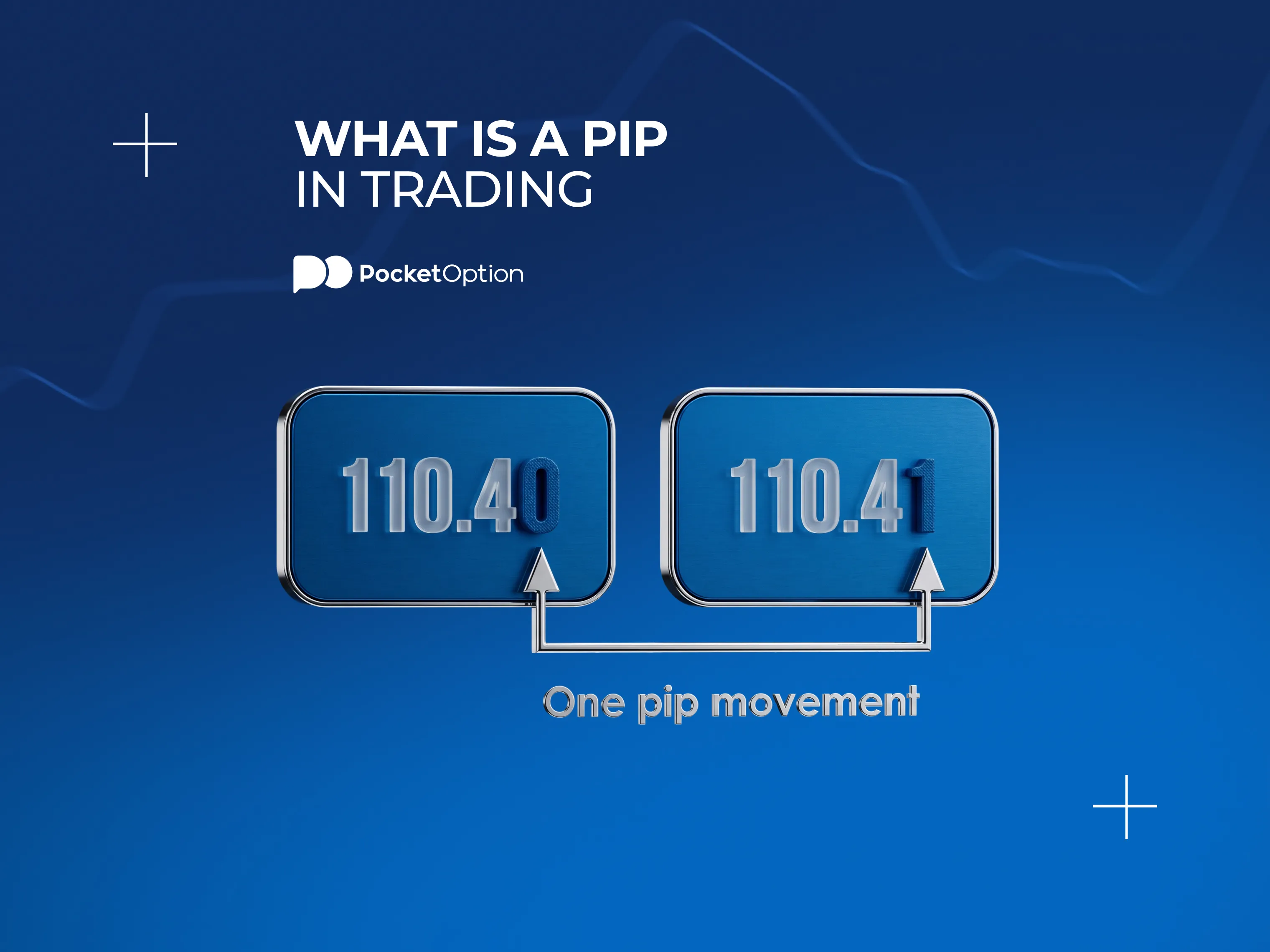
So, what does pip mean in trading? A pip is short for “price interest point.” It’s the smallest standard unit of price movement in the exchange rate of a currency pair. It came from forex trading, but is now used for metals trading, stocks, and even crypto. In most cases, 1 pip in trading is equal to 0.0001, or one ten-thousandth of a unit of the asset pair being traded.
So if EUR/USD moves from 1.0850 to 1.0851, it means it has moved one pip. If a pair in forex trading moves from 1.0850 to 1.0900, the movement was 50 pips. It’s easier to understand this way, and also understand the magnitude of the move. A 50 pip move during the day is usually a rather large price swing, even though the increase in the price on paper could be seen as not that massive.
This is also the best way to compare various markets and timeframes. What is pip in trading? It’s a great universal unit of measurement, no matter if you trade XAU or US dollar pairs.
Pips vs Pipettes: What's the Difference
For user convenience many exchanges and brokers, including Pocket Option, display prices with five decimal places rather than four. This is done in order for users to be able to capitalize on even smaller price moves, or to do even tighter risk management. The fifth decimal place in such cases is called a pipette. One pipette is equal 0,1 of a pip.
So if the EUR/USD pair is trading 1.08503, the ‘3’ here is the pipette. It’s the fifth decimal place. Pipettes allow for tighter spreads and more precise execution in trading, but sometimes they confuse newer traders. If a stop is ‘20 pips away’, it means 200 pipettes, not 20 pipettes.
How Pip Value Is Calculated
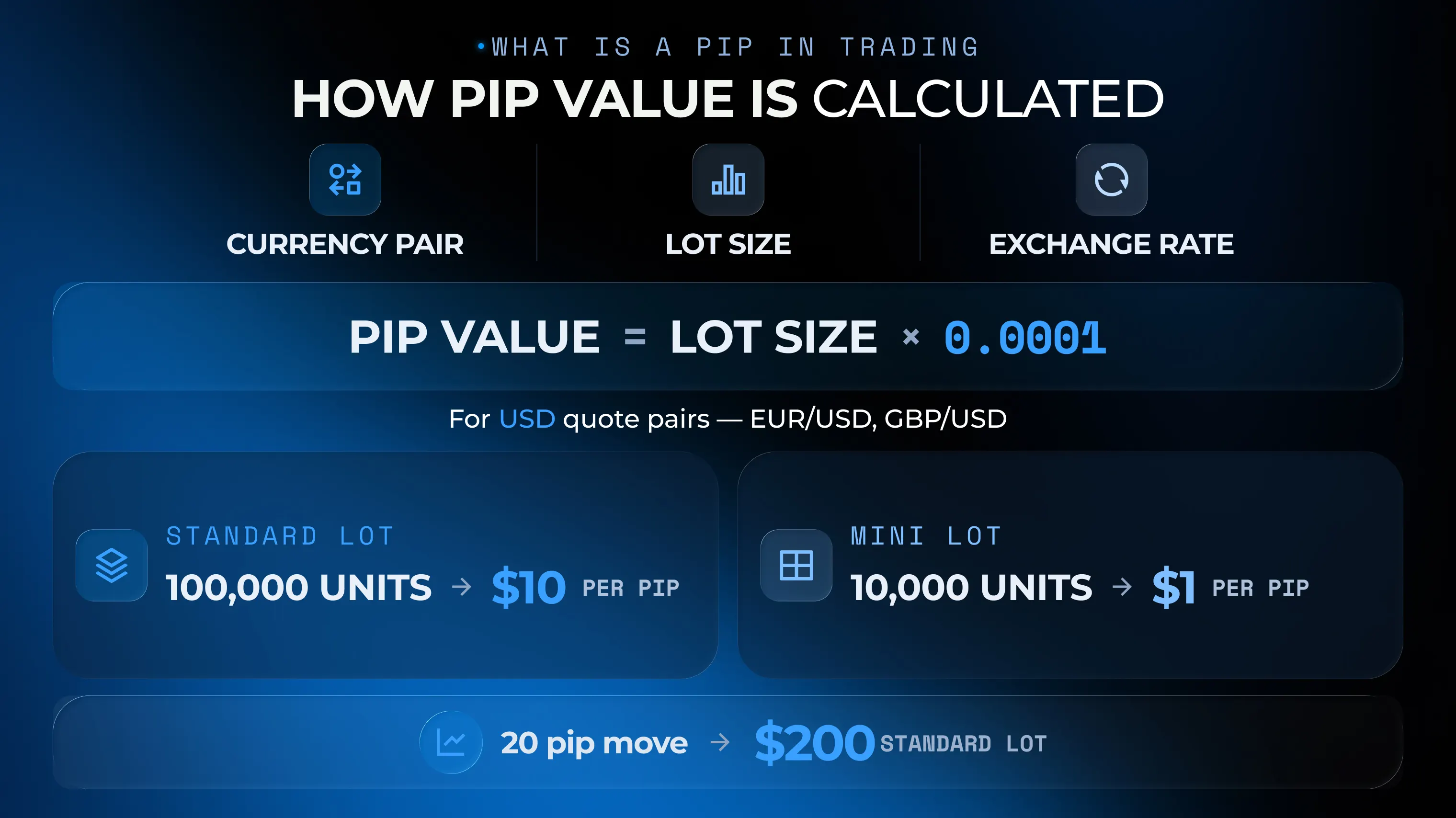
The value of 1 pip depends on three factors: currency pair being traded, lot size, and exchange rate (between the quote currency and the first currency in the asset pair).
Most commonly, for pairs where the US dollar is the quote currency (like EUR/USD or GBP/USD, so dollar is at the bottom of the equation), the math is simple:
Pip value = Lot Size × 0.0001
For a standard usd lot (meaning, 100,000 units of quote currency), one pip is worth $10. So if you expect a 20 pip move, that would be a $200 move for your account balance. For a mini lot (equal to 10,000 units), one pip is worth $1. This is important to understand in case you move between different accounts or are doing forex trading with multiple brokers.
Pip Value by Lot Size: Standard, Mini, and Micro Lots
Lot Type | Units | Pip Value (USD pairs) | 20 Pip Move = $ |
|---|---|---|---|
Standard | 100,000 | $10.00 per pip | $200.00 |
Mini | 10,000 | $1.00 per pip | $20.00 |
Micro | 1,000 | $0.10 per pip | $2.00 |
This table applies to pairs where the US dollar is the quote currency (meaning, it is divided by in the equation, like EUR/USD). For cross-pairs and pairs with a different quote currency (like USD/JPY, so JPY at the bottom), the pip value is adjusted by the exchange rate between pairs. Usually it’s done automatically by the exchange or your broker.
How JPY Pairs Work Differently
Japanese yen pairs are quoted up to two decimal places, instead of four. This means that for USD/JPY, one pip is worth 0.01, not 0.0001. If the USD/JPY pair moves from 155.00 to 155.50, the move is said to be worth 50 pips. The 1 pip in a standard lot on a Japanese yen pair is equal to ~$6.45 (depending on the USD/JPY rate at the time), not $10.
This is why people are asking whats a pip in trading: this aspect can be confusing, and the difference between asset pairs catches many forex trading beginners off guard. If your broker lets you set stop-losses in pips, this often leads to incorrect risk management. A 100 pip move on EUR/USD (so from 1.0800 to 1.0900) and a 100 pip move on USD/JPY (from 155.00 to 156.00), while being equally large, represent very different percentage changes in visible exchange rate, even if they’re measured in the same units.
Real-World Examples of Pips in a Trade
A lot of beginners are initially confused as to what’s a pip in trading, so let us explain. Suppose you buy EUR/USD at 1.0850, and it rises to 1.0890. This means, the price has moved 40 pips in your favour. On a regular lot, that would be a $400 gain for your account. On a micro lot, it is $4.
Now say you buy GBP/USD at 1.2700 and set a 25 pip stop loss (at 1.2675). On a mini lot, your maximum risk on this trade would be $25. On a standard lot, it is $250. Easy to calculate, easy to understand to other traders, no complex calculations required. Just remember that those same 25 pips can mean very different things depending on your lot size: regular, micro, or mini. Switching between accounts with different lot sizes is the pitfalls of using pips for risk management.
Live trading with Pocket Option
Get Started!Using Pips to Set Stop Loss and Take Profit Levels
Pips give an easy way to define risk and reward. A stop loss of 30 pips means trade will be automatically closed if price moves 30 pips against you, no matter what the price is, or which asset you’re trading. A take profit of 60 pips means the trade will close when the price moves 60 pips in your favour. The ratio between these two values (in this case, 1:2) is the risk to reward ratio of the trade (also called R:R). The lower the ratio, the better the trade could be.
Using a pip in trading to set stops and targets is useful because you are forced to think in terms of market structure, and not exchange rate or account balance. You are automatically linked to actual price action. A 30 pip stop should be placed at a technically important level (below support, above resistance, etc), not at a point where a currency number looks good and round. Using pips is often a way to eek out a few more percentage profits out of your overall trading journey.
Using Pips for Position Sizing and Risk Management
The pip in trading can be the bridge between your stop loss distance and your position size. The formula here is:
Position size = (Account risk in $) / (Stop loss in pips × Pip value per unit)
For example, if you have a $1,000 account and want to risk 2% of it ($20) on a trade with a 25 pip stop loss. A pair is EUR/USD. The pip value on a micro lot will be $0.10. In this case, proper position size = $20 / (25 × $0.10) = 8 micro lots. This is how much you should put into the trade. This ensures that no matter where S/L is placed, at which exact exchange rate, the dollar risk to your account remains constant. This is what a pip in trading is doing: giving you an even better risk management, if used correctly.
That said, many exchanges and brokers, including Pocket Option, allow you to enter your risk directly, in US dollars, rather than in pips or price points. This can be an even easier way to set how much money you are willing to lose, or are hoping to gain from a trade. It is not as rigorous according to TA, but it may be useful for total beginners or so-called ‘vibe traders’.
Learn to trade like the best
Register For FreeTracking Strategy Performance in Pips
Recording results in pips rather than dollars isolates strategy performance from your position sizing choices, or emotional noise. Instead of thinking ‘I will profit $500!’, you are thinking ‘this move can be 50 pips’.
A strategy that generates +150 pips per month is performing consistently, no matter how many dollars that is, and no matter if it's micro lots, standard lots, or a demo account. This makes it simpler to see if you have an edge in the market, and if you should be scaling up. Building your thought processes around pips makes it harder to make irrational choices.
Common Pip Mistakes Beginners Make
Confusing pips with pipettes. The most common one, happens even with brokers themselves. A 5 pipette spread is 0.5 pips, not 5 pips.
Setting S/L in dollars instead of pips (can be suboptimal long-term).
Ignoring pips when shifting lot sizes (i.e. from standard lot to micro lot).
Not adjusting for JPY pairs. A ‘50 pip’ move for USD/JPY is not the same in terms of price as a 50 pips on EUR/USD.
Conclusion
What is a pip in forex trading? It’s the fundamental unit of measurement for price movements, stop losses, take profits, and many other metrics in currency markets. Understanding how pips are calculated, how their value changes with lot sizes and quoted currencies, and how they are applied to risk management is not an optional skill. It's the foundation on which every other aspect of forex trading is built.
Risk disclaimer: Trading involves significant risk of capital loss. This article is for educational purposes only and does not constitute financial advice. Always conduct independent research and consider your risk tolerance before making any trading decisions.
See more:Knowledge baseTrading