Forex Binary Trading Solutions
One of the attractive features of forex binary trading is its perceived simplicity. All you have to do is to pick up a currency pair, choose a direction of price move, pick up an expiry time and you already know how much can you win or lose. Indeed, the clarity is true for this format. What this guide attempts to show is the fact that the simple structure and the positive outcome is not the same thing.

What Is Forex Binary Trading?
Forex binary trading is a form of binary trading on currency pairs. You commit a certain amount of money, choose whether the price of the pair will be above or below its current price in a set moment in the future and the trade is resolved in this particular moment. There are only two possible outcomes in such type of trading and this is why it is named binary.
Let us compare forex binary trading with the purchase of a currency pair on the market. The latter requires you to make a profit on the distance of the price move. In binary trading, the distance does not matter. The price move of one pip will be treated in the same manner as a move of eighty pips if it lands on the right side of the threshold at the expiry. Therefore, the trade is the kind of short-term fx speculation rather than a currency investment, as there is no position held and no ownership in the process.
An important remark before we proceed further. Such type of trading is either limited or banned for retail investors in several countries including the UK and EU countries after the review of losses on such accounts revealed by the regulators. The availability of this product depends on your country completely.
How Binary-Style FX Trades Work
There are three basic parameters which describe a trade and they all are settled before you open a position.
The underlying currency pair. Usually it is a major one, which provides a predictable level of liquidity and tight quotes, and major currency pairs trading dominates this format for exactly that reason. EUR/USD, GBP/USD and USD/JPY lead the way here.
The expiry. The expiry time in binary trading is the resolution moment, with the range going from several seconds to the end of the trading day. Faster does not necessarily mean easier despite the user-friendly interface.
The stake and the payout on the trade. You commit the certain amount of money. If the trade resolves in your favor, you will get the payout. Otherwise, the total loss is equal to the committed stake.
The last point is what makes fixed payout trading differ from many other formats and it is important to understand this point clearly. The winning trade brings you back less than 100% of your stake while the losing trade means the loss of the stake completely. Thus, there is an imbalance between two outcomes.
What does it mean? If a winning trade returns you eighty percent of your stake and a losing trade means the loss of your stake completely then even a win rate of fifty percent makes you lose money. In order to break even you have to win significantly more than half of your trades and it is easy to forget about it looking at the interface but this is the crucial point to consider before you open your first position.
Forex Binary vs Spot Forex and CFDs
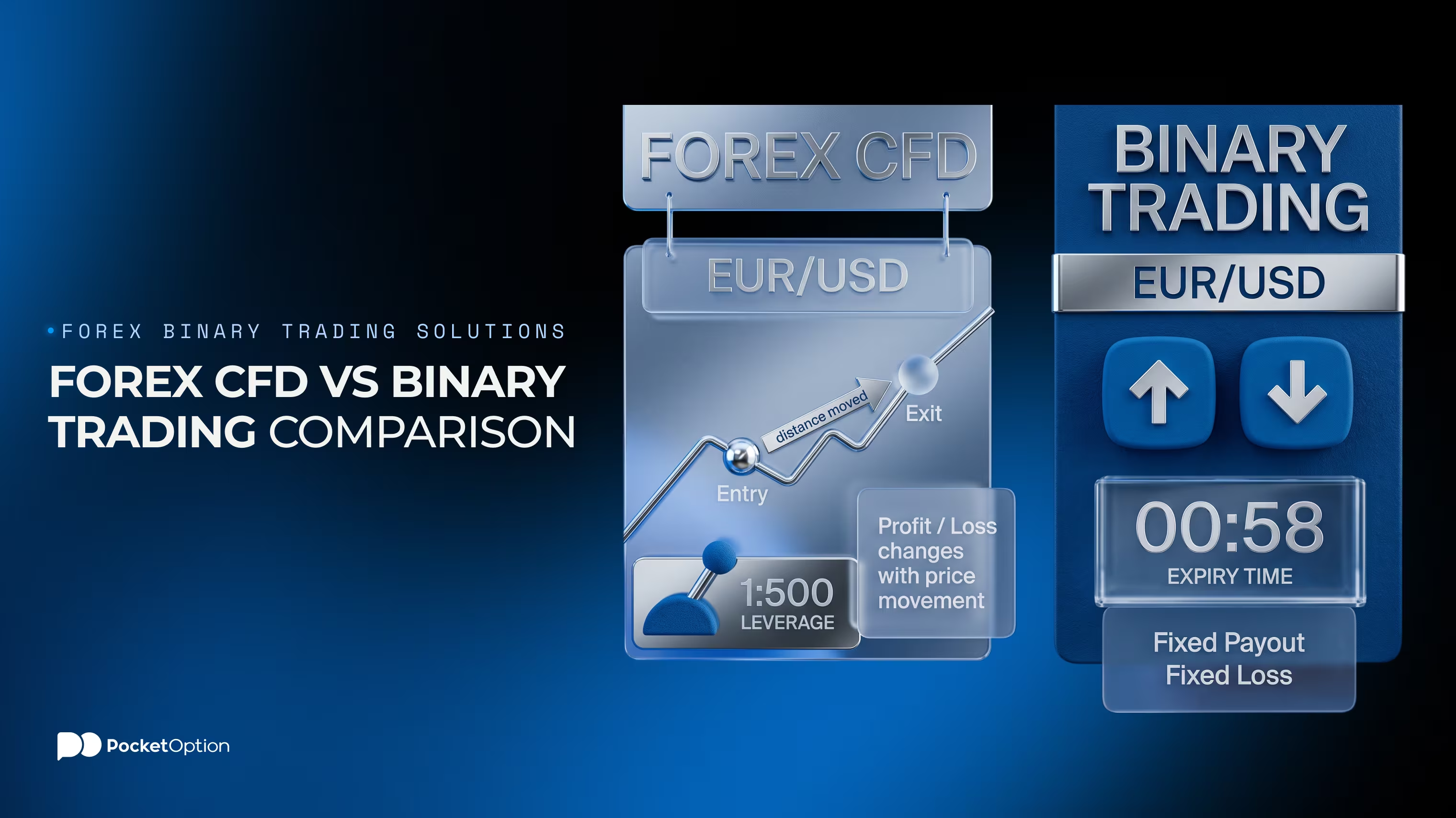
The forex CFD vs binary comparison comes down to the parameters of a trade and the way how they affect the outcome of your actions, in binary trading versus regular spot forex.
Binary-style FX | Spot forex and CFDs | |
|---|---|---|
Outcome | Fixed, determined at the expiry time | Depends on the price movement |
Maximum loss | The stake committed | Depends on the position size and stop loss |
Control after entry | None; the position is open until the expiry time | There is the opportunity to adjust your position, close it early or to scale out |
Stop loss orders | Does not apply as the stake is the maximum possible loss | Crucial parameter in the position management |
Leverage | Not used | Sets the maximum position size |
Overnight costs | Does not apply as the position expires | Financed on positions held overnight |
Main risk | Losing the stake on each trade | Losses running further than the trader planned |
Neither of the two formats is inherently safer. The first one limits the maximum loss on each trade which is helpful for those traders who are prone to widening of the stop loss orders. However, it does not give you the opportunity to recover from losses gradually as you cannot close the position early.
Leverage and margin in forex apply only to the second column, as the trader does not borrow anything on a fixed-outcome position. Thus, this format reduces one risk category but increases another: a loss on each trade equals to the whole stake rather than just a distance from the stop loss.
If the mechanics of the latter part of the comparison feel unfamiliar to you, there is a guide to forex trading for beginners that discusses pips and spreads in proper detail, and a separate article describing forex trading strategies.
Compare them on the platform yourself.
Get StartedCommon Setups in Binary Forex Trading
It is safe to assume that most beginners' actions belong to one of the typical patterns. Describing them is not the same as endorsing them, of course. Each of them comes with its own caveat.
The directional trades on the majors is probably the most common pattern for beginners in binary forex. It is a natural choice as the majors are liquid and quotes on them are tight and there is plenty of analysis available. The problem is that predicting the direction of the movement over five minutes is an absolutely different skill from the prediction of the direction over five days and the shorter horizon is noisier.
Trading news around the scheduled releases is the second popular pattern. Employment data, inflation data and central bank decisions affect the market at a predictable schedule, so it seems to be a logical approach. The reality is that the immediate price reaction often reverses in several minutes and the fixed expiry means that you have no opportunity to wait out this reaction even if your analysis was correct.
Trend continuation is the third pattern that can be observed in binary forex. Here, you predict the direction of the movement on the higher timeframe and trade this direction on shorter expiry periods. It is the least controversial pattern among the three as it is aligned with something larger than the current candle, but the trend itself pauses quite often.
What all these setups have in common is the asymmetric payout of the trades discussed above. It means that a setup with sixty percent accuracy still can lose money depending on the payout. Every setup should be tested in light of this mathematical fact rather than being analyzed for the predictive accuracy.
Risk Profile: Why Most Short-Term Traders Lose
Evidence on short-term retail trading is consistent throughout the markets and time.
Regulators conducting the reviews of EU retail accounts found that the share of losing accounts among retail customers trading the leveraged products ranged between 74% and 89% and the average losses per client ranged between about 1,600 and 29,000 euros. Reviews of fixed outcome products revealed similar losses, which led to the restriction mentioned above.
Academic research on the short-term trading shows the same pattern. For example, Chague, De-Losso, and Giovannetti in the study of Brazilian traders found that among those who were trading for over 300 days, 97% of them lost money after all costs, without signs of improvement due to trading experience.
The reasons behind it are structural, not individual:
The asymmetric payout: winning less than losing per unit of the stake means that the win rate has to be significantly higher than fifty percent in order to break even.
Noise: the very short horizon means that the price movements are noisier than the analytical information.
Frequency of the trades: the nature of this format implies many trades every day and all of them have the same structural disadvantage.
Behavior: losses increase the frequency of trading and the size of the stake rather than reducing them.
This does not mean that the format is fraudulent. It just means that it is hard and the interface hides it successfully.
Risk Management Rules for Binary Forex Exposure
Risk management in binary trading is simpler compared to the leveraged formats. As a matter of fact, there is only one number you have to control, and this simplicity makes it easier to do, and easier to forget about it.
The stake is your risk. There is no stop loss order and no position size to base it on the stop distance. The amount you commit is the amount you can lose in full for this trade. Thus, limit each stake at one or two percent of the account balance, which means that you lose about a tenth in case of ten losses in a row.
Limit the number of the trades you make per day, and write it down somewhere before you start. Set the daily loss limit as well and stop as soon as you hit it. The amount of three percent is common in this situation. The most important thing here is the pre-commitment of the figure; the same series of losses later in the day would be handled by a different person.
Keep the record of each trade you make, including the stake, expiry, reason and result. After the thirty or forty records, you can calculate your win rate and compare it with the required one. This comparison is the only honest measure of effectiveness of your strategy, and a written trading plan is what turns a set of intentions into something you can actually check.
Test the format on a demo balance.
Try DemoIs Binary Forex Trading Suitable for Beginners?
The honest answer to this question is: it is accessible to beginners, but it is not suitable for them.
What makes it accessible is quite clear. The maximum loss on any trade is clear before you commit anything, there is no margin call to worry about and the interface asks you about three decisions, not fifteen. Anyone who has never traded before can open a position on the new account within minutes and know exactly what he or she will lose.
What makes it difficult for beginners is also quite clear. Quick resolution of the trades teaches the wrong lessons, as quick wins due to the random movements can mislead you into thinking that you have skills. The asymmetric payout requires the win rate which is hard to achieve. And the low barriers to making the next trade make it the wrong feature for a beginner.
Thus, the recommendation for those who want to start with binary forex trading for beginners is quite clear: spend enough time on the demo balance first. It should be enough to collect the sample, not just to have one good day. Determine your win rate and compare it with the win rate you require. Keep the stakes low at first and consider the first few months the cost of figuring out whether the format is for you at all.
If it is not for you, it does not mean failure. Many traders figure out that the fixed format is not for them and that they work better with the format that allows them to be right slowly.
Conclusion
Calculate the win rate your payout actually requires and find out whether you can achieve it.
Everything in this article depends on this one single calculation. If a winning trade returns you eighty percent and a loser means the loss of a hundred then you need far more than fifty percent of your trades to break even and no amount of chart reading can change this math. Most traders never calculate this number, which explains why the format has such a bad reputation. Calculate it on the demo balance for a few hundred trades and compare the results honestly, and you will have a better answer about whether this suits you than any article can give you.
Disclaimer: Trading involves significant risk of capital loss and may not be suitable for all investors. Short-term speculative trading carries a high probability of loss, and the availability of particular trading formats depends on your jurisdiction and may be restricted where you live.
See more:Knowledge baseTrading