Day Trading Taxes: Everything You Need to Know
Day trading taxes can shock a lot of people who actively engage in this type of trading, as their transactions leave traces that need to be reported to the IRS once tax filing comes around. This article highlights how profits from trading are taxed, what Pocket Option reports, and what it does not.

How Is Day Trading Taxed: The General Rule
Profits made through day trading are generally not taxed at the reduced rate available to long-term holdings. Because positions are closed within the same day or within a very short time frame, they produce short-term capital gains, and short-term capital gains are taxed at ordinary income rates rather than at the preferential long-term rates. So when people ask how is day trading taxed, or how do you pay taxes on day trading, the answer is that these gains are taxed at the same rates that apply to wages and other ordinary income, even though they remain capital gains in character.
There is no single special day trading tax rate. Any stock or CFD position held for one year or less produces a short-term capital gain regardless of whether it came from five transactions in a year or five thousand. Losses run the other way and offset gains from other transactions, subject to the limits described below.
Short-Term vs Long-Term Capital Gains
It is the difference between short-term and long-term capital gains that matters for an active trader. If the assets are sold after being owned for one year or less, the capital gain produced will be short-term and taxed at the ordinary income rate. If the asset is owned for over one year before selling it, it’s considered a long-term asset and taxed at a reduced rate, ranging from 0% to 20%, depending on your annual income.
Because day trading positions are closed very quickly, within minutes, hours or at most a few days, practically all of this activity falls on the short-term side and is taxed at ordinary income rates. That treatment applies whether the position was in the stock market, forex or CFDs.
The Wash Sale Rule Explained
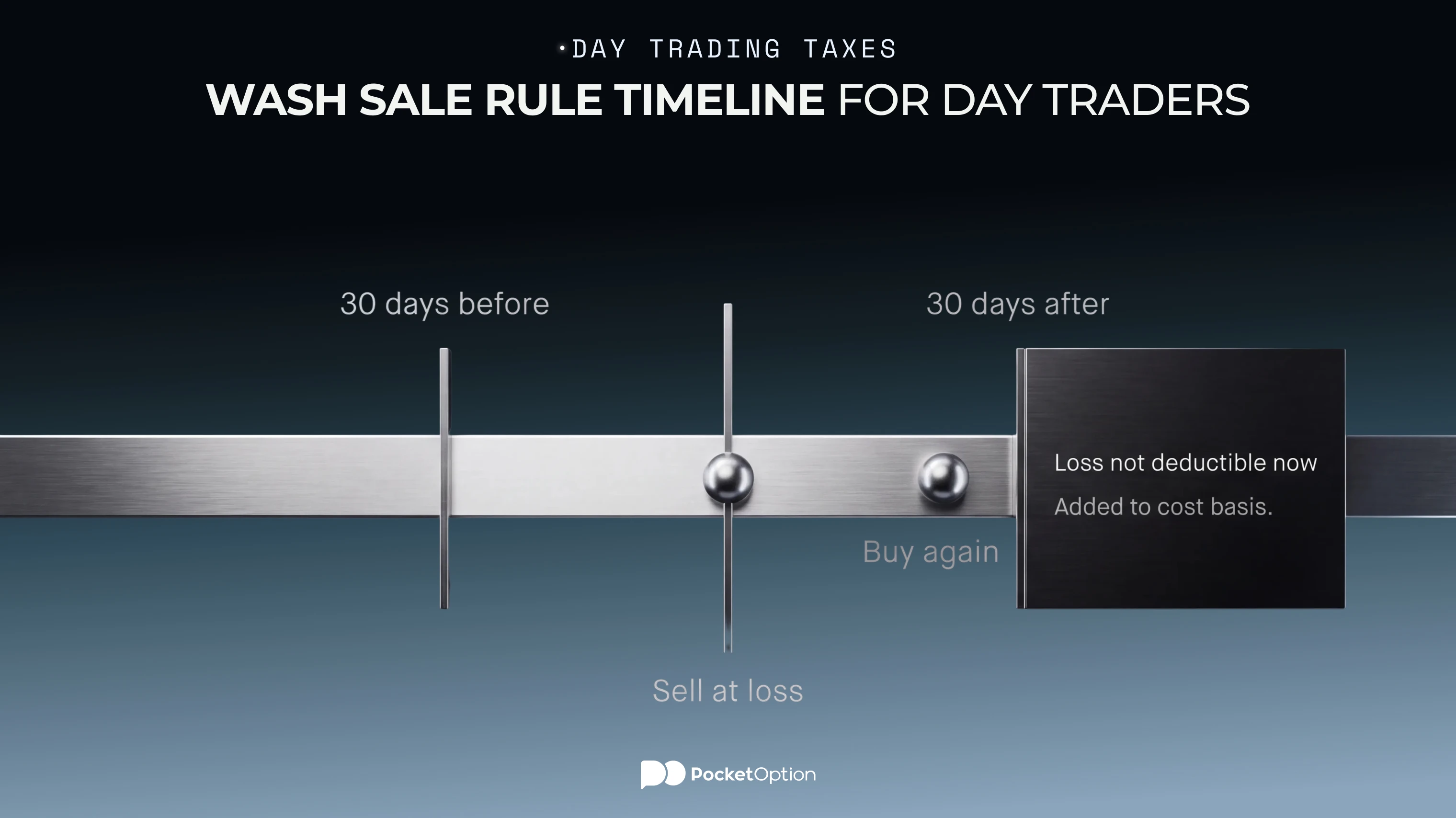
If you sell a security for a loss and purchase another one that's substantially identical in 30 days prior to or after this sale, then you will be unable to claim the loss as a tax deduction immediately. Instead, the loss will be deferred to the new purchase by adding it to the cost basis. So, you will not be able to deduct this loss until you sell this newly purchased security.
This rule prevents you from being able to take a tax loss while remaining invested in a substantially similar way. Frequent day traders, in particular, often run into the wash sale rules because of the fast re-entering of similar position after the sale. You will need to carefully record the dates and tickers of all your trades in order to detect the wash sales.
What Trader Tax Status Means (and How It Differs From PDT Rules)
Trader Tax Status (TTS) is a tax designation for those who qualify as qualifying active traders that allows claiming expenses related to their trading activity and making special election in their taxation. However, this is not the same as Pattern Day Trading (PDT) rules that are not even tax requirements, but rather a margin requirement imposed by brokers for US equity margin accounts. Trader tax status does not require filling of a special form and is based on the trader's activities and intentions, i.e. how frequently the trader trades and for how much money.
If the trader meets the requirements for TTS, then he or she will be able to deduct the expenses discussed in this guide and elect mark-to-market treatment.
The Mark-to-Market Election (Section 475(f))
An eligible trader may make the mark-to-market election under Section 475(f) of the tax code. Open positions are then treated as if they had been sold at fair market value at year-end. This is the one situation where trading results genuinely become ordinary income and ordinary loss rather than capital gains and losses, which is a change in character and not only in rate. The advantage is that the wash sale rules no longer apply and losses become fully deductible without the capital loss limitations.
However, in exchange for this benefit, you will be losing the reduced rate of capital gains tax on any position that would otherwise qualify. The mark-to-market election should be made by the original deadline of the prior tax year.
Section 1256 Contracts and the 60/40 Rule for Futures
Some securities (regulated futures, broad-based index options, certain foreign currency) fall into the category of Section 1256. The gain or loss is 60% long-term and 40% short-term regardless of holding period. Such assets are marked-to-market at year-end, which means that gains are taxed as if they were realized on December 31.
In case of futures traders, this blended approach usually provides a better result than short-term status for stocks and options, where a portion of gain is subjected to long-term rate even when the trade takes place within a day.
Deductible Trading Expenses
Qualified for TTS traders can deduct the following expenses:
Fees for platform and data
Regularly-used home office
Education and research relating to trading
Computer equipment and software related to trading
Interest expense on margin
Quarterly Estimated Tax Payments
Because no withholding applies to trading income, profitable traders make quarterly estimated tax payments (in April, June, September, and January). In case of underpayment of estimated taxes, there is a separate penalty, even if the payment for the year will be made in full by tax day. Due to changing trading income each quarter, most traders calculate their estimate quarterly and not four equal parts of previous year total.
How Taxes on Day Trading Options Work
Options bring additional considerations into the general rules for short-term gains and losses. Taxes on day trading options will be done in accordance with the ordinary income short-term rules for stocks, except for options covered by Section 1256 (such as broad-based index options). The purchase followed by sale of a call or put option will produce simple short-term gain or loss.
Assignment and exercise of an option creates additional complications. The purchase price of a call when exercised will be added to the cost of the stock; the purchase price of a put, when exercised, will reduce the proceeds from the stock sale. Combination strategies (spreads, straddles, iron condors) are usually considered individual transactions, unless a particular election treats them otherwise. That's why so many people try to consult an options specialist for tax advice on day trading options taxes.
on a live Pocket Option account
Get StartedDoes Pocket Option Tax or Report Your Trading?
Pocket Option does not withhold, deduct, or remit taxes. The short answer to does Pocket Option report to IRS or any tax authorities, is No. It is up to you to declare your trading earnings and pay taxes in your country of residence.
Pocket Option will not send you anything that looks like a 1099 tax form. The company also does not issue a Pocket Option tax form. You have to make your own calculations and file the tax return based on the data from the account statement or export history of trades from the trading platform.
Additionally, demo account trades use simulated money and are not subject to pocket option taxes, while real account trades are taxable.
How Tax Treatment Varies Outside the US
There is no global law for the taxation of day trading profits. They differ depending on the country. In the UK, capital gains tax may be imposed on profits from trading, but, in case trading takes place often and is considered to be business activity, then those profits will be assessed as income by the HMRC using the same criteria as for US TTS.
In most European countries, there is a flat capital gains tax rate irrespective of the duration of the investment. There are some countries where trading profits are taxed only if they are considered a business/professional activity, while others do not impose any capital gains tax at all.
Record-Keeping: What to Track for Tax Season
Good record keeping skills will transform your filing season into a more organized process. You must keep records such as:
Entry and exit dates of all positions
Price of purchase, price of selling, and any related fees
Interest/dividend amounts, where relevant
Wash sales from previous transactions
Transactions involved in every deposit and withdrawal to finance the trading account
The use of a day trading tax calculator will give you a rough figure for your tax payments per quarter depending on the number of transactions recorded. Consider the output as just an estimation and not as an actual filled-in tax form. When reconciling your statement of account, consider all withdrawals in order to prevent a rush work at the end.
Practice on a free demo account first
Try DemoCommon Day Trading Tax Mistakes
Below is a brief list of mistakes that contribute to the vast majority of tax questions of day traders during each filing season:
Trusting a broker, such as Pocket Option, that will send a tax form automatically and neglecting to keep records
Not considering the wash sale rule for the same position that was entered within 30 days
Filing a tax return instead of making quarterly tax estimates
Combining private and business expenses without proper documentation
Considering option assignment and exercise the same way as buy/sell transaction without taking care of cost basis
One of these mistakes is enough to turn a successful year into a surprise tax payment, not due to an increased amount of tax liability but to additional penalties and lost deductions that happen because of inadequate records.
Conclusion
The main principles for calculating taxes on your day trading income are quite simple: understanding what tax rules are applicable to the particular trading instrument you use, keeping organized records all year round instead of just at the end of a year, and making quarterly estimates instead of paying everything at once. Pocket Option does not hold back anything, nor does it file tax forms, so the trader is fully responsible for this process and gets an opportunity to do planning. This guide is not personalized tax advice, and a tax specialist is the right person to advise you in such a situation.
Disclaimer: Day trading carries risks of capital losses. This article does not provide any tax or financial advice; please consult a tax specialist or attorney regarding your specific needs.