
API Trading Essentials
In today's fast-paced financial landscape, api trading has emerged as a game-changing technology, revolutionizing the way traders and investors interact with markets. This innovative approach leverages Application Programming Interfaces (APIs) to automate trading processes, access real-time data, and execute sophisticated strategies with unprecedented speed and efficiency.

API Trading: A Complete Guide
API Trading is an automated trading method that allows programs to interact with trading platforms without manual input. Using API for trading helps traders automate trading strategies, integrate algorithmic trading, and respond quickly to market changes.
Key Features of API Trading
Trading APIs provide traders with multiple functions that simplify the trading process. These include automated order placement, risk management, and real-time market data collection.
Benefits of API Trading
- Automation – eliminates the need for manual input.
- High execution speed – instant order placement and cancellation.
- Flexibility – enables the programming of trading strategies.
- No human factor – removes emotional decision-making errors.
- Data access – real-time market information retrieval.
How Does API Trading Work?
The process of using API for trading can be broken down into several steps:
| Step | Description |
|---|---|
| Connection | Establishing a connection with the broker’s server. |
| Data retrieval | Accessing quotes, order books, and news. |
| Order execution | Automatically opening and closing trades. |
| Position monitoring | Tracking current assets and orders. |
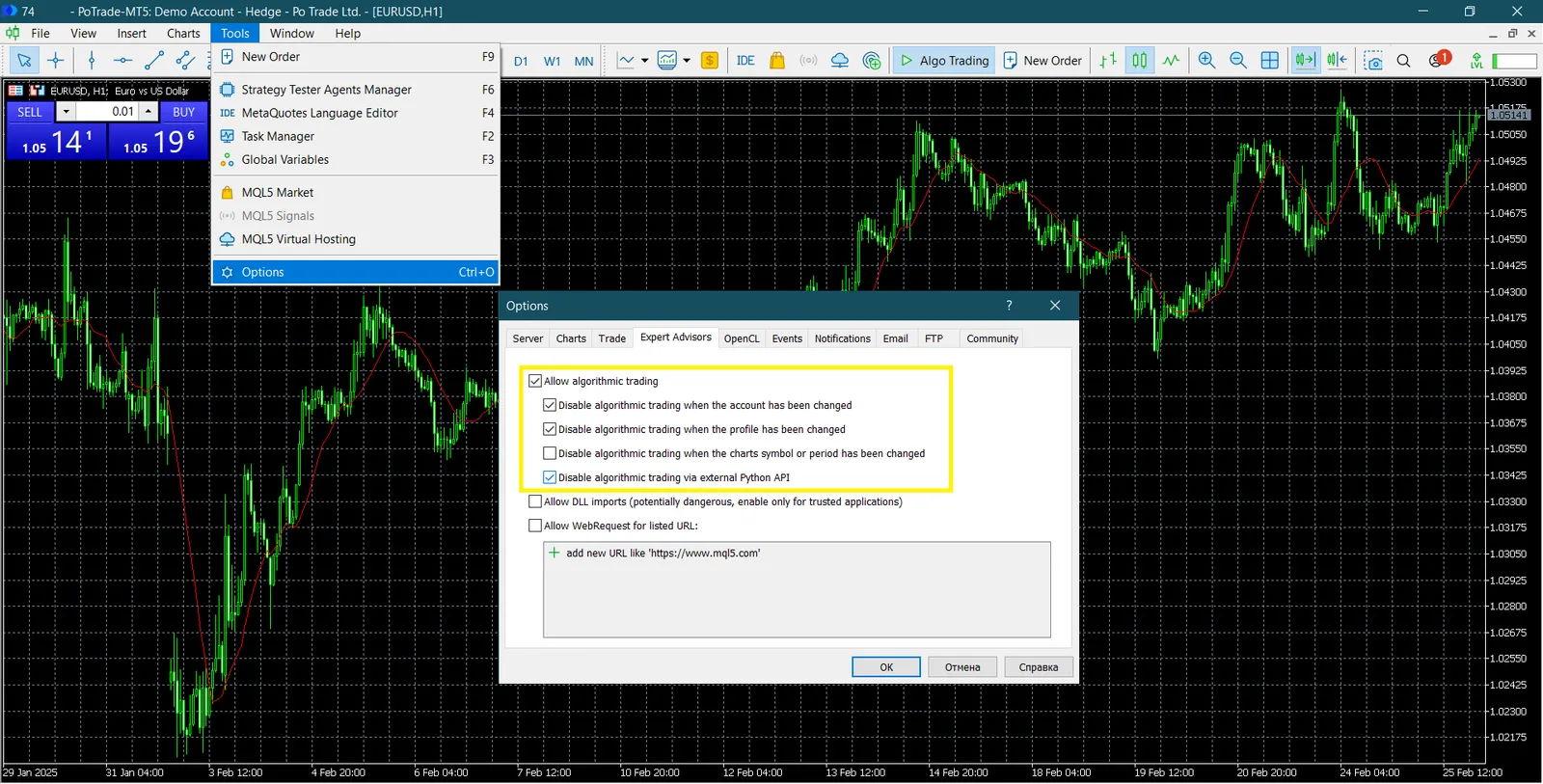
MetaTrader 5 (MT5) provides a built-in API that allows for the automation of trading operations, integration of third-party applications, and processing of market data.
Types of Trading APIs
There are several types of trading APIs, each serving different functions and use cases:
REST API
- Uses the HTTP protocol.
- Suitable for retrieving market data and placing orders.
- Limited by slower update speeds.
WebSocket API
- Enables real-time data streaming.
- Used for high-frequency trading.
- Allows for rapid market response.
FIX API
- Used by institutional traders and large funds.
- Provides low-latency order execution.
- Requires complex integration and significant resources.
Key Factors in Choosing a Trading API
When selecting a trading API, consider the following factors:
- Compatibility – support for required platforms and exchanges.
- Processing speed – latency in executing requests.
- Security – protection of data and API keys.
- Functionality – access to order books, historical data.
- Cost – potential fees for API usage.
Popular API for Trading Solutions
Many trading APIs are available on the market, each with unique features.
| API | Type | Features |
|---|---|---|
| Binance API | WebSocket, REST | High processing speed, large liquidity pool. |
| Kraken API | REST, WebSocket | Supports margin trading and staking. |
| MetaTrader API | FIX, REST | Suitable for algorithmic forex trading. |
| Interactive Brokers API | FIX, REST | Access to various markets and a wide range of instruments. |
| Alpaca API | REST, WebSocket | Ideal for the US stock market. |
Main Risks of API Trading
Despite its advantages, API trading carries several risks:
- Technical failures – unstable broker servers.
- Coding errors – incorrect execution of trading strategies.
- High-frequency trading risks – losses due to sharp price fluctuations.
- Cyber threats – API key leaks and unauthorized access.
To minimize risks, traders should use secure authentication methods, conduct regular strategy testing, and implement loss limits.