
Bitcoin Price Prediction 2040
Of course, any Bitcoin price prediction 2040 is speculative, but past cycles have left us with plenty of data to analyze. We will cover the best forecasting models and the assumptions each of them makes for the next decade and a half of BTC performance.

Why Long Term Bitcoin Forecasts Matter
If you are a day trader, the only thing you may care about is current BTC price, and an outlook for the next week or so. But long-term outlook is important for investors, and ultimately, investors drive the price forward. If investors have a predominately negative Bitcoin price prediction 2030 2040 2050, then the growth is unlikely to materialize. Any asset needs inflows to grow, after all.
So if a forecast is negative, you should adopt a bearish bias, and trade breakouts, rather than breakdowns (if you’re counter-trending). In any case, the ‘Sell’ button should be much more appealing to you.
However, if investors think that crypto market will rise, then a bullish bias is in order. It’s an important signal that the market may treat every price drop as a ‘buy the dip’ opportunity, rather than the sell signal. That is why even such long-term outlooks are still worth understanding, even when doing shorter-term trading at Pocket Option or with other brokers.
How Scarcity Shapes the Bitcoin 2040 Outlook
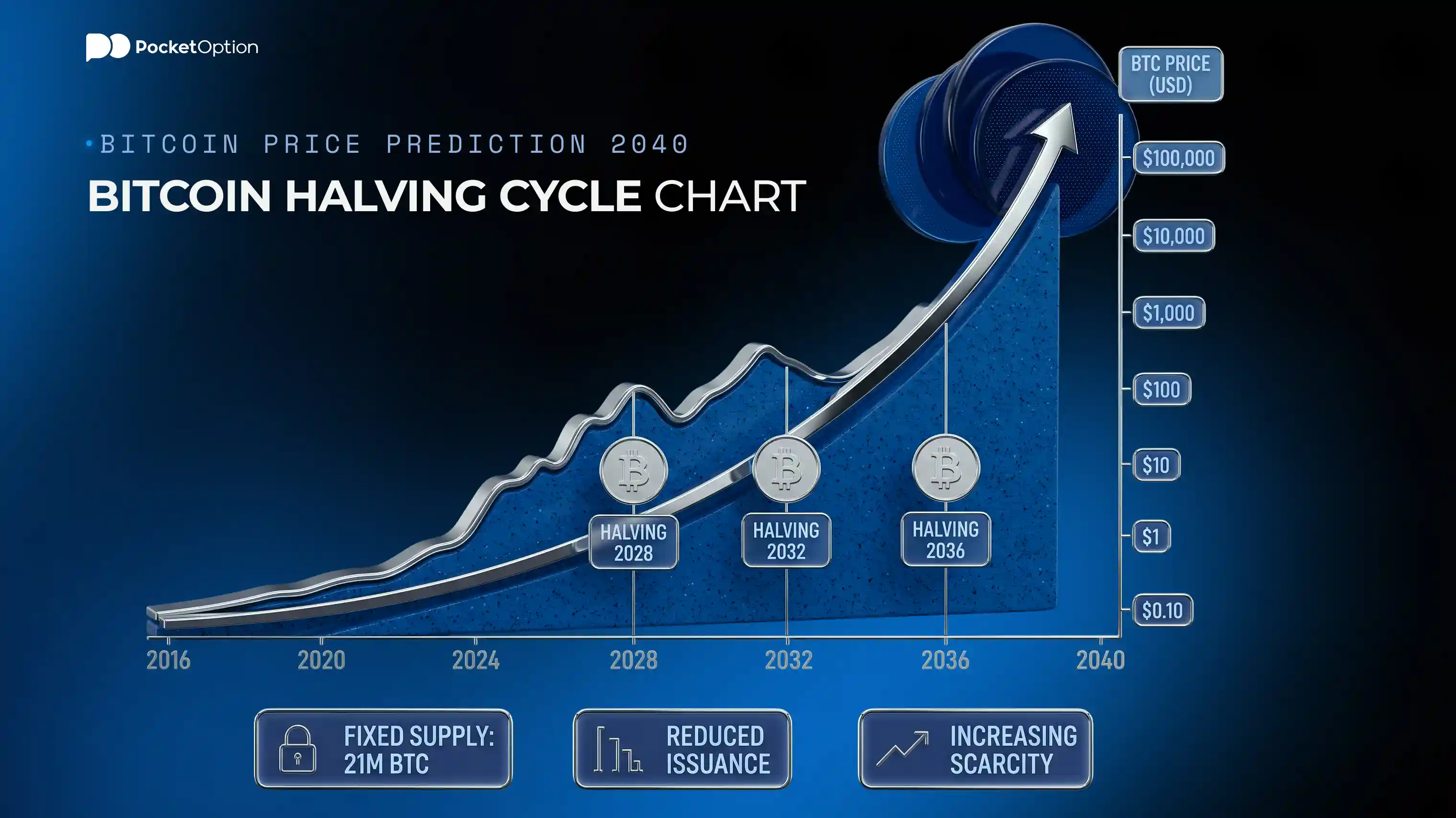
Bitcoin's price is largely driven by halvings. Hype around the next halving will drive the price up, and the post-halving year is often the best for BTC price. Everybody knows that supply of the coin is forever capped at 21 millions, and so new coins are becoming ever more rare. The rate of new issuance is reduced by half (‘halved’) every 4 years. And by 2040, there would have been at least 3 new halvings that took place: in 2028, 2032, and 2036. This would greatly reduce new coins being mined, and such scarcity should push Bitcoin price up, compared to current levels.
If Bitcoin price today is roughly in the $65k-$70k range, then 3 extra halvings should push it at least a few times, in the positive direction. Every next halving has less impact than the last, but so far the effect on prices have still been extraordinary, 400% on average:
2012 Halving: A rally of over 7,000% in the following year
2016 Halving: Roughly 291% over the next year.
2020 Halving: +541% the next year.
2024 Halving: rather muted gains because of preceding rally, but still around 60%.
Of course, scarcity alone doesn’t create new Bitcoin value: it also needs demand for BTC, which would offset this new (reduced) issuance. And demand is largely dependent on investor’s perceptions. If everybody knows that 2040 halving will be bullish, then it’s very unlikely for it to not manifest.
Forecasting Models Used for Long Term BTC Predictions
There are a few models that have price predictions for Bitcoin value, each having its own assumptions:
Stock to Flow is math model which matches existing supply to new coins issuance. The assumption is that the driver of price is the scarcity. The rarer new BTC is, the higher the price, that’s about it. This model was working well at the start of the Bitcoin lifetime, but faced sharper criticism later on.
Adoption curve models see price growth as dependent on amount of users and wallets that BTC has. If that was true, the Bitcoin price today would be dropping, because of all the new chains and stablecoins being released. Obviously, the size of each user matters a lot here: as more and more banks, governments, and hedge funds adopt BTC, the amount of wallets may keep decreasing, even if the demand for Bitcoin is rising.
Regression models are based on charts. They use various trend lines to extrapolate to the future. Historical data is their biggest friend. So far, these models have been largely accurate, although the band they produce is often quite wide, and can fit a significant variety of prices. The power-law regression model assumes that BTC price in 2040 would be between $350 000 and $1.4 million.
Scenario-based models are based on outcomes. They choose outcomes that seem possible, and assign probabilities to each of them. Say, if BTC gets adopted as US reserve, or as global reserve currency, or gets hacked by a quantum computer. End price is the result of all these outcomes, multiplied to their probabilities. Each such model is rather binary, and has a lot of assumptions baked into it.
Our overview of how long term crypto forecasts are constructed covers the mathematics behind each such forecasting model in more detail.
Bear, Base, and Bull Case Scenarios for 2040
Most analysts admit they can’t give Bitcoin 2040 price prediction with complete accuracy, and so they give a range of possibilities:
Scenario | Key Assumption | General Direction |
|---|---|---|
Bear case | BTC adoption stalls, chain gets hacked; regulators crack on BTC globally | Bitcoin holds its current value but does not reach new highs |
Base case | Slow adoption, scarcity remains (premium on it holds), no unexpected events | BTC continues rising in price, though much slower than previously |
Bull case | Bitcoin gets adopted as reserve currency, major banks or funds start accumulating | New ATHs, possible double-digit growth YoY for multiple years |
Notice these are not specific price targets: the output would be greatly different depending on the actual model used. The maximum they can agree upon is the general direction, and rough speed of growth.
What Could Drive Adoption by 2040
In the most bullish narrative, some Bitcoin 2040 price prediction models think that the coin gets adopted by banks, governments, large institutions, as collateral or the de-facto ‘digital gold’, in which most long-term value is stored. One cited reason for this is that the current young or middle-aged demographic, which is much more in-tune with crypto, will get older. Thus, more pro-crypto people will get elected into governments, or start being heads of their companies. This might enable last regulatory pressures to fall, and BTC to start getting real adoption by the largest players.
None of these is guaranteed, however. If something happens with the blockchain during this time, or if these adoption drivers just don’t materialise, a bearish scenario will look increasingly more likely. To push the BTC price significantly higher, an inflow of trillions of dollars is needed. Banks and governments can cough out that money pretty easily, but the small retail crowd could not.
How These Forecasts Compare to 2025, 2030, and 2050 Outlooks
Models that are built around Bitcoin price prediction 2030 2035 2040 ranges are usually centered around halvings, as the speed of adoption is much harder to predict. Halvings are exact and consistent, and would imply a slow growth trajectory, possibly with BTC reaching $350k-$400k price by the end of the timeline.
However, any model that claims a high level of precision for 2040 cannot be trusted. Even predicting an accurate price (within $100k) for 2030 is a challenging task. For this, read our guide on comparing short and long term crypto forecasts. Scaling effect is real, and needs to be understood, before trying any extrapolations.
Why No Model Can Reliably Predict a 15 Year Price
Every model discussed above has in-built assumptions about the future, which might, or might not, come true. Famously, changes in the crypto market landscape are numerous and unpredictable. Not many models predicted the rise of the RWA markets, and none predicted the 2020-2021 NFT wave ahead of time. What other innovations can wait on the horizon?
The uncertainty of prediction is not a weakness though, it is a feature. It’s impossible to correctly guess something that is based on future human decisions that have not been made yet.
at Pocket Option
Get StartedWhat This Means for Trading Bitcoin Today
A long term outlook leans bullish, but the Bitcoin price today doesn’t depend on that fact. Daily inflows or recent news events dictate the action, not the goalposts far away. However, sizing a trade, or forming a long-term, structured bias, can be based on price predictions. Many BTC traders are only interested in trading the upside, for example. They will never take short positions, because they aren’t quite sure when the BTC will start ‘ripping’, and they don’t want to miss out on the rally, or let alone be caught on the other side of that trade.
The outlook you adopt can also inform the size of the trade, the acceptable drawdown, and even timeframes you prefer (longer-term or short-term). No event is completely isolated from a decades-long view, it’s just a small part of it.
How to Trade BTC Volatility on Pocket Option
Pocket Option allows trades on Bitcoin's price movement without owning the underlying asset. You don’t need to hold BTC for fifteen years to take advantage of its moves. You can choose either Quick Trading mode (usually for trades lasting less than 5 minutes, sometimes just a few seconds), or one of the MetaTrader modes, for algorithmic trading or longer-term timeframes, where you can exit your position at any time.
This is one of the best ways to trade volatility, without emotional commitment to the asset itself. A trader can have a bullish view on a bitcoin price prediction 2040, but still take shorts, because there is a clear separation between the two, when trading at Pocket Option. If you prefer making day to day decisions based on chart patterns, momentum, or news, this can be done with size at Pocket Option, without the need to commit to a multi-year hold. Not to mention, this can be done with paper trading. You can practice your skills in any mode without committing any real funds.
Risk Management for Long Term Crypto Exposure
If you have a bullish bias (as most people interested in Bitcoin have), it is worth exploring a concept called hedging, which many stock investors practice. The price may decrease short-term, even if it will be going up on longer timeframes. That is why, on short-term, you can take smaller-size short positions during large news events. If BTC price decreases, your shorts win, while your long-term holdings stay largely unaffected. If the price increases, your shorts close in a loss (either by timing out, or through stop-loss), but your larger investment offsets it.
This strategy overall may limit your upside, but it will limit your downside as well. This is a good practice to have in your toolkit, for crypto risk management. Other than that, proper position sizing and never adding to the losing trade are a must-follow suggestions to any trader engaging with BTC.
Remember that even a long-term bullish outlook doesn’t remove the possibility of a sustained, multi-year decline of any asset. Doubling down or tripling down on a losing strategy is a surefire way to get burned. Refine your skill on a demo account before fully committing to anything.
Conclusion
A Bitcoin price prediction 2040 is best used as a general framework, as a thought exercise about adoption, scarcity, and uncertainty. It can inform a bias, but not inform the trade. It is educational, but not prescriptive, and no model should be treated as gospel, even if there’s a nice number attached to it. Trading Bitcoin's shorter-term volatility on Pocket Option is one way to continue engaging with price action and pay attention to markets, without waiting fifteen years for any full thesis to play out.
Disclaimer: Trading cryptocurrency carries significant risks, and past price movements do not guarantee future results. Nothing in this article is personal financial advice, and should not be treated as such.
at Pocket Option demo account
Get StartedSee more:Knowledge baseMarkets