How to Claim Unclaimed Bitcoin : Practical Strategies and Insights
Some Bitcoin just sits there, idly. Nobody touches it, nobody ever spends it, and in plenty of cases nobody even can. This guide covers what that actually means for you. If anything can realistically be got back, and what is gone for good.

What Is Unclaimed Bitcoin?
There is no official list of unclaimed coins anywhere. No ‘lost and found’ desk, no registry. Therefore, the first place people seeking on how to claim unclaimed Bitcoin online go is usually the blockchain. It shows you the balance, and the outgoing/incoming transfers. If there has not been any outgoing transfers in many years, that’s a high chance that the wallet is no longer ‘claimed’. As in, the person owning it either forgot the keys, forgot about the wallet entirely, died, or lost their access in some way.
However, this is not a confirmation. We can’t even know if Satoshi, the creator of BTC, is alive or not, and whether he still has the key to his on-chain wallet. So a question about how to claim unclaimed Bitcoin turns out to be a lot more complicated than first appears. Even discovering truly unclaimed Bitcoin wallets is an art in itself.
Common Reasons Bitcoin Becomes Unclaimed
Mostly it is ordinary stuff going wrong, over a long time, and people not paying attention to their ‘small’ BTC balance (that over years could’ve grown to millions). These can be the cases like:
A drive died, or got wiped, or got sold.
A forgotten Bitcoin password on an encrypted wallet, and so the coins stay visible on the chain but are in fact completely stuck.
A lost private key Bitcoin case, usually in a paper wallet or a key file that went out with a stack of papers or something of the sort.
Dormant exchange accounts, for example on platforms that changed hands, changed the rules, or shut the doors. These can be accounts on Mt.Gox, for instance.
Somebody died and left no instructions on how to access their BTC. This then turns into an unclaimed crypto inheritance, where nobody in the family can act on it.
Early mining rewards in wallet formats that current software just will not open without some proper work first.
That last one shows up more than many think. Coins (or even passwords) from 2010 and 2011 often live in specific files built by software that has been rewritten several times since, or is no longer supported. So getting them out can be a conversion job, rather than a recovery job.
How to Claim Unclaimed Bitcoin: Step-by-Step
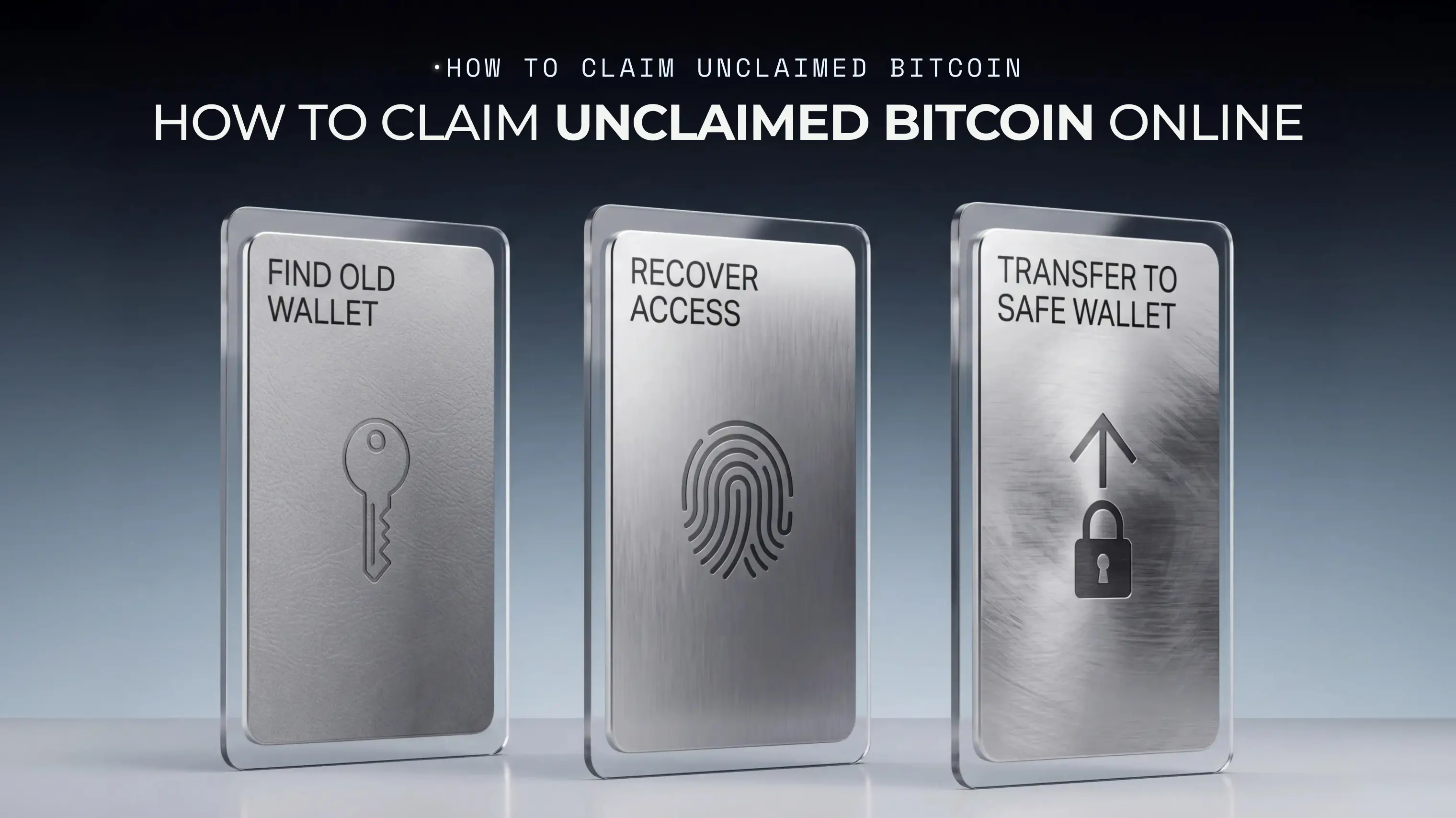
Most of the searching for how to claim unclaimed Bitcoin online goes through a step-by-step process, like this:
Search for Old Wallets and Devices
Lost Bitcoin wallet recovery can start with a hunt through your own stuff rather than with any clever tool.
Old laptops, phones, external drives, USB sticks, etc. Including the ones you assume are blank!
Cloud backups. Time Machine images and forgotten Dropbox or Google Drive folders can have a copy of a wallet file the original machine lost years ago.
Your email archive (if you had one). Search exchange names, wallet names, and words like receipt, deposit, or confirm your address.
Anything printed out. Like paper wallets, printed QR codes, a seed written on the back of something else entirely.
The password manager, or the browser you were using at the time, maybe on your old PC or laptop.
It also helps to know what you are looking for. Bitcoin Core keeps a file called wallet.dat, which lives in the AppData\Roaming\Bitcoin folder on Windows, or in ~/Library/Application Support/Bitcoin on macOS. Checking if that file exists on some old PC might be the way in for you.
Electrum uses a plain file usually named default_wallet. Older Multibit installs left a .wallet file with a matching .key file next to it. But be careful with searching for them. Copy everything that looks probable onto fresh media (like USB sticks) and leave the originals where they are.
Recover Seed Phrases and Private Keys
A modern seed phrase is 12 or 24 words, pulled from a list of 2048. That list is public. If one of your written words is not on the list, it was written down wrong! You might need to check it. The right word, that restores your access to the wallet, can be just a letter or two away. This is actually a way to restore forgotten bitcoin password: check which words are possible, and which ones you have written, and compare the two.
Order counts as well. Seed phrases carry a checksum, so a wrong order gets rejected outright. If you have written the seed phrase incorrectly, it might be worth it trying a different order (not left-right, but top-down, for instance).
If the wallet file is encrypted, and the password is the missing piece, write out every variation of the passwords you were using back then. Work through them, possibly offline. Software that automates the guessing exists, and it gets used by the people who recover lost cryptocurrency for a living. Run it on a machine with a network switched off.
Ideally, never type a seed or a key into a website, a form, or a chat window, to anybody. Searches for lost private key Bitcoin cases turn up a lot of forum threads and not many have happy endings, especially if they trusted some stranger to handle the business.
If you are successful, and need somewhere new to hold the coins once you are back, we have a guide on how to get a crypto wallet. It covers the safer options for storing your recovered funds.
Check Dormant Exchange Accounts
This is the friendlier branch of the problem. Dormant exchange accounts have a company standing behind them, and so companies keep records! Even defunct exchanges might still have a way for you to access your BTC.
Start with the login and the recovery email. If that goes nowhere, open a support ticket. Expect to prove who you are (usually with ID, often with the original deposit details too). Balances do not expire on most platforms, although inactivity fees do exist in some places.
If the exchange collapsed, process moves to a bankruptcy trustee. There will be a claims window with a hard deadline attached to it, usually. Search the exchange name together with the word ‘claims’, then read the court filings. Give your emails to the team to contact you once the court case is done, and your BTC can be recovered.
Inheritance and Legal Documentation
The Bitcoin estate and probate side moves at the speed of a court, there’s no way around that. An executor needs authority before an exchange will talk to them at all. In practice this means a death certificate + whatever grant or letters the local court issues.
With that in hand, a custodial balance can usually be moved or liquidated. Coins on the chain, though, are a different matter. No court order can shift them. You need a key, or a seed phrase. An unclaimed crypto inheritance sitting in self custody only becomes reachable if the access to them turn up. So the whole search described above (searching passwords, papers, old laptops, USB hardware wallets) still has to happen.
Learn the platform before you trade
Quick StartSecurity Checks Before Moving Recovered Bitcoin
Getting in is not a guarantee that you will recover lost cryptocurrency. The moment an old wallet is opened, it can become a target. Even more so because old wallets are usually opened on old machines, and those might have been sitting unpatched for a decade, without an updated antivirus software or all the latest Windows security features.
So do the boring things. Use a clean device, to try to access the wallet. Download wallet software from the project's own site, and use a modern one, if possible. Check the signature if the project publishes one. First send a small test amount and wait for it to confirm everything, before you move anything else.
Watch the receiving address in the field you copied it to. Clipboard malware sneakily swaps the address at the moment you paste it, and address poisoning can drop lookalike addresses into your transaction history (in the hope that you will copy one back out later on). So checking the first four and last four characters can be not enough. Compare the whole string, or better off, read it off a hardware device's own screen.
When Unclaimed Bitcoin Cannot Be Recovered
Sometimes the answer is just not there, and it is worth saying that plainly rather than dressing it up.
If there is no seed phrase, no key, no backup file, and no password (even a snippet of it), there’s nothing to work with. Guessing a BTC private key is not a matter of patience or better hardware. The number of possible keys sits closer to the count of atoms in the observable universe, than to anything a modern computer works through.
Coins sent to an address nobody controls are equally final. A typo in an address usually fails its checksum and bounces, which is the good outcome, but a valid address with no owner behind it just holds the balance forever.
State unclaimed property programs come up constantly in this context and they do not help. Those programs work because a bank or an insurer is holding your money and cannot return it, so the state takes custody and waits for you. Nobody holds on-chain Bitcoin on your behalf. There is no institution to escheat from, which leaves the program nothing to collect. Cash from a custodial account at a registered business is a separate story, and that one is occasionally worth a look.
Avoiding Scams While Searching for Lost Bitcoin
People searching for lost coins are a known target, and the pitch is always tuned to hope.
Any request for your seed phrase or private key. There is no legitimate version of this request.
Payment up front, especially in crypto, before any work has been done.
Guaranteed recovery, or a success rate quoted with no way to check it.
A message that arrived first, in your inbox or your DMs, offering help you never asked for.
A request to install remote desktop software so somebody can look at it for you.
Invented credentials. No certification body for crypto recovery exists.
A few legitimate specialists do exist. They tend to work on one narrow problem, usually an encrypted wallet file where the client remembers part of the password, and they take a share of whatever gets found rather than a fee up front. They also turn down most enquiries, because most cases genuinely cannot be worked. Keeping your holdings quiet helps here as well, and this look at how to buy Bitcoin anonymously gets into the trade-offs of that approach.
Preventing Future Loss: Backup and Security Basics
Write the seed on paper, then on metal if the amount justifies the cost, and keep the copies in two places that will not burn down together. Then test the restore. An untested backup is a guess, and people tend to find out it was the wrong guess at the worst possible moment.
Note the surrounding details too, since a seed on its own is sometimes not enough on its own. Which wallet software. Which derivation path. Whether a passphrase was set on top of the seed, because that is a separate secret and it is the one people forget they added. Ten years later that little note is the difference between a restore that takes five minutes and one that eats a weekend.
Leave instructions for whoever ends up handling your affairs, and keep those instructions well away from the seed itself. A will becomes a public record once it has been through probate in many places, so a seed phrase written into the will is a seed phrase published. A sealed envelope in a safe, with the will pointing at where the envelope is, does the same job without that problem.
The habit underneath all of it is practising on something that does not cost you anything when it goes wrong. That applies to restoring a wallet, and it applies to learning how any trading screen behaves as well, which is what a demo account on Pocket Option is there for.
Test your ideas with virtual money
Try DemoConclusion
Most of this comes down to searching your own past carefully rather than finding some clever tool that does it for you. Records, drives, old email, whatever an executor can get out of a court. And then a plain note in a drawer saying which wallet, which path, and where the metal plate went, which is the cheapest item on this entire list and the one almost everybody skips.
Disclaimer: This article is for informational purposes only and does not constitute financial advice. Trading involves risk, and losses can exceed initial deposits.
See more:Knowledge baseLearning