Free Trading Courses
Free trading education courses have gotten much better over the past decade. You no longer need to pay $5,000 for a seminar to just learn the basics of TA and market structure. However, there is still a big difference between a good free course, and a shallow one. In this guide, we cover what's actually available online, and how to use it well.

Why Free Trading Courses Matter for New Traders
The main value of free online trading courses isn’t in the fact that they are free, it’s that they remove all the excuses. A person willing to learn has an abundance of information to find online, structured and available. There are:
webinars and live classes
video tutorials for traders
online academies and universities
self paced trading lessons
trading simulators demo accounts, and so on.
As long as you have the time, the path to learning the basics of trading is rather straightforward.
That said, there are good and bad programs. Some are designed to build you up, while others are focused on extracting as much money from you as possible (even if the beginning stages are free). Learning to differentiate between them is crucial. The volume of content available now means that ‘hidden gems’ are even harder to find. New traders stepping into the field are having a hard time understanding what to focus on: video tutorials, paper trading practice, or broker academies. That is why we decided to break this down.
Types of Free Trading Education You Can Use
Good trader training is built, first of all, around risk management. There are no promises of guaranteed returns (if you encounter that, run!). Chart reading, TA and fundamentals are secondary. The beginning stages should be focused on why trading might not be for you, and what to do in order to ensure you don’t lose more than what you started with. If there are no caveats like that in the free day trading courses for beginners that you’re taking, this is the first sign that something might not be quite right.
Otherwise, everything has its place and time. Good free trading education online generally falls into a few distinct categories, each suited to a different stage or style of learning.
Type | Best for | Format | What to watch out for |
|---|---|---|---|
Structured beginner courses | Complete beginners, building fundamentals | Self-paced, sequential lessons | Content being too broad to apply to specific market |
Day trading courses | To learn short-term, faster setups | Video lessons, sessions | Light coverage of risk management is a red flag |
Broker academies | Learning the exact platform you'll trade on | In-platform guides, webinars, tutorials | Content focused on encouraging more trading, and not better trading |
Trading communities | Peer perspectives, real-time answers | Forums, Discord, Telegram, social groups | Uneven quality: some advice might not be great. |
1. Free Online Trading Courses for Complete Beginners
These focus on basic concepts: what is a candle, how a price moves, what is a pip, which trading sessions exist, etc. Their advantage is that they have a structured trading curriculum: a user is shown the next bit of information after they’ve finished digesting the previous one. This is by far the best approach for complete beginners. The most reliable in this category are university-affiliated platforms and specific financial education sites. At this stage, you should learn trader training that is not specific to any one broker or strategy.
2. Free Day Trading Courses
Scalping and day trading education is a distinct step above starting beginner courses. You start learning shorter timeframes, technical analysis, managing noise and risk, and discipline within the session.The best free day trading courses for beginners focus on risk management and position sizing at first. Short-term trading is by far the most punishing to weak discipline, and any strategy can become unviable without safety guardrails first.
3. Broker Academies and Platform-Based Free Trading Courses
Large brokers and trading platforms offer their own free online trading courses: tutorials, guides, webinars, and so on. These are the convenient next step, because they're built around the exact UI you'll actually be using, and are often focusing on the exact trading strategies that are proven to work. But make sure a platform isn’t just encouraging trading for the sake of it (to collect the fees), and is still adamant about demo trading and discipline.
4. Trading Communities and Peer Learning
This is often the last step in the beginner’s journey, because participating in discussions requires your knowledge about which questions to ask. Forums, Discord servers, and social communities on the platform are great places to refine your strategy, or find people with similar ideas. It can also be quite cathartic seeing how other beginners think through the same mistakes you've made before. However, the value in advice given here can be uneven: a community is only as good as its most active, most profitable members.
By the way, Pocket Option combines all of the above: beginner trading courses, an in-built guide about the platform itself, a blog that covers trading basics and day trading strategies, as well as a trading community (popular chats on the platform where traders can ask for advice and discuss specific nuances).
Using Demo and Simulators as Part of Trader Training
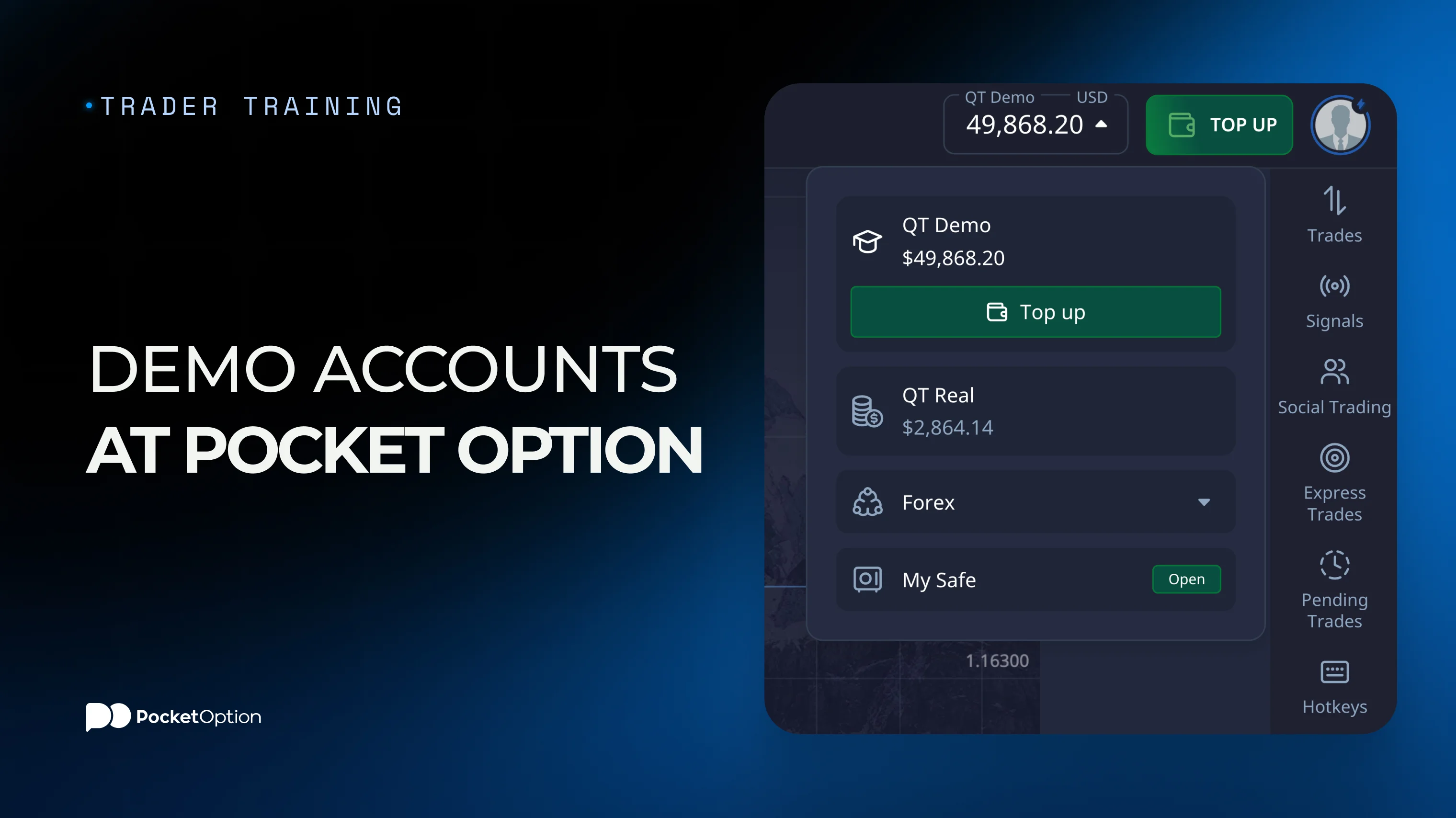
Reading or watching a course teaches you concepts. But you need to apply them to practice, as quickly as possible. To not acquire any losses while learning, the ideal environment is a trading simulator or a demo account. Conditions there should be no different from real trading, and once your strategy is able to succeed there, you should be ready to move to a real account.
A few ways to get the most value out of demo trading while completing free trading courses:
Treat it like a real account, use the same order sizes and try to limit your risk. Using a demo carelessly teaches you nothing. It should be treated exactly as if you’re trading with real money.
Test one course at a time. Only when you understood previous concept should you move on to the next. Trying to apply five new ideas from a course makes it hard to tell which one is actually working for you.
Track results, even if informally. Paper trading practice needs a record. Don’t rely purely on memory or the platform's log. Having an idea why you opened a trade, or why you closed it at a particular time, helps in seeing which strategy works best for you.
Don't mistake a winning streak for mastery. Even if you had a great run on demo, don’t throw thousands of dollars into a real account yet. The real test is consistency of results, and performing well in various market environments, not one strong week or even month.
This is how you turn free trading education into real-world practice, and explore your trader training to the utmost.
Trading Education on Pocket Option
If you're using Pocket Option specifically, note that the platform's Help section includes a wide variety of guides and tutorials. They cover things like:
forex glossary and tutorial
video tutorials
trading strategies
platform guides.
There are 38 in-depth trading strategies explained in the form of video tutorials for traders in the Help section. Plus you can read the Pocket Option blog, with over 5000 articles about any trading topic that is of interest to you. Here, we publish ongoing strategy breakdowns and market education pieces you can easily pair with demo practice.
All of this educational content can be paired with any free trading courses you are taking online. You can use it to hone in on any specific topic you’ve found an interest in.
on a Pocket Option Demo Account
Get StartedDisclaimer: Trading involves significant risk of capital loss. This article is for educational purposes only and does not constitute financial advice. Practice any strategy on a demo account before using real funds.
See more:Knowledge baseLearning