Slippage in Trading Explained: Causes, Risks and Prevention
You click buy at one price. It fills at another. That gap has a name. And across hundreds of trades, it quietly chews through your results. Once in a while it helps you. Mostly it does not. So let us break down what causes it, how it hits your money, and how to keep it small.

What Is Slippage in Trading?
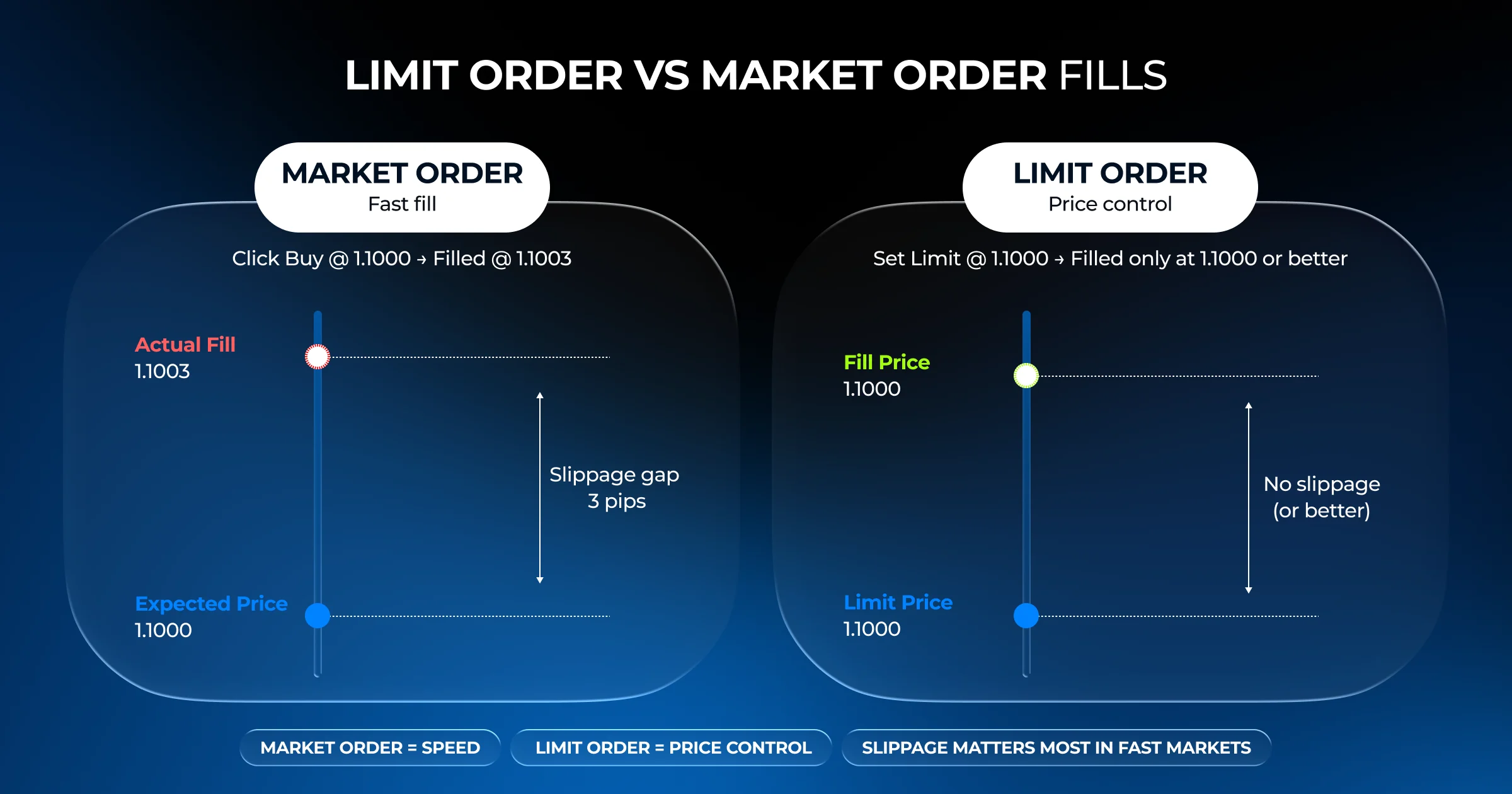
So what is slippage in trading? Simple. It is the difference between the price you wanted and the price you got. You aim for 1.1000. You get 1.1003. Those three pips? That is slippage. Why does it happen? Price moves in the split second between your click and the order hitting the market. Looks tiny. It is not. It is a real cost, a real risk, and it can blow up fast when things get messy.
Curious how fills really behave? Open a free demo account and watch orders execute in real time on 100+ assets with virtual funds.
Open DemoReading about a price gap is one thing. Watching your own order land a few pips off in a fast market is another. It is easy to shrug off, right up until you see it happen live, trade after trade, and add up the damage over one session. Better to learn that where a mistake costs you nothing.
A demo trading account lets you place real-time orders with virtual funds and watch exactly how and where they fill, before any of your own money is on the line.
Why Does Slippage Occur?
Getting a grip on slippage in trading starts with the why. It is not random bad luck. A handful of forces drive nearly every case:
High volatility: price jumps between your click and the fill, so the number shifts.
Low liquidity: there are simply not enough orders sitting at your price to fill you there.
Large orders: a big trade eats through several price levels to complete.
Slow execution: a laggy connection or platform delays the order just long enough for price to move.
News releases: they spike volatility and thin the order book at the same time.
New to how orders even reach the market? The pocket option tutorial covers the basics of order types and execution before you put this into practice.
Positive vs Negative Slippage
Before we get to how to avoid slippage in trading, know this: not all of it hurts. Sometimes price swings your way in that split second and you get a better fill than you asked for. That is positive slippage. A worse fill is negative slippage. Guess which one traders complain about.
Aspect | Positive Slippage | Negative Slippage |
|---|---|---|
What happens | Filled at a better price than expected | Filled at a worse price than expected |
On a buy order | Executes lower than your target | Executes higher than your target |
Effect on cost | Lowers cost, a small bonus | Raises cost, a hidden drag |
When it shows up | Price drifts in your favor during the delay | Fast moves, news, thin liquidity |
Same mechanism, opposite directions. But over time the negative kind wins out. Why? The worst gaps show up exactly when the market is racing against you.
How to Calculate Slippage
The slippage meaning in trading gets concrete the moment you put numbers to it. The formula is as simple as it sounds:
Slippage = Execution Price − Expected Price
You try to buy EUR/USD at 1.1000. It fills at 1.1003. So your slippage is 1.1003 − 1.1000 = 0.0003, three pips. On one lot, that is 100,000 units, three pips runs about 30 dollars, gone before the trade even breathes. Bigger position, bigger bite. That is why you never judge size and slippage apart.
Slippage in Forex, Crypto and Other Markets
It shows up everywhere. Just not evenly. In forex, the major pairs are deep and liquid, so the gap stays small away from news. Ask what is slippage in crypto trading and it is the same idea, dialed up. Crypto swings hard, and liquidity on smaller coins can vanish in seconds. Stocks land somewhere in the middle, worst around the open, the close, and earnings. Rule of thumb: thinner and wilder market, bigger gap.
How Slippage Affects Trading Results
Want to see what does slippage mean in trading for your account? Follow the money. A few pips sounds like nothing. But a scalper trading dozens of times a day pays it every single time, and it piles up into a real dent in the profit. It wrecks your risk math too. A stop set to cap a 20-pip loss can fill at 25 in a fast market. Blew right past your limit. Ignore it long enough and a strategy that looks great on paper barely breaks even.
How to Avoid Slippage in Trading
You cannot delete it. You can shrink it. And the same playbook works whether you trade forex or wonder what is slippage in cryptocurrency trading, because the mechanics never change:
Use limit orders instead of market orders when price matters more than speed.
Trade liquid markets and major pairs, where deep order books absorb your trade.
Steer clear of major news releases unless the gap is part of your plan.
Trade during peak hours, when liquidity runs highest.
Keep position sizes sensible, since big orders push further through the book.
Set a slippage tolerance if your platform offers one, capping how far a fill can drift.
Common Slippage Mistakes
A quick what is slippage in trading definition refresher: it is the price gap on execution. Most beginner errors come from forgetting it exists. The usual ones:
Firing market orders straight into a news release and hoping for the best.
Ignoring liquidity and trading thin, exotic instruments.
Assuming the quoted price is the price you will always get.
Setting stops so tight that ordinary slippage trips them early.
Never checking fills, so the cost slips by unnoticed trade after trade.
Each one is avoidable. Awareness alone fixes most of them.
Risks and Important Considerations
Here is what no tool fixes: you can never remove it entirely. That is the honest definition of slippage in trading risk. It shrinks. It never hits zero. Limit orders guard your price but can leave you unfilled. Stop orders still slip when markets move fast. Wild volatility, surprise news, thin overnight hours, any of them can rip the gap wide open no matter how careful you are. So the goal is not zero, which is a fantasy. It is to expect it, plan for it, and keep it from wrecking a sound strategy.
Risk Disclaimer: Trading involves significant risk of capital loss. This article is for educational purposes only and does not constitute financial advice. Always conduct independent research and consider your risk tolerance before making any trading decisions.
See more:InterestingTrading Strategies