
What Is Inducement in Trading? How Smart Money Sets the Trap Before the Real Move
Within the Smart Money Concepts framework, inducement is described as bait buried in the price action: an obvious level that traders expect will attract retail orders and stop placement before the real move develops. It is an interpretive lens rather than a proven mechanism, and this guide covers how SMC traders use it.

What Is Inducement in Trading: Definition
Well, what is inducement in trading, then? In terms of the Smart Money Concepts approach, inducement refers to a level or a price formation that looks like a reasonable buy/sell signal or a reliable level of support/resistance, while being, in fact, an artificial price point designed to catch retail orders. They are needed to launch a further institutional move against the price trend.
So what is inducement in trading? Within the Smart Money Concepts approach, inducement describes a level or price formation that looks like a reasonable buy or sell signal, or a dependable support or resistance level, but which SMC traders interpret as a likely area of resting liquidity rather than a level worth trading directly. The framework treats these areas as places where orders accumulate before a larger move develops in the opposite direction.
The central idea of inducement trading is that price rarely travels straight to its destination. It frequently trades through the obvious levels first, and SMC traders interpret those excursions as price reaching the areas where orders were most likely resting. What can be observed on a chart is the price movement itself. Why price went there, and who was on the other side, is not something a chart can establish.
Why Institutions Need Retail Liquidity to Fill Orders
Large positions are difficult to fill at a single price without moving the market against the buyer or seller. Filling size requires resting orders on the other side, and within SMC this is the reasoning offered for why price is drawn toward areas where orders are likely to be concentrated.
Stop orders and breakout entries sitting just beyond an obvious high or low are where those orders are assumed to cluster. What is verifiable here is narrow but real: a stop order becomes executable once price reaches its trigger, so orders resting beyond a level will be filled if price trades through it. What cannot be established from a chart is who moved price there, or whether it was moved there deliberately at all. Smart Money Concept treats this as a working interpretation, not as demonstrated fact.
How Inducement Forms: The First Pullback After BOS or CHOCH
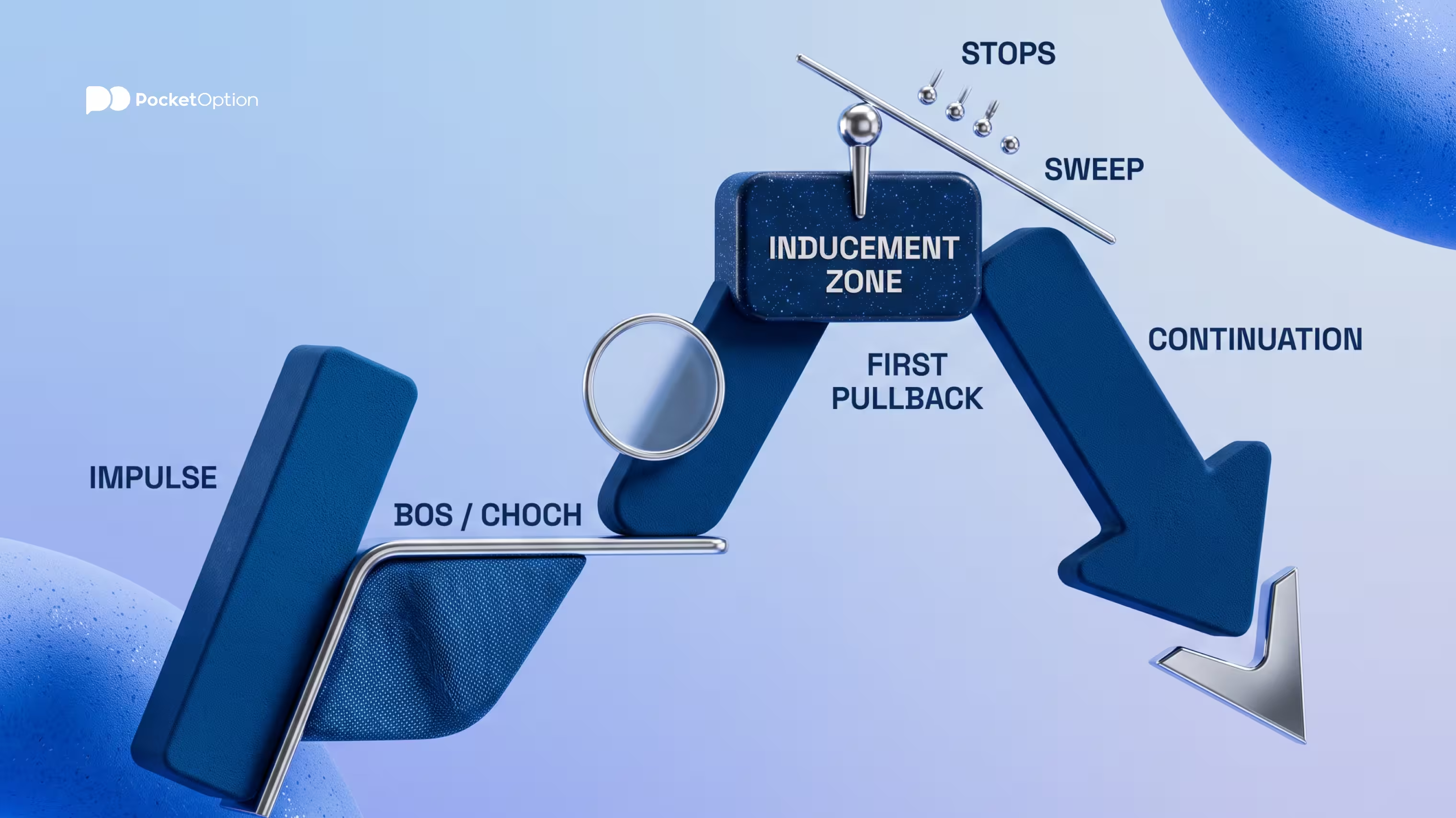
In some SMC setups, the first pullback after a break of structure or a change of character is treated as a potential inducement area. This is not a universal rule, and most pullbacks are simply pullbacks. Where traders apply the label, it is usually because the pullback overshoots slightly and produces a level that looks like an obvious re-entry point, and because other context supports the reading.
Traders entering at that level typically place stops just beyond the pullback extreme, which puts a concentration of orders in a predictable place. Whether price subsequently trades through that area and then resumes the earlier direction is something you observe after the fact, not something the pattern guarantees in advance. How the break of structure was confirmed helps in locating the area worth watching, but confirmation still has to come from price behaviour rather than from the label.
Inducement vs a Genuine Support/Resistance Level
While genuine levels have some consistency in being tested in more than one period and reaction away from them normally includes the reduction of volume to the level and clear rejection, inducement levels look very clean and easy to identify exactly because of this feature which makes them attractive for traders.
One of the filters is whether the level is respected also in a larger timeframe. Respectively, identification of genuine support and resistance is based on confluence of timeframe, while inducement levels are typically easily identifiable only on smaller timeframe where the setup is being traded.
Inducement vs Liquidity Grab: What's the Difference
These concepts are connected, but not interchangeable. The term inducement designates the level or pattern which seduces the orders prior to the sweep. The term liquidity grab designates the actual sweep, the penetration of the level that will cause resting stops and pending orders to be executed.
In short, inducement refers to the setup and liquidity grab refers to the event. Inducement and order block trading are usually discussed alongside liquidity grabs, since SMC traders often locate the grab at the edge of an order block, which the framework treats as the area where resting orders would allow a larger position to be filled. This remains an interpretation of what the price movement means rather than a description of what any particular participant did.
How to Avoid Entering Before Inducement Is Swept
Approach the most visually obvious recent high or low with appropriate skepticism, but not conviction.
Wait until price swings past that level before you begin to think about entering the opposite direction.
Watch for a quick rejection back through the level after the sweep. This is price-action confirmation that the level did not hold, which is what the setup relies on. It does not establish that any specific pool of liquidity was absorbed or removed.
Do not place your entry at the level you think may have been the inducement spot; wait to see the sweep first.
Check the level on the timeframe above to verify if it has any sort of structural importance beyond just the current chart.
test this on a free demo account
Try DemoCommon Mistakes When Identifying Inducement
The biggest mistake is entering right at the most obvious level without waiting for the sweep, which places your own stop inside the very area the setup expects price to trade through. Another common one is labelling every pullback as inducement when most of them are not. Applying the concept too broadly leads to hesitation on perfectly reasonable entries.
Most traders will try to spot patterns visually using only Trading View without cross-referencing their volumes and checking higher timeframes for structural information.
Conclusion
Within Smart Money Concepts, inducement is the bait and the sweep is the event that follows it. The framework interprets the most obvious level on a chart as a likely place for retail orders to have accumulated, which is offered as an explanation for why price so often overshoots such levels before reversing. Treat that as a lens for reading price rather than as proof of what any market participant intended. What separates this approach from ordinary support and resistance trading is the willingness to wait for the sweep and the rejection before acting.
open a free account today
Get StartedDisclaimer: CFDs and other financial derivatives are highly risky instruments. Please familiarize yourself with the working principles of the instrument prior to trading.
See more:InterestingTrading Strategies