Short Term Trading: How to Work with Quick Moves
Short-term trading means making relatively quick market moves. In other words, the goal of this method is to trade as quickly as possible. This guide includes the key points that you should know about short term trading, and what trading strategies you should apply to profit from market volatility.

The definition of Short-Term Trading
Short term trading involves entering and closing positions over time intervals, ranging from a few seconds to a few weeks. The focus is on price action and technical analysis, not long term fundamentals.
Entry signals are based mainly on chart patterns and price indicators, along with reactions to important economic data releases. Exits usually come once an anticipated move has been taken, or once the original trading idea has been invalidated. It’s sometimes called “active day trading” since it demands more frequent decision making and screen time, compared to traditional investing that is run on entirely different principles.
Key distinction between Short-Term Trading and Long-Term Investing
Long term trading usually relies on fundamentals. For example, earnings growth, geopolitical developments, major economic data. However, it’s rarely the one output. Positions are held for months or even decades, while short term price fluctuations are treated as noise and nothing more.
In contrast, short-term investment strategies respond to price behaviour in the near-term price behaviour. For example, gold might have obvious long-term buy opportunities, but if the chart shows resistance and buyers’ exhaustion, a short term trader is unlikely to buy.
Both can be a part of the same portfolio, but one should not confuse them.
Use the best trading platform for retail
Try Demo AccountTypes of Short-Term Traders: Scalper, Day Traders, and Swing Traders
Scalpers open and close trades on the shortest timeframes, from seconds to minutes, with a rapid speed. Scalpers work with small price moves and make a high number of trades to try to capture them. At the same time, a high trade count on its own doesn't guarantee profit. This style demands more screen time and emotional discipline.
Day traders operate on longer timeframes, compared to scalpers, holding positions from minutes to hours. This is a different risk profile from scalping, not necessarily a smaller one.
Swing traders hold positions the longest among short term traders, typically for several days to a few weeks. This is the least time-intensive of the three styles, and it’s often more convenient for beginners, who can’t engage in full-time trading due to their jobs.
Each style carries a different risk profile, and each demands a different level of commitment. The choice between them should come down to the trader's personality and time commitment, not which sounds more fun.
Most efficient markets for Short-Term Trading
The best stocks for short term gain, along with other financial instruments, tend to share three common features:
high liquidity,
reasonable transaction costs.
enough volatility to produce trading opportunities.
Major forex pairs (EUR/USD,USD/JPY), popular indices (US100, GER40), and liquid commodities (gold, oil) are commonly used for short term trading.
Markets with thin liquidity must be treated with extra caution. Not only because of increased transaction costs, but also sharp and unpredictable price swings.
Foundational Short-Term Trading Strategies
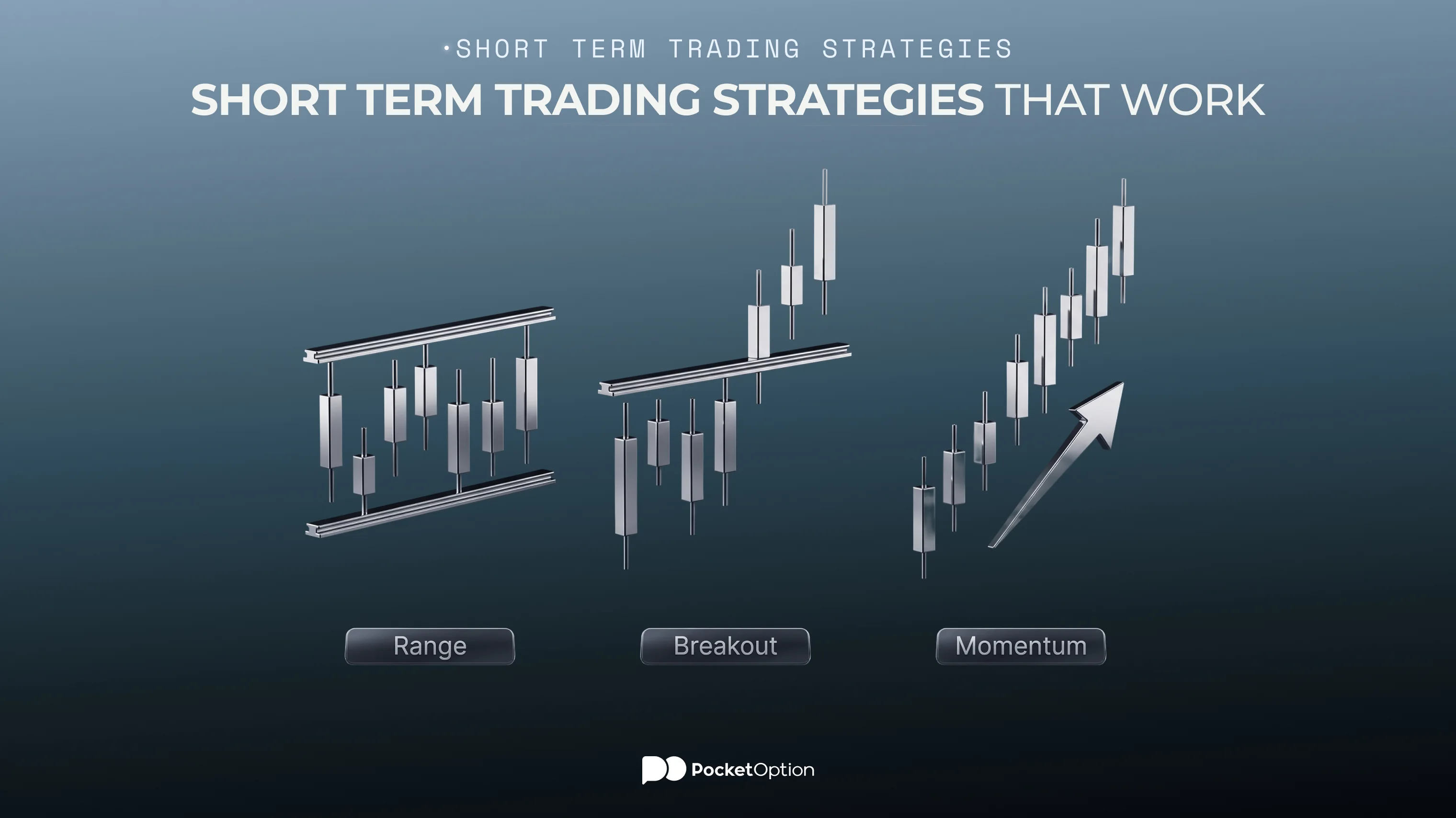
Range Trading
Range trading works when the currency or stock market is moving between identifiable support and resistance levels The approach works best in liquid, consolidating markets, but tends to fail once a breakout occurs, which is inevitable sooner or later in any market.
Breakout Trading
Breakout trading is the opposite of range trading and is usually observed in volatile markets with thin liquidity. As a rule of thumb, positions open once a price moves aggressively beyond a defined S&R. Once a particular level is broken, traders expect a formation of a new trend.
Momentum Trading
Momentum strategies are based on straightforward observation of the price that is already moving in one direction. The assumption here is the possible continuation of this move. Positions are entered once a move is confirmed by corresponding volume or indicator, and open until momentum begins to fade.
Reversal Trading
Reversal trades are conducted against the trend at points where the trader believes that the trend is running out of steam.Trade size must be determined prior to reversal trades being undertaken. This can be considered a more challenging trading strategy since it requires anticipating change in direction before it has been confirmed. For safety purposes, position sizes should stay smaller.
Strategy | Core Logic | Best Market Condition | Key Risk |
|---|---|---|---|
Momentum | Enter in the direction of an aggressive and accepted by market structure move | Trending with rising volume | Late entries near points of exhaustion |
Range | Buy at support, sell at resistance within defined extremes | Sideways, low volatility | Breakout that turns into trending market |
Breakout | Enter when price clears range extreme | After broken range with rising volume | Fake breakouts that tend to reverse |
Reversal | Enter against the current trend at points of exhaustion | At major support and resistance levels, backed up by confirmed momentum change | Trading against momentum too early |
Core Indicators for Spotting Quick Moves
Volume for confirming the conviction behind any move.
Small period Moving Averages, such as MA10 or MA20 for near-term trend direction.
RSI (14 period) to identify overbought (above 70) and oversold market conditions (below 30).
Bollinger Bands for volatility compression and expansion.
Average True Range (ATR) for volatility monitoring.
Nevertheless, one should not use too many indicators at the same time. Indicators are aimed to clarify the picture, not to clutter it.
How to Choose Assets for Short-Term Trades
Short term investment stocks and other trading instruments are best screened on three criteria:
daily average volume, which helps to understand whether an asset has enough liquidity;
average true range, which provides an information whether there’s sufficient volatility to work with;
spread relative to the expected move, so transaction costs do not eat into the edge.
Assets that fail any of these three criteria should be filtered out, no matter how interesting the chart pattern looks.
Building a Short-Term Trading Plan on Pocket Option
Select one strategy from the four mentioned above (momentum, range, breakout, reversal).
Choose one to three instruments that meet the liquidity and volatility criteria.
Define the entry condition precisely: the indicator reading, price level, or candle pattern that triggers it.
Define a daily trade limit and a daily loss limit.
Test the plan on the Pocket Option demo account before considering trading with real funds.
built for short-term trading
Get StartedRisk Management Rules for Short-Term Trading
Decide your trade amount before entering, and keep it’s recommended to keep it fixed and consistent.
Set a session loss limit in advance. For example, a fixed amount or a set number of losing trades. Once reached, all trading activity should cease.
Some traders also determine how much of their account they're willing to risk per session. Note that specific numbers might vary depending on account size and risk tolerance, so treat any percentage as an example rather than a rule.
Realistic Expectations about Short-Term Trading
Retail traders who do not possess any effective risk management techniques, lack a well-built trading plan and proper demo practice often lose money while using short-term trading strategies. However, strict risk management and a tested trading strategy can help traders manage processes more consistently. Certainly, this is not a sure win and those who say otherwise often have something to sell.
Conclusion
Effective short term investment strategies typically have certain characteristics including a clear edge, rigorous risk control, and disciplined execution. The type of a strategy is less important than how carefully it is implemented. Trading strategies based on momentum, range, breakout, and reversal could be successful in some market conditions and only if practiced by a trader adequately.
Start on the Pocket Option demo account and test your chosen strategy. Monitor account’s performance consistently and without bias. And let the data, not personal feeling, determine whether you are ready to trade with real capital.
Disclaimer: All trading involves risk. It is possible to lose all your capital. This material is for general informational & educational purposes only and should not be considered as investment advice or an investment recommendation.
See more:InterestingTrading Strategies