Order Block vs Breaker Block: What's the Difference and When Each One Works
An order block is an area, a zone in which a trader built a position and thus prices show respect towards the area. A breaker block is the exact same zone, once it got broken and the support and resistance switched places. Trading in the exact same fashion the two concepts is the most frequent mistake traders make with either one.

What Is an Order Block
An order block is a final candle or a group of several candles in a consolidation zone prior to an impulsive movement of price. Derived from the general Smart Money Concepts, the concept says that this zone is the place at which an institutional trader managed to accumulate his position before making an impulsive move in favor of him. As there may still be some of his orders left in the zone, it is likely that price will come back to it to continue the trend.
Two ways to detect a possible order block zone exist. First, a sudden impulse following the zone. Candles that follow the zone must be definitely larger than those of the zone itself. Second, breaking of the formation. If the impulse does not break the previous swing top/bottom, the zone may not be considered a proper one, and any attempts to draw a box on the chart will mean creating imaginary zones where there is no response of the price whatsoever.
What Is a Breaker Block
Initially, the breaker block is an order block too. However, once the price goes through the block, it changes its status. The block stops supporting price or being its resistance. Thus, it becomes resistance or support depending on what it had been before the break.
And, of course, it is important to know how to use this pattern when trading. If you see the order block, you will have to trade in line with the trend, while in case of the breaker block, it would be wiser to enter the market against the trend.
These two strategies differ much, and thus, mistakes when analyzing the breaker block lead to losing deals, as usually the trader enters the market in the wrong way thinking that the trend continues.
As for another difference, it concerns the moment when you enter the trade. In case with the order block, you may place your deal right at the moment when the price reaches the block. However, with the breaker block, you will not be able to do it right away. You should wait until the price retraces the block. It is why traders often lose money analyzing the breaker blocks.
How Order Blocks Form
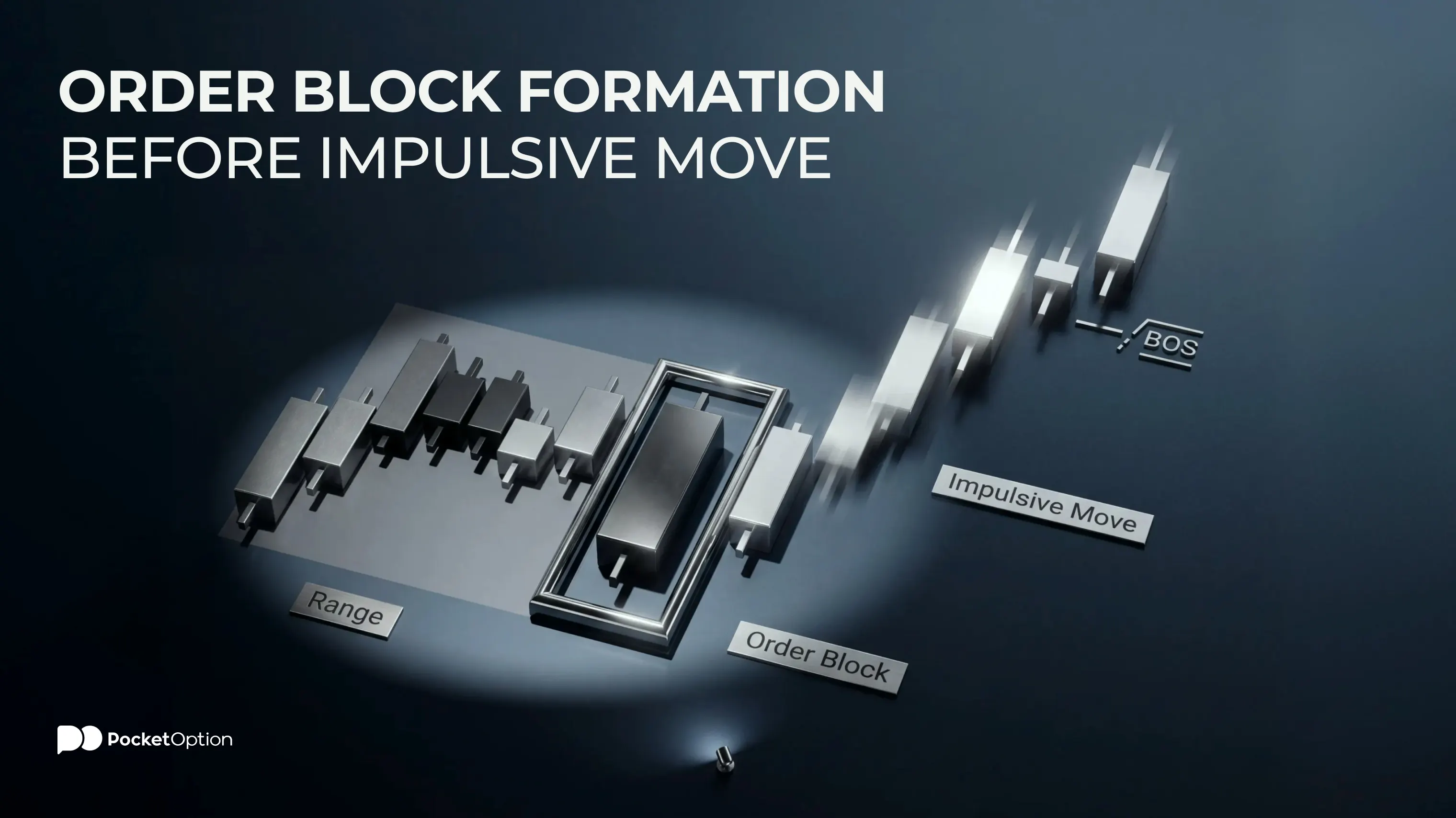
Most often the patterns occur after an extended period of ranging price, while quietly a big position is being built. This is followed by the final bearish candle in case of an impending breakout to the upside, or the final bullish candle in case of an impending breakout to the downside. The order block pattern is identified with the fast move away from the zone accompanied by a break of structure and increased volume indicating significant buying/selling pressure.
Timeframe matters here, and it directly related to the importance of the zone. The order block on 4 hour or daily timeframe indicates a larger position compared to the order block on 5 min timeframe. The larger order blocks tend to attract a reaction upon the approach of the price to the zone. Lower timeframe order blocks are frequent and tempting, but they tend to breakdown without a pause.
How Breaker Blocks Form: When an Order Block Fails
Formation of a breaker block usually comes in three stages. In the first stage, an order block emerges, followed by price respect to the new block, moving in the right direction according to the expectations. Next, the price turns and breaches the block zone directly, usually after seeing a change in character at a lower timeframe. Finally, there is retest of the breached zone from the other direction, and the setup should be taken when retesting, and not during the breach.
This process may take different time lengths. Sometimes, the price reaches the retest shortly after the breach while other times the price moves very far before coming back for the retest in some hours or even days later, thus changing the context completely. Thus, putting a limit on the time spent in waiting for the retest will prevent you from taking a setup just because you marked that block zone before.
The Key Difference: Role Reversal
Feature | Order Block | Breaker Block |
|---|---|---|
Origin | Zone of institutional accumulation before an impulsive move | A failed order block, broken and retested |
Expected role | Continuation zone in the original trend direction | Reversal zone, with support/resistance flipped |
Price behavior | Tends to hold and bounce in the original direction | Breaks through, then gets retested from the other side |
Best used for | Trend continuation entries | Reversal entries after a structure break |
After analyzing the table, one can come up with a conclusion that all rows represent the same zone at various stages of its life cycle. The thing that does not change is the origin of the zone: a breaker block starts as an order block. However, what does change is the ability of the zone to hold after the price reaches it. If it holds, one gets an order block, but if the zone fails to hold, one gets a breaker block. It means that these zones cannot be interchanged as there are clear signs of their existence in the market.
Visual Cues to Tell Them Apart on a Chart
Order block was not violated at all; the price has merely approached it without closing inside the zone..
Breaker block, in its turn, indicates that the violation occurred as the price closed outside the zone and then tested the block candle from the opposite direction.
Order block usually follows the general trend of the higher time frame, whereas breaker blocks tend to form after the change of trend.
Checking for the integrity of the level by defining actual support and resistance zones on a higher timeframe can help differentiate the true zones.
Trading Order Blocks: Entry, Stop-Loss, and Risk/Reward
The order block can be recognized by examining the last candle in the direction opposite to the current trend, which appears before the impulsive movement.
Wait until the price enters the zone and reacts to it, in the form of rejection wick or reversal candlestick pattern on a lower timeframe.
Enter in the same direction as the impulsive move, but not against it.
Stop loss is placed right outside the outermost part of the order block..
The profit target should be the most recent swing high/low, or a certain multiple of the risk taken, generally speaking 2:1 and above.
Trading Breaker Blocks: Entry, Stop-Loss, and Risk/Reward
Make sure that there has been a breakdown of the zone with a whole candle formation outside it, and not just a spike to it.
Wait until the zone is retested from the opposite side, and do not enter upon breakdown of the zone.
Enter only if the candle rejects the price action and turns around in the opposite direction.
The stop-loss is placed just outside the candle of the breaker block on the opposite side of rejection.
Since breaker blocks trade against the previous trend, risk reward ratio should be tighter than on a regular order block trade.
get started with a free account
Get StartedWhen Each Approach Works Best
Best order block examples can be found in an established trend, where traders look for significant pullbacks to join the trend direction, instead of trying to predict the highs and lows in the market. The breaker blocks work well when applied after the true break of the structure, with the goal being to capture the start of a new trend and not to continue the old one. It’s the confusion of those two, mistaking a new order block for a breaker, that causes traders most problems by entering a reversal trade too soon.
Common Mistakes When Confusing the Two
The most common mistake people make when confusing order block trading with breaker block trading and taking a reversal on contact with the price level which has not broken yet by treating the new order block like a breaker block.
Another mistake is the entry on the breakout itself without the retest, skipping the confirmation which makes this trade setup profitable at all.
The third common mistake is completely forgetting about the trend on the higher timeframe and taking reversal trades on breaker blocks in the trending environment.
Conclusion
Both order block and breaker block occur at the same level price zone. However, each requires a completely different approach to trading. Market will give you a clue whether you should be using an order block or a breaker block before making any decisions. It is easy: is price respecting the price zone as it goes back or is it breaking through?
Order block requires some patience and gives an opportunity for a continuation entry trade. Breaker block requires waiting for a signal of failure and then retesting.
Neither order nor breaker block works without the other. Therefore, price zone should be considered as something that has to be watched and nothing more until you get a sign from the price zone.
practice on a Pocket Option demo account
Try DemoDisclaimer: CFDs and other leveraged products are highly risky and may result in fast loss of your funds. Please understand the terms of the product before you start trading.
See more:InterestingTrading Strategies